

A couple of years ago, my younger sister got her first job and came to me super excited, asking, “Bhai, I want to start saving properly now. Should I open an FD or an RD?”
And honestly? My first reaction was, “Same thing basically, just pick one.” That’s how little most people actually think about the difference. I’d been using both for years by then, but I’d never sat down and actually compared them side by side.
So we sat with her salary slip, a notebook, and her banking app, and actually worked through it. That conversation turned into months of me reading up, testing both products with small amounts, asking my bank’s relationship manager a dozen “dumb questions,” and eventually figuring out where each one actually fits.
If you’re in that same spot — confused between FD and RD, not sure which suits your situation, or just want to understand what you’re signing up for — this is the article I wish someone had handed me years ago.
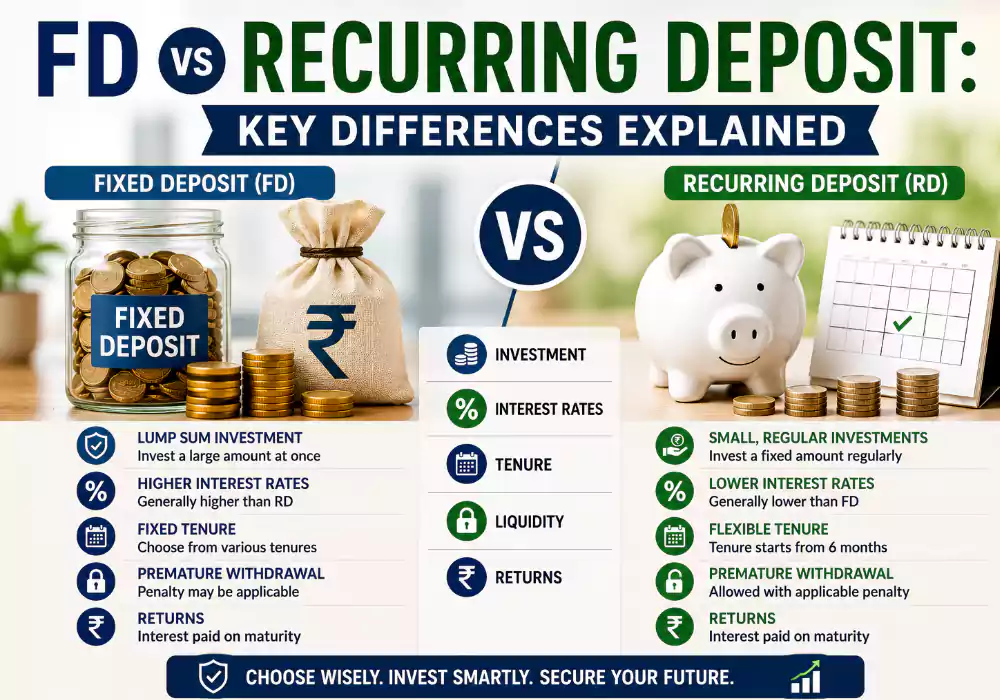
FD vs Recurring Deposit: Key Differences
A couple of years ago, my younger sister got her first job and came to me super excited, asking, “Bhai, I want to start saving properly now. Should I open an FD or an RD?”
And honestly? My first reaction was, “Same thing basically, just pick one.” That’s how little most people actually think about the difference. I’d been using both for years by then, but I’d never sat down and actually compared them side by side.
So we sat with her salary slip, a notebook, and her banking app, and actually worked through it. That conversation turned into months of me reading up, testing both products with small amounts, asking my bank’s relationship manager a dozen “dumb questions,” and eventually figuring out where each one actually fits.
If you’re in that same spot — confused between FD and RD, not sure which suits your situation, or just want to understand what you’re signing up for — this is the article I wish someone had handed me years ago.
The Core Difference
Here’s the simplest way I explain it to people now:
FD (Fixed Deposit) = You have a lump sum of money right now, and you park it for a fixed time to earn interest.
RD (Recurring Deposit) = You don’t have a lump sum, but you can commit to setting aside a fixed amount every month, and it grows into a decent corpus over time, also earning interest.
That’s really it at the core. One is for money you already have. The other is for money you’re going to have, bit by bit, every month.
My sister’s situation was the second one — she had a salary coming in monthly, no big lump sum sitting idle, but she wanted to build a habit of saving. That’s a textbook RD use case, and that’s what she eventually went with.
How an FD Works
I’ve written about this in detail elsewhere, but here’s the short version for context:
You deposit a lump sum (say ₹1,00,000) in one go
You choose a tenure (7 days to 10 years)
The bank gives you a fixed interest rate for that tenure
At maturity, you get your principal + interest back
You can choose to take the interest periodically (monthly/quarterly) or let it compound and get everything at the end
The key thing: the money has to already exist before you open an FD. You can’t “FD” your future salary.
How an RD Actually Works
This is where most people get confused, so let me break it down properly.
Step 1: You choose a monthly amount
This could be ₹500, ₹2,000, ₹10,000 — whatever you’re comfortable committing every single month. Most banks have a minimum of ₹100-₹500 for RDs, which makes it super accessible even for students.
Step 2: You choose a tenure
RD tenures usually range from 6 months to 10 years, similar to FDs. Common choices are 1 year, 2 years, 3 years, and 5 years.
Step 3: You deposit the fixed amount every month
This is the part that requires discipline. On the same date every month (or close to it), the chosen amount gets deducted from your linked savings account — either automatically (if you set up auto-debit) or manually if you prefer to do it yourself.
Step 4: Interest is calculated on each deposit separately
Here’s something that surprised me when I first understood it properly — each monthly deposit earns interest only for the time it’s actually been in the account. So your first month’s deposit earns interest for the full tenure, but your last month’s deposit only earns interest for that last month (or quarter, depending on compounding).
Step 5: At maturity, you get everything together
All your monthly deposits + the interest earned on each of them, added up and paid out in one go at the end of the tenure.
Example to Make This Click
Let’s say my sister starts an RD of ₹5,000/month for 1 year at 7% interest.
Over 12 months, she deposits a total of ₹60,000 (₹5,000 x 12).
The interest earned won’t be a flat 7% of ₹60,000 (that would be ₹4,200). It’ll actually be less than that, because:
– Her first deposit (₹5,000) earns interest for close to 12 months
– Her second deposit earns interest for close to 11 months
– …and so on
– Her last deposit earns interest for barely a few days/weeks
So the actual interest comes out to something around ₹2,200-₹2,300 (depending on the bank’s exact compounding method), making her maturity amount roughly ₹62,200-₹62,300.
This was honestly the biggest “aha” moment for both of us. People often assume RD interest works the same way as FD interest on the total amount, and it just doesn’t.
Side-by-Side: FD vs RD
Let me lay this out the way I’d explain it on a whiteboard if we were sitting together.
Investment type
– FD: One-time lump sum
– RD: Monthly fixed deposits
Best suited for
– FD: Money you already have and don’t need immediately
– RD: Building savings discipline from regular income
Minimum amount
– FD: Usually ₹1,000-₹10,000 (varies by bank)
– RD: Usually ₹100-₹500 (much more accessible)
Interest rate
– FD: Often slightly higher than RD for the same tenure (though many banks now keep them equal)
– RD: Slightly lower or equal to FD rates
How interest is calculated
– FD: On the full amount, for the full tenure
– RD: On each monthly installment separately, for the remaining time it stays deposited
Liquidity
– FD: Can break the whole thing (with penalty) if needed
– RD: Can usually close early too, but you lose the benefit of future planned deposits and incur a penalty
Ideal for
– FD: Parking bonuses, maturity proceeds, inheritance, emergency fund
– RD: Salaried individuals, students, anyone building a savings habit
Where I Personally Use Each One
FD — for “found money”
Whenever I get something unplanned — a bonus, a freelance payment, gift money during a festival — it goes straight into an FD. I don’t “see” it in my regular spending account, so I don’t end up spending it on random Amazon orders (we’ve all been there).
RD — for monthly savings goals
I run a couple of RDs for specific goals:
– One for my annual health insurance premium (so I’m not scrambling for ₹15,000 in one shot every year)
– One that I started for a phone upgrade — turned ₹3,000/month into enough for a decent phone in about 8 months
The RD basically forces me to “pay myself first” before I see that money in my regular account and get tempted to spend it.
Step-by-Step: How to Open an RD (Using Your Bank App)
Here’s exactly how my sister set hers up using her bank’s mobile app (she uses an HDFC account, but the process is nearly identical across SBI, ICICI, Axis, etc.):
1. Open the bank’s app and go to the “Deposits” or “Investments” section
2. Select “Open Recurring Deposit”
3. Choose the monthly installment amount** — she started with ₹3,000
4. Select the tenure — she went with 2 years
5. Choose the debit date — pick a date right after your salary credit, so the money is deducted before you can spend it. She chose the 2nd of every month (salary comes on the 1st)
6. Enable auto-debit from her linked savings account — this is the part that makes it actually work long-term
7. Confirm and review the RD certificate/receipt generated
8. Set a calendar reminder for the maturity date
The auto-debit part in step 6 is, honestly, the single most important step. The few times I tried doing RD deposits “manually” every month, I missed two months in a row because I simply forgot, and ended up paying a small penalty for the missed installments.
Mistakes I’ve Made (and Seen Others Make)
1: Starting an RD amount that was too aggressive
When my sister first set up her RD, she got excited and committed ₹8,000/month, which was almost 40% of her take-home salary at the time. Two months in, she had a month with unexpected expenses (a friend’s wedding gift, a phone repair) and couldn’t make the deposit.
start lower than what feels comfortable. ₹3,000-₹5,000 that you can consistently maintain is far better than ₹8,000 that you’ll miss. You can always start a second RD later if you have more to save.
2: Treating FD interest like RD interest (or vice versa)
I’ve seen people calculate their expected RD returns using the simple “amount x rate x time” formula that works for FD, and then feel disappointed when the actual maturity amount is lower. Understanding that RD interest is calculated per-installment (as I explained above) saves you from this disappointment.
3: Forgetting about TDS on both
Just like FDs, RD interest is also subject to TDS if your total interest income from a bank crosses ₹40,000 in a financial year (₹50,000 for senior citizens). This applies across all your deposits with that bank — FDs and RDs combined. If you’re not in a taxable income bracket, submitting Form 15G (or 15H for senior citizens) to the bank can help you avoid this deduction.
4: Breaking an RD midway for a non-essential reason
A friend of mine broke his 3-year RD after 18 months because he wanted to buy a new gaming console during a sale. He got his deposited amount back with a much lower interest rate (and a penalty), and honestly, in hindsight, he admitted the console wasn’t worth losing months of disciplined saving for.
If it’s not a genuine emergency, let the RD run its course. The whole point is the discipline.
5: Not comparing RD interest rates across banks
Just like FDs, RD rates vary across banks. I once had an RD running at 6.5% with my regular bank, while a small finance bank was offering 7.5% for the same tenure on RDs. Over 2-3 years, on a decent monthly amount, that difference adds up to a meaningful sum. Apps like Groww and Paytm Money, or simply checking bank websites, make comparing this pretty easy now.
When Should You Choose FD Over RD?
Based on my own experience and conversations with a lot of readers, here’s how I’d think about it:
Go with FD if:
– You’ve received a lump sum (bonus, gift, maturity proceeds, sale of an asset) and want to park it safely
– You’re building or topping up an emergency fund
– You want predictable interest payouts (monthly/quarterly) for regular expenses — common for retirees
– You’re doing tax-saving under Section 80C with a 5-year tax-saving FD
Go with RD if:
– You’re salaried and want to build a saving habit without thinking about it every month
– You’re saving for a specific short-to-medium term goal (a trip, a gadget, an annual expense like insurance premium)
– You don’t have a lump sum right now but can commit a fixed amount monthly
– You’re a student or just starting out and want to start small (₹500-₹1,000/month)
You can also do both — and honestly, that’s what most people end up doing. My own setup right now is a mix: a couple of FDs from past bonuses sitting as my “safe corner,” plus an active RD for my insurance premium goal.
A Slightly Different Use Case: RD as a “Reverse EMI”
Here’s something I started doing that’s worked really well — using an RD almost like a “reverse EMI” for big planned purchases.
Instead of buying something on EMI (and paying interest TO the lender), I calculate roughly how much I’d need monthly to save up for that purchase by a target date, and I set up an RD for that amount.
For example, when I wanted to upgrade my laptop (around ₹70,000), instead of an EMI plan with 12-13% interest, I started an RD of ₹6,000/month for about 11 months. By the time I had saved up, I had ₹66,000 + a bit of interest, and I bought the laptop in cash (well, UPI, but you know what I mean) — no interest paid to anyone, and I actually earned a little extra.
This obviously works only if you can wait for the purchase. But for non-urgent big-ticket items, it’s a genuinely useful trick.
Common Questions I Get Asked About FD vs RD
“Can I withdraw money from FD/RD before maturity if there’s an emergency?”
Yes, both allow premature withdrawal, but with a catch — you’ll typically get a lower interest rate (based on how long you actually held it) plus a small penalty (usually 0.5%-1%). Your principal is always safe; you just earn less interest than planned.
“Which one has better interest rates — FD or RD?”
It depends on the bank, but for the same tenure, they’re often very close, sometimes identical. Don’t choose based on a 0.1-0.2% difference — choose based on whether you have a lump sum (FD) or monthly income to set aside (RD).
“Are both covered under deposit insurance?”
Yes, both FD and RD deposits with banks are covered under DICGC insurance up to ₹5 lakh per depositor per bank (combined across all your deposits in that bank, not separately for each FD/RD).
“Can I have multiple FDs and RDs at the same time?”
Absolutely, and honestly, this is a good practice. I have multiple FDs with different maturity dates (laddering) and a couple of RDs running for different goals simultaneously.
My Honest Take After Years of Using Both
If I had to summarize this in one line for someone in a hurry: FD is for money you have, RD is for money you’ll have.
Neither one is “better” in general — they solve different problems. The mistake is treating them as competitors when they’re actually teammates.
My sister, by the way, now runs two RDs (one for her annual travel fund, one for emergencies-in-progress until it’s big enough to move into an FD) and has one FD from her Diwali bonus last year. She checks on them maybe once every couple of months, and honestly, that’s exactly how it should be — not something you obsess over daily, but something quietly working in the background.
If you’re just starting out, my suggestion would be: if you have a lump sum sitting in your savings account doing nothing, move a chunk of it into an FD today. And if you have a stable monthly income, start a small RD — even ₹1,000/month — just to build the habit. You can always increase the amount later, but starting the habit early is what actually compounds, not just the money.
1. Which is better FD or RD?
FD is better for lump sum investment, while RD is better for monthly savings.
2. Do FD and RD have same interest rates?
Yes, most banks offer similar interest rates for both.
3. Is RD safer than FD?
Both are equally safe as they are bank-backed investments.
4. Can I convert RD to FD?
No direct conversion, but you can close RD and invest in FD.
5. Is TDS applicable on RD?
Yes, TDS may apply depending on interest income and bank rules.