

A few years back, I opened a fixed deposit with the money I got as a year-end bonus. I felt pretty proud of myself, honestly. I’d finally done something “responsible” with extra cash instead of blowing it on a new phone.
Fast forward to the next tax season. I’m filling out my income tax return, and I see this little entry under “Income from Other Sources” that I had absolutely no idea was coming. Interest from my FD had been added to my total income, and on top of that, my bank had already deducted tax from it without sending me any kind of heads-up message that I noticed.
I remember staring at my laptop thinking, “Wait, isn’t FD supposed to be the safe, simple option? Why is there a tax surprise here?”
If you’ve ever felt that same confusion, you’re definitely not alone. A lot of people open fixed deposits thinking of them purely as a “set it and forget it” savings tool, without realizing that the interest you earn is very much taxable income in the eyes of the tax department.
Let me walk you through everything I learned – the easy way and the hard way – so you don’t end up staring at your tax portal wondering what just happened.
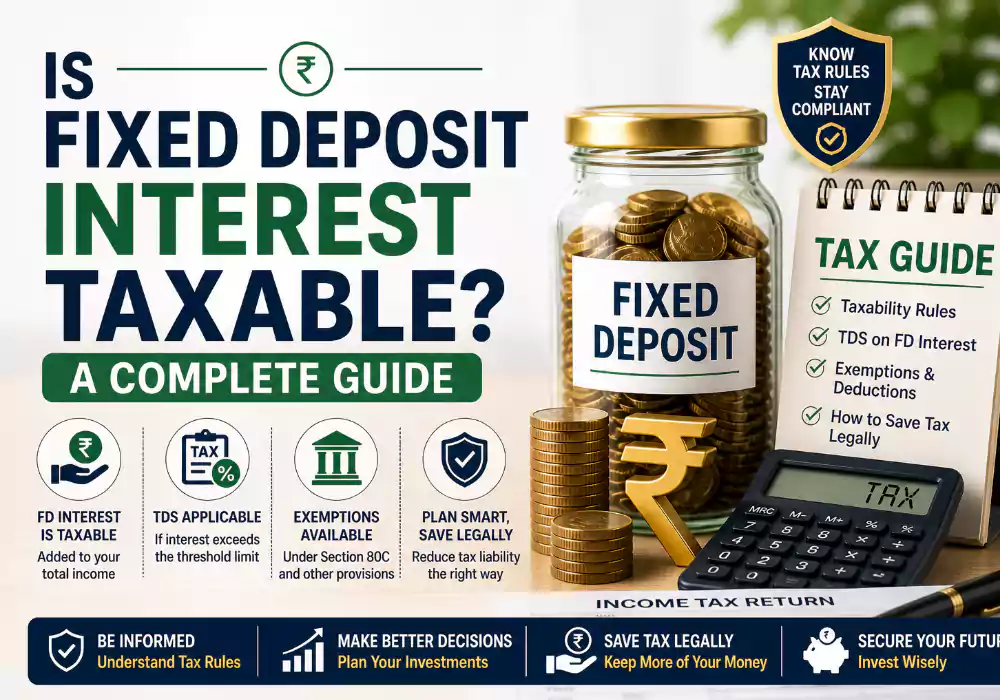
FD Interest Really Taxable? Yes, Every Single Rupee
Here’s the simple truth: the interest you earn on a fixed deposit is added to your total income for the year and taxed according to your income tax slab.
It doesn’t matter if the FD is with a public sector bank, a private bank, a small finance bank, a post office, or a co-operative bank. The interest is treated the same way – it falls under “Income from Other Sources” in your tax return.
A lot of people assume that because tax is already deducted by the bank (we’ll get to that TDS part shortly), their job is done. That’s actually one of the biggest misunderstandings I see among friends and family, and honestly, I made the exact same assumption for my first couple of years of investing.
The bank deducting tax is just one part of the process. You still need to report the full interest income in your return and pay any additional tax if your slab rate is higher than what the bank deducted.
My First Lesson: TDS Is Not the Final Tax
When my bank deducted tax on my FD interest, I genuinely thought, “Great, tax is handled, nothing more to do here.”
That assumption cost me a small penalty and some extra interest when I filed late after realizing my mistake.
Here’s how it actually works.
Banks deduct what’s called TDS (Tax Deducted at Source) on FD interest if the total interest earned from that bank crosses a certain limit in a financial year. As of recent years, this threshold is:
- ₹40,000 for most individuals
- ₹50,000 for senior citizens (60 years and above)
If your interest income crosses this limit, the bank deducts 10% as TDS (assuming you’ve provided your PAN). If you haven’t given your PAN to the bank, they can deduct a much higher rate, sometimes around 20%, so always make sure your PAN is linked to your FD account.
Now here’s the part that tripped me up. That 10% TDS is just an advance payment of tax, not your final tax liability.
If you fall in the 20% or 30% tax bracket, you still owe the difference. If you fall in the 5% bracket or have no taxable income at all, you might actually be eligible for a refund of that TDS.
In my case, my total income that year pushed me into the 20% slab, so I owed an additional 10% on my FD interest that the bank hadn’t deducted. I found this out only when I sat down properly with my Form 26AS and my bank’s interest certificate.
Where to Check Your FD Interest and TDS Details
If you want to avoid my mistake, here’s where you can actually verify all this information instead of guessing:
Step 1: Log into your net banking or banking app
Most banks like HDFC, ICICI, SBI, Axis, and Kotak let you download an “Interest Certificate” or “TDS Certificate” for FDs from the net banking portal itself. I usually find this under sections like “Tax Centre” or “Statements & Certificates.”
Step 2: Check Form 26AS on the Income Tax portal
Form 26AS is basically a summary of all the tax that’s been deducted on your behalf throughout the year, including FD interest TDS. You can access this by logging into the Income Tax e-filing website (incometax.gov.in) and going to “e-File” > “Income Tax Returns” > “View Form 26AS.”
Step 3: Cross-check with AIS (Annual Information Statement)
This one genuinely surprised me the first time I opened it. The AIS shows almost every FD you hold across different banks, along with the interest earned on each one. I had completely forgotten about a small FD I’d opened years ago with leftover cash, and AIS reminded me it existed – interest and all.
Step 4: Add up the total interest from all your FDs
This is the number that actually matters for your tax calculation, not just the interest from one bank. If you have FDs spread across three or four banks, each one might individually be below the TDS threshold, but the total interest income still needs to be reported and taxed according to your slab.
A Mistake Almost Everyone Makes: Spreading FDs Across Banks to “Avoid Tax”
I’ve heard this advice so many times from well-meaning relatives: “Just split your FD into smaller amounts across different banks so no single bank deducts TDS.”
Technically, this can reduce the TDS deducted at source. But – and this is important – it does not reduce your actual tax liability.
The interest is still fully taxable based on your total income, whether it’s split across five banks or sitting in one account. All it does is delay when the tax gets paid, and it can actually create more work for you because now you have to track interest certificates from multiple banks at tax time.
I tried this approach myself one year, opening three smaller FDs instead of one big one. End result? Less TDS deducted upfront, sure, but I still had to pay the full tax amount when filing my return – plus I had three separate certificates to dig up instead of one. Not exactly a win.
Form 15G and 15H: The Forms That Actually Help (If You Qualify)
This is where things get genuinely useful, especially if your total income is below the basic exemption limit.
Form 15G is for individuals below 60 years of age whose total income is below the taxable limit (currently ₹2.5 lakh under the old regime, though this can vary based on which tax regime you choose).
Form 15H is the same idea but specifically for senior citizens (60 years and above).
If you submit one of these forms to your bank at the start of the financial year (or whenever you open the FD), and you genuinely qualify based on your income level, the bank won’t deduct TDS on your FD interest at all.
My mother is a senior citizen with no other income besides her FD interest and a small pension. For years, the bank was deducting TDS on her FD interest even though her total income was well below the taxable limit. She was eligible for a refund every year, but it meant waiting for the refund to come through after filing her return.
Once she started submitting Form 15H at the beginning of each financial year, the bank stopped deducting TDS altogether, and her money stayed with her instead of going to the tax department and coming back months later.
Quick steps to submit Form 15G/15H:
- Visit your bank’s net banking portal or the branch directly
- Look for “Form 15G/15H Submission” – most major banks have this online now
- Fill in your PAN, estimated total income for the year, and FD details
- Submit before the interest is credited, ideally at the start of the financial year
- Repeat this every financial year – it’s not a one-time submission
One word of caution though: only submit these forms if you genuinely qualify. Submitting a false declaration when your income is actually above the taxable limit isn’t just risky – it can lead to penalties. I’ve seen people submit 15G just to avoid TDS without checking their actual income, and that’s not a shortcut you want to take.
How FD Interest Actually Gets Taxed (With a Example)
Let me break this down the way I wish someone had explained it to me, using actual numbers.
Say you earned ₹60,000 in FD interest in a financial year. Here’s what happens:
- Your bank checks if this crosses the ₹40,000 threshold (it does)
- The bank deducts 10% TDS, which is ₹6,000
- You receive ₹54,000 as actual interest credited, but the full ₹60,000 is your “income” for tax purposes
- When you file your return, you add the full ₹60,000 to your total income
- Tax is calculated on your total income (salary + FD interest + any other income) based on your slab
- The ₹6,000 already deducted as TDS is adjusted against your total tax liability
- If your total tax liability is more than ₹6,000, you pay the difference
- If it’s less than ₹6,000, you get a refund of the excess
I went through this exact calculation using ClearTax’s online calculator one year just to double-check my own math, and it matched what my CA had calculated manually. If you’re someone who likes verifying things yourself (I definitely am), tools like ClearTax or the income tax department’s own tax calculator on the e-filing portal can help you estimate this before you file.
What About Recurring Deposits and Cumulative FDs?
This one confused me for a while too.
With a cumulative FD (where interest is paid out at maturity instead of monthly/quarterly), I assumed the interest would only be taxable in the year I actually received it – i.e., at maturity.
That’s not how it works.
FD interest is taxable on an accrual basis, meaning it’s taxed every year as it accrues, even if you don’t receive the money until maturity. Banks typically calculate and report this accrued interest annually, and it shows up in your AIS and Form 26AS for that year, regardless of whether the FD has matured or not.
So if you have a 5-year cumulative FD, you (technically) need to account for the interest portion every year, not just dump it all into the final year when the FD matures. Most banks handle this reporting automatically, which is why you’ll see “interest” entries in your AIS even for FDs that haven’t matured yet.
Recurring Deposits (RDs) follow the same logic – the interest earned is taxable, and TDS rules apply similarly if the interest crosses the threshold.
Senior Citizen FDs: A Few Extra Things to Know
If you’re managing FDs for your parents or grandparents (which is honestly how I learned most of this), here are a few specific points that matter:
- Senior citizens get a higher TDS threshold (₹50,000 instead of ₹40,000)
- Many banks offer senior citizen FDs with slightly higher interest rates, which is great, but also means slightly higher interest income to account for
- Section 80TTB allows senior citizens to claim a deduction of up to ₹50,000 on interest income (including FD interest) from the total taxable income – this is a big one and a lot of families don’t know about it
- If their total income (after this deduction) is still below the taxable limit, Form 15H becomes very useful
When I helped my mother file her return one year, that 80TTB deduction made a difference. Her FD interest was around ₹45,000, and with the 80TTB deduction, it effectively reduced her taxable interest income significantly, which meant less tax overall.
Common Mistakes People Make With FD Taxation
Based on my own experience and conversations with friends and family, here are the mistakes I see most often:
1: Assuming no TDS means no tax
Some smaller FDs or post office deposits might not have TDS deducted at all, especially if interest is below the threshold. But “no TDS” doesn’t mean “no tax.” The interest is still taxable; it just hasn’t been deducted at source.
2: Forgetting about FDs in old or dormant accounts
I genuinely forgot about a small FD I’d opened years ago at a different bank branch. The interest kept accruing, kept getting added to my income on paper, and I wasn’t reporting it because I simply forgot it existed. AIS helped me catch this.
3: Not checking Form 26AS and AIS before filing
These two documents are honestly your best friends during tax season. They show exactly what the tax department already knows about your income and TDS. If your return doesn’t match these, you might get a notice asking for clarification.
4: Submitting Form 15G/15H without actually qualifying
As mentioned earlier, this isn’t a loophole – it’s a declaration, and it needs to reflect your actual income situation.
5: Not factoring FD interest into advance tax calculations
If your total tax liability (after TDS) for the year exceeds ₹10,000, you might be required to pay advance tax in installments throughout the year, not just at the time of filing. FD interest can push you over this threshold without you realizing it, especially if you have a few FDs running.
What I Do Now (My Personal System)
After going through this learning curve, here’s the simple routine I follow every year, and it’s genuinely made tax season much less stressful:
- Around January or February, I log into my bank’s net banking and download interest certificates for all my FDs
- I check my AIS on the income tax portal to make sure I’m not missing any FD I’ve forgotten about
- I add up the total interest across all FDs and other sources (savings account interest, dividends, etc.)
- I use a basic tax calculator to estimate my total liability, including this interest
- If I’m likely to owe more tax than what’s already been deducted as TDS, I check whether I need to pay advance tax before the deadlines
- For my mother’s FDs, I make sure Form 15H is submitted at the start of every financial year, well before any interest is credited
It sounds like a lot when written out, but in practice it takes maybe an hour, once a year, and it’s saved me from late fees and unpleasant surprises ever since.
A Quick Note on Tax-Saving FDs
You might have come across “Tax Saving FDs,” typically with a 5-year lock-in period, that qualify for deduction under Section 80C.
Here’s the part that confuses people: the deduction under 80C applies to the amount you invest (up to ₹1.5 lakh per year), not the interest you earn.
The interest earned on a tax-saving FD is still fully taxable, exactly like a regular FD. So while you save tax on the investment amount when you put the money in, you don’t get any special tax exemption on the interest it generates. I made this mistake when I first opened one, assuming the whole thing was “tax-free” because of the word “tax-saving” in the name.
1. Is FD interest taxable for senior citizens?
Yes, but they get a higher TDS exemption limit of ₹50,000.
2. Can I avoid tax on FD interest completely?
No, but you can reduce tax using deductions and planning strategies.
3. What if TDS is deducted but my income is below taxable limit?
You can claim a refund while filing your ITR.
4. Is interest from tax-saving FD tax-free?
No, only the investment gets deduction. Interest remains taxable.
5. Do I need to report FD interest if TDS is already deducted?
Yes, reporting is mandatory even if TDS is deducted.