

my dad called me up all excited because the bank had just offered him a “special FD scheme” with a slightly higher interest rate. He’d put in three lakh rupees for five years, feeling pretty proud of himself. Around the same time, I had started dabbling in mutual funds through an app, mostly because a colleague kept talking about SIPs during lunch breaks.
Fast forward five years. My dad’s FD matured, taxes were deducted, and after adjusting for inflation, he basically broke even. My mutual fund SIP, despite a couple of scary market crashes in between, had grown to almost double what I’d put in.
Now, I’m not telling you this to say mutual funds are always better. That would be a lazy take, and honestly, it’s not even true for everyone. My dad sleeps peacefully at night. I, on the other hand, have checked my portfolio at 11 PM during market dips more times than I’d like to admit.
This whole FD vs mutual fund debate isn’t really about which one is “better.” It’s about which one fits your life, your goals, and honestly, your personality. Let’s break it down properly.
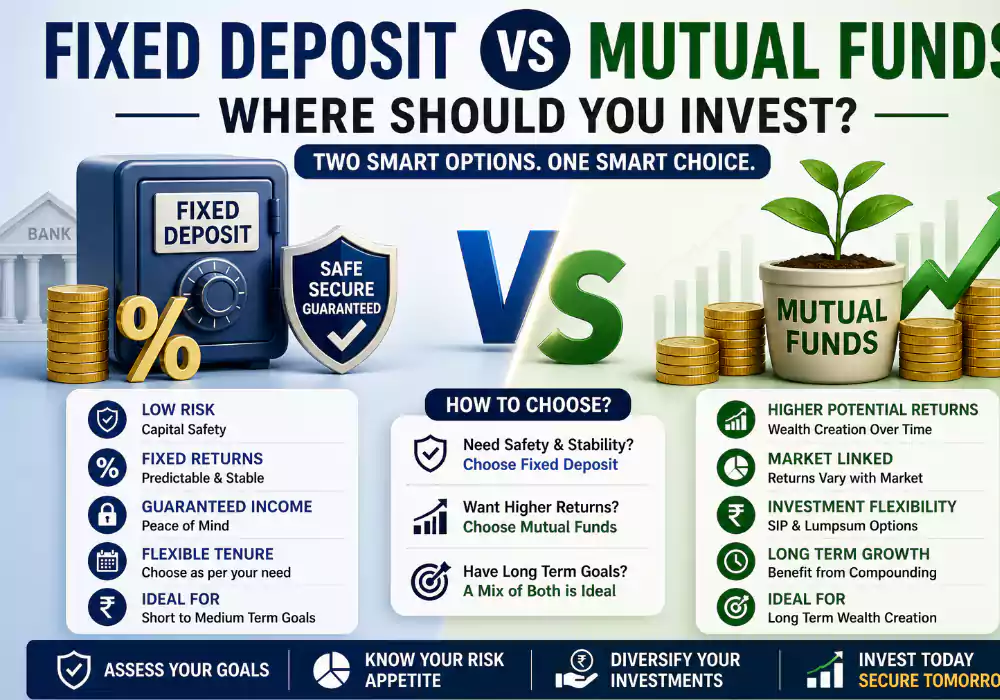
What Exactly Is a Fixed Deposit?
A fixed deposit, or FD, is probably the first investment most of us in India ever made — usually because our parents opened one for us as kids, or we got our first salary and a bank relationship manager pounced on us.
Here’s how it works in plain terms: you give the bank a lump sum of money for a fixed period — say 1 year, 3 years, or 5 years. In return, the bank promises you a fixed interest rate, no matter what happens in the economy. At the end of the term, you get your original amount plus the interest.
I remember opening my first FD with ₹10,000 from my first internship stipend. I felt very “adult” doing it. The interest rate was around 6.5%, and I genuinely thought I was being smart with money. Looking back, I was — for a beginner with zero risk appetite, it was a fine first step.
Why People Love FDs
- Guaranteed returns – you know exactly how much you’ll get on maturity
- Safety – your money isn’t tied to stock market ups and downs
- DICGC insurance – deposits up to ₹5 lakh per bank are insured, which gives peace of mind
- Simple to understand – no charts, no jargon, no overthinking
My grandmother, who’s 78, still only invests in FDs. She doesn’t trust anything she “can’t see.” For her, that fixed number on the certificate is everything. And honestly, for someone at her stage of life, that’s the right call.
What Exactly Are Mutual Funds?
Mutual funds work very differently. Instead of giving your money directly to a bank for a fixed return, you’re pooling your money with thousands of other investors. A fund manager then takes this pool and invests it in stocks, bonds, or a mix of both, depending on the type of fund.
There’s no “guaranteed” return here. Your money’s value goes up and down based on how the underlying investments perform.
I started my first mutual fund SIP (Systematic Investment Plan) of ₹2,000 per month through an app called Groww. I picked a fund because it had a nice graph going up-and-to-the-right over the last 5 years — which, looking back, is probably the worst reason to pick a fund, but we’ll get to that mistake later.
Why People Choose Mutual Funds
- Potential for higher returns – historically, equity mutual funds have outperformed FDs over long periods (though past performance doesn’t guarantee future results)
- Flexibility – you can start with as little as ₹500/month via SIP
- Variety – debt funds, equity funds, hybrid funds, index funds — there’s something for almost every risk level
- Liquidity – most mutual funds (except ELSS) can be redeemed within a few days
The first time I saw my mutual fund portfolio drop by 8% in a single week during a market correction, my stomach dropped too. I almost sold everything in panic. I didn’t, and that decision (or rather, indecision) turned out to be the best thing I did. But more on that later.
The Difference: It’s Not Just About Returns
People often reduce this comparison to “which gives more returns,” but that’s only one piece of the puzzle. Here’s what I think actually matters more:
1. Risk Tolerance
This is the big one. FDs are like a calm lake — predictable, steady, boring (in a good way). Mutual funds, especially equity ones, are more like the sea — sometimes calm, sometimes you’re seasick.
If market volatility makes you anxious to the point where you can’t sleep or you check your phone obsessively, FDs (or at least debt mutual funds) might suit you better. There’s no shame in that. I’ve seen people lose more money panic-selling during a dip than they would’ve ever lost by just staying in an FD.
2. Time Horizon
This is where things get interesting. For short-term goals (under 3 years) — like saving for a wedding next year or a car down payment — FDs or even short-term debt funds make more sense. You don’t want market volatility messing with money you need soon.
For long-term goals (5+ years) — retirement, your kid’s education, building wealth — mutual funds, especially equity funds, have historically had the edge because they get time to recover from dips and benefit from compounding.
I learned this the hard way. I once put money meant for a trip (happening in 4 months) into an equity mutual fund because “it might grow a bit more.” The market dipped right before my trip, and I had to either sell at a loss or dip into my emergency fund. Lesson learned: short-term money and equity mutual funds don’t mix well.
3. Taxation — The Part Nobody Talks About Enough
This one genuinely surprised me when I first understood it properly.
FD Taxation:
- Interest earned on FDs is added to your total income and taxed according to your income tax slab
- If you’re in the 30% tax bracket, a big chunk of that “guaranteed” interest disappears
- TDS (Tax Deducted at Source) is usually applicable if interest exceeds ₹40,000 in a year (₹50,000 for senior citizens)
Mutual Fund Taxation (as per rules around 2024):
- For equity mutual funds, gains held for more than 1 year (long-term) are taxed at 12.5% on gains above ₹1.25 lakh in a financial year
- Short-term gains (held less than 1 year) are taxed at 20%
- Debt mutual funds are taxed as per your income slab, similar to FDs, for investments made after April 2023
When my dad’s FD matured, he was shocked to see how much tax he had to pay on the interest because it pushed him into a higher bracket that year. Meanwhile, my long-term equity mutual fund gains were taxed at a much lower rate. That difference alone changed how I think about where to park money.
(Tax rules can change, so always check the latest rules or consult a tax advisor before making big decisions based on this.)
A Side-by-Side Look (Without the Boring Table Overload)
Let me put this in everyday language instead of throwing a complicated table at you.
Imagine you have ₹1 lakh to invest for 5 years.
In an FD at around 6.5-7% interest, your money would grow to roughly ₹1.38-1.40 lakh before tax. After tax (assuming 20% slab), you’re looking at something closer to ₹1.30-1.32 lakh.
In an equity mutual fund, historically averaging around 10-12% annually over long periods (though this varies wildly and isn’t guaranteed), your ₹1 lakh could potentially grow to ₹1.60-1.75 lakh. After tax on long-term gains, you’d still likely come out ahead.
But — and this is a big but — that mutual fund value isn’t a straight line. In year 2, it might have dropped to ₹90,000 before recovering. Can you stomach seeing your money “shrink” temporarily, even if it recovers later? That’s the question.
My Step-by-Step Approach to Deciding Where to Put My Money
Over the years, I’ve developed a rough system. It’s not perfect, but it’s helped me avoid a lot of anxiety and a few costly mistakes.
Step 1: Build Your Emergency Fund First — In an FD or Liquid Fund
Before investing anywhere else, I keep 3-6 months of expenses in something safe and accessible. I personally split mine between a sweep-in FD (which automatically links to my savings account) and a liquid mutual fund.
Why? Because if my laptop dies or there’s a medical emergency, I don’t want to be forced to sell my equity investments at a loss just because I need cash urgently.
Step 2: Define Each Goal With a Timeline
I literally made a list once — sounds nerdy, but it helped:
- Trip to Japan – 1 year away
- New laptop – 18 months away
- Down payment for house – 5 years away
- Retirement – 25+ years away
For the trip and laptop, I used FDs and short-term debt funds. For the house down payment and retirement, I went with mutual funds (a mix of equity and some debt for balance).
Step 3: Match the Investment to the Timeline
- Under 1 year: FD, recurring deposit, or liquid funds
- 1-3 years: Short-term debt funds or FDs
- 3-5 years: Hybrid mutual funds (mix of equity and debt) or balanced FDs
- 5+ years: Equity mutual funds (diversified, index funds, or large-cap funds)
Step 4: Don’t Put All Your Eggs in One Basket
Even now, with a decent amount of experience, I keep some money in FDs — not because I think they’ll outperform, but because they balance out the unpredictability of mutual funds. When the market crashes, my FD money doesn’t even flinch. That stability matters psychologically, even if it’s not the “optimal” return-maximizing move.
Step 5: Start Small With Mutual Funds If You’re Nervous
If you’ve never invested in mutual funds before, don’t dump your life savings in on day one. Start with a small SIP — even ₹500/month — through apps like Groww, Zerodha Coin, Paytm Money, or directly through AMC websites like SBI Mutual Fund or HDFC Mutual Fund.
Watch how it behaves for 6-12 months. See how you react when it goes up and when it goes down. This “test run” tells you more about your risk tolerance than any quiz ever could.
Examples From People I Know
My colleague Priya kept all her savings (around ₹15 lakh) in FDs for 8 years because her parents told her it was “safe.” When she finally calculated her returns after tax and inflation, she realized her money had barely grown in terms. She now keeps an emergency fund in FD but has shifted the rest to a mix of index funds and hybrid funds.
My friend Rohit, on the other hand, went all-in on small-cap mutual funds because a YouTube video promised “20% returns guaranteed.” Spoiler: nothing is guaranteed in mutual funds, especially not by random YouTube videos. He lost almost 30% of his investment in a market crash and panic-sold everything. He’s now back in FDs because the experience scared him so much. I think he overcorrected, but I understand why.
My own approach now: 40% in FDs and debt instruments for stability and short-term goals, 60% in mutual funds (mostly index funds and a couple of actively managed large-cap and flexi-cap funds) for long-term growth.
Common Mistakes People Make (I’ve Made Most of These)
1: Choosing investments based on what worked for someone else. Just because your cousin made great returns in a small-cap fund doesn’t mean it’s right for you. Your timeline, risk tolerance, and goals are different.
2: Putting short-term money into equity mutual funds. I did this with my trip money. Don’t do this. If you’ll need the money within 1-3 years, equity mutual funds are too risky for that timeline.
3: Breaking an FD early due to panic, losing the bonus interest. My uncle broke his 5-year FD after 2 years because he heard mutual funds were “better,” paid a penalty, got a lower interest rate for the period he held it, and then… never actually invested in mutual funds. He just kept the money in his savings account. Worst of both worlds.
4: Not accounting for taxes when comparing returns. A 7% FD and a 10% mutual fund return don’t translate to the same “take-home” amount after tax. Always think post-tax.
5: Checking your mutual fund portfolio every single day. This one’s more about mental health than money. I used to check mine daily, sometimes multiple times. It stressed me out for no reason, since short-term fluctuations don’t matter for long-term goals. Now I check maybe once a month, and I’m much happier.
6: Ignoring the “lock-in” period of certain investments. ELSS mutual funds, for instance, have a 3-year lock-in. Tax-saving FDs have a 5-year lock-in. Know this before you invest, especially if you might need the money sooner.
A Quick Word on ELSS and Tax-Saving FDs
If you’re looking at tax-saving options under Section 80C, both tax-saving FDs and ELSS (Equity Linked Savings Scheme) mutual funds qualify.
Tax-saving FDs have a 5-year lock-in and give you fixed, predictable returns. ELSS funds have a shorter 3-year lock-in and invest in equity, so returns can be higher but aren’t guaranteed.
I personally use ELSS for my tax-saving investments because the shorter lock-in and growth potential made sense for my age and goals. My dad, again, sticks to tax-saving FDs. Different strokes for different folks — and different life stages.
Tools and Apps That Made This Easier for Me
A few things that genuinely helped me along the way:
- Groww and Zerodha Coin – for tracking and investing in mutual funds, with clean interfaces that show your returns clearly
- Bank apps with FD laddering features – some banks now let you split FDs into smaller chunks with different maturity dates, so you’re not locking everything for the same period
- Value Research Online – for checking mutual fund history, ratings, and comparing funds without bias
- A simple Google Sheet – honestly, this helped more than any app. I track all my investments (FDs, mutual funds, everything) in one place so I get the full picture instead of fragmented views across apps
So, Where Should YOU Invest?
If I had to boil this down to one piece of advice, it’d be this: don’t think of it as FD versus mutual funds. Think of it as FD and mutual funds, in proportions that match your life.
If you’re someone who:
- Needs the money soon (under 3 years) → lean towards FDs
- Has zero tolerance for seeing your money’s value drop, even temporarily → FDs, or at least mostly debt funds
- Is investing for retirement, a child’s future education, or wealth building over 10+ years → mutual funds, primarily equity-based, should make up a good chunk
- Wants a balance of safety and growth → a mix, like the 40/60 or 50/50 split many people (including me) settle into eventually
There’s no universal “right” answer here, and anyone who tells you there is probably hasn’t actually gone through a market crash with their own money on the line.
1. Which is better FD or mutual funds?
FD is safer, while mutual funds offer higher returns. The choice depends on your risk tolerance.
2. Are mutual funds riskier than FDs?
Yes, mutual funds carry market risk, while FDs are risk-free.
3. Can I lose money in mutual funds?
Yes, especially in the short term due to market fluctuations.
4. Are mutual funds tax-free?
No, but they are more tax-efficient than FDs.
5. Can I invest in both FD and mutual funds?
Yes, combining both helps balance risk and returns.