
A few years back, my dad handed me an envelope with ₹50,000 in it and said, “Son, put this in an FD, don’t waste it.” I was 23, I had just gotten my first decent paycheck bonus, and honestly, I had no clue what an FD really was beyond “the boring thing my parents keep talking about at family functions.”
I walked into my bank (a regular nationalized bank branch near my house), sat across a tired-looking officer, and asked him to “do the FD thing.” He printed a form, I signed wherever he pointed, and I walked out feeling very adult. Three years later, when that FD matured, I got a call from the bank saying my money was ready. I genuinely forgot I had even opened it.
That little forgotten deposit ended up being one of the best financial decisions I made purely by accident. And that’s kind of the magic of a Fixed Deposit — it’s boring, it’s simple, and it quietly does its job while you live your life.
If you’re someone who’s been hearing about FDs from your parents, relatives, or that one uncle who “only believes in FDs and gold,” and you want to actually understand what’s going on before you put your hard-earned money in one — this article is for you. I’ll break it down the way I wish someone had explained it to me back then.
What Exactly Is a Fixed Deposit?
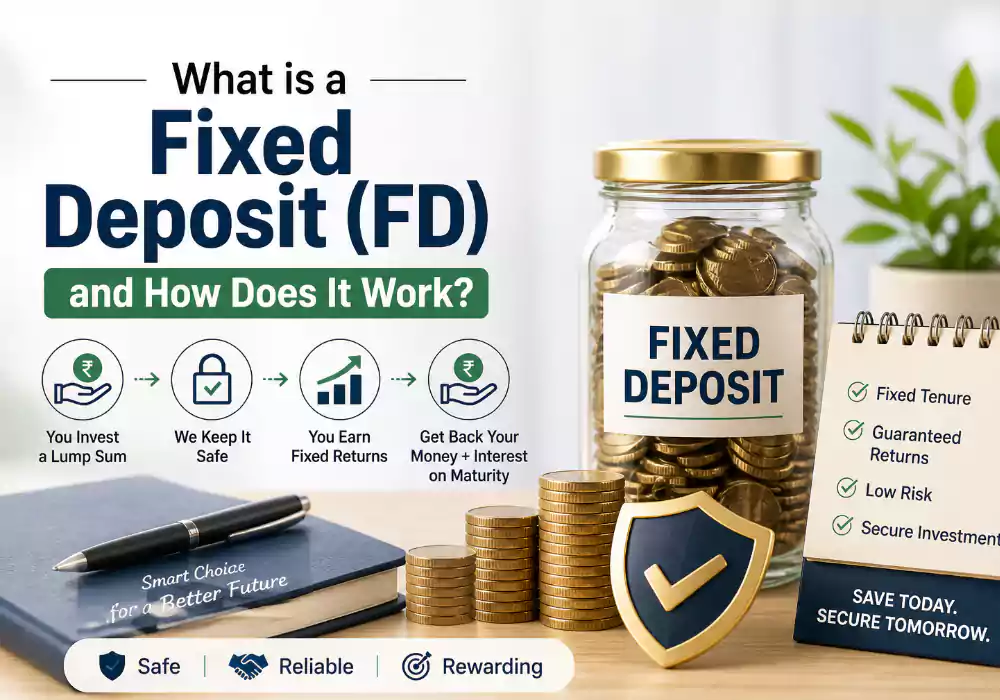
Here’s the simple version. A Fixed Deposit is basically you giving your money to a bank (or post office, or NBFC) for a fixed period of time — say 6 months, 1 year, or 5 years — and in return, they pay you a fixed rate of interest on it.
You can’t touch that money during the lock-in period (well, technically you can, but there’s usually a penalty, more on that later). At the end of the term, you get your original amount back, plus all the interest it earned.
Think of it like lending money to the bank with a written promise — “give me this much, keep it for this long, and I’ll pay you this much extra.”
The “fixed” part refers to two things:
- The interest rate is fixed at the time you open the FD (it won’t go up or down with market changes, unlike a savings account)
- The tenure is fixed too — you decide upfront how long you want to lock the money in
This is exactly why FDs feel so different from, say, mutual funds or stocks. There’s no guessing game. You know exactly what you’re getting on day one.
How Does an FD Actually Work, Step by Step?
Let me walk you through this the way I’d explain it to my younger cousin who recently asked me the same thing.
Step 1: You decide how much money you want to lock in
This could be ₹5,000, ₹50,000, ₹5 lakh — most banks have a minimum deposit amount, usually somewhere between ₹1,000 and ₹10,000 depending on the bank. There’s no upper limit (well, beyond your bank balance, obviously).
Step 2: You choose your tenure
This is the part people overthink. Tenures usually range from 7 days all the way up to 10 years. Common choices are 1 year, 3 years, and 5 years because the interest rates are usually most attractive in that range.
Step 3: You pick the interest payout option
This is something nobody told me when I opened my first FD, and I think it’s one of the most useful things to understand:
- Cumulative FD — interest gets added back into your deposit and compounds. You get everything (principal + interest) at maturity. Best if you don’t need regular income.
- Non-cumulative FD — interest gets paid out to you monthly, quarterly, half-yearly, or annually. Good if you’re retired or need regular cash flow, like my grandmother who uses her FD interest as a monthly “pension top-up.”
Step 4: The bank gives you a fixed interest rate
This rate depends on:
- Which bank or institution you choose
- The tenure you pick
- Whether you’re a senior citizen (most banks give an extra 0.25% to 0.75% to senior citizens — my mom literally switches banks sometimes just to chase that extra bit)
- Current RBI repo rate trends (when repo rates go up, FD rates usually follow)
Step 5: Your money sits there, earning interest
During this period, your money is essentially “locked.” Some banks allow partial withdrawal, some don’t. We’ll get into that.
Step 6: Maturity
On the maturity date, you get your principal + accumulated interest, either credited automatically to your linked savings account or you can choose to reinvest it into a new FD (a lot of banks do this automatically if you don’t respond — which is exactly what happened with my forgotten ₹50,000 FD).
Example to Make This Click
Let’s say you put ₹1,00,000 in a 1-year FD at 7% interest (cumulative).
At the end of the year, you’d roughly get back: ₹1,00,000 + ₹7,000 (interest) = ₹1,07,000
Now if it’s compounded quarterly (which most bank FDs are), the actual amount is slightly higher than ₹1,07,000 because you’re earning interest on interest every quarter. It usually works out to something like ₹1,07,186 or so, depending on the exact compounding method.
It’s not a huge jump, I know. But here’s the thing — this is guaranteed. No market crash, no “oops the fund underperformed” emails, nothing. That ₹1,07,000-ish is yours, period.
Want to run your own numbers? Try our FD Calculator to see exactly how much your deposit will grow based on amount, tenure, and interest rate.” This is the moment readers are most curious to plug in their own figures.
Why I Personally Use FDs (Even Though I Also Invest in Mutual Funds and Stocks)
I’ll be honest — for a long time, I thought FDs were “for old people” and that anyone serious about money should be in the stock market or mutual funds. I was partly wrong.
Here’s where FDs actually fit into my financial life now:
1. Emergency fund parking I keep about 3-4 months of expenses in a combination of a savings account and short-term FDs (called “sweep-in FDs” — more on that below). This way, the money isn’t just sitting idle earning 3% in a savings account, but it’s also not locked up in something risky.
2. Short-term goals When I was saving for a trip to Goa with friends (about 8 months away), I didn’t want to put that money in the stock market because I needed it on a fixed date and couldn’t risk it dropping in value. A 6-month FD worked perfectly.
3. My parents’ retirement income My dad retired two years ago, and a chunk of his retirement corpus is in FDs across different banks (laddering — I’ll explain this too). The quarterly interest payout literally functions like a salary for them.
The Sweep-In FD Trick Nobody Talks About
This one genuinely surprised me when my relationship manager mentioned it.
A sweep-in FD (also called “auto-sweep” or “flexi deposit”) works like this — any amount above a certain threshold in your savings account automatically gets converted into an FD, earning FD interest instead of savings account interest. If you need money and your savings balance goes below the threshold, the bank automatically breaks the FD (partially) and moves money back.
I set this up with my SBI account with a threshold of ₹25,000. Anything above that automatically becomes an FD earning a better rate. When I needed money for a sudden expense, it just pulled from the FD portion without me doing anything. No paperwork, no visiting the branch.
If your bank offers this (most major banks like HDFC, ICICI, Axis, and SBI do), it’s genuinely worth setting up.
Mistakes I Made With FDs (So You Don’t Have To)
1: Putting all my money in one single FD with a long tenure
Early on, I put a large chunk of money into a single 5-year FD. Then, six months later, I had a medical emergency and needed cash urgently. Breaking that FD meant:
- A penalty of about 1% on the interest rate
- Interest recalculated at the rate applicable for the actual period it was held (which was much lower)
Lesson learned: don’t put all your eggs in one FD basket. Spread it across multiple smaller FDs with different tenures. This is called FD laddering, and it’s honestly one of the smartest things you can do.
2: Ignoring the TDS (Tax Deducted at Source)
Nobody warned me about this. If your total interest income from FDs across all your accounts in a bank crosses ₹40,000 in a financial year (₹50,000 for senior citizens), the bank deducts TDS at 10% before paying you the interest.
I got a shock when I checked my Form 26AS and saw TDS deductions I didn’t know about. It’s not extra tax — it’s adjusted against your total tax liability — but if you’re in a lower tax bracket and your total income is below the taxable limit, you can submit Form 15G (or 15H for senior citizens) to the bank to avoid this TDS altogether.
3: Not comparing rates across banks
I kept renewing my FDs with the same bank out of pure laziness. One day, I casually checked rates on a comparison tool and realized a small finance bank (like Equitas Small Finance Bank or AU Small Finance Bank) was offering almost 1-1.5% higher interest than my regular bank for the same tenure, with DICGC insurance covering up to ₹5 lakh per bank anyway.
That 1-1.5% difference, compounded over years, on a decent amount of money, is not small money. I now actively compare rates using apps like Groww, Paytm Money, or even directly checking bank websites before renewing.
4: Choosing cumulative FD when I actually needed regular income
When my dad retired, we initially set up his FDs as cumulative (interest reinvested). A few months in, he realized he needed monthly cash flow for expenses. We had to restructure everything into a non-cumulative, monthly-payout FD. Lesson: think about whether you need the interest now or later, before you open the FD, not after.
Premature Withdrawal — What Happens
This is something people get genuinely anxious about, so let me explain it simply with an example.
Say you open a 3-year FD at 7% interest, but you withdraw it after 1 year because of an emergency.
What typically happens:
- The bank checks what the interest rate was for a 1-year FD at the time you opened your deposit (let’s say it was 6.5%)
- They apply that rate (6.5%) instead of the original 7%, since you only held it for 1 year
- On top of that, most banks deduct a penalty of about 0.5% to 1%
- So your effective rate becomes something like 5.5% to 6% for that 1 year
You still get your principal back, plus this reduced interest. You don’t lose your principal — that’s a common myth I’ve heard people worry about. You just earn less interest than you would have if you’d waited.
Different Types of FDs You Should Know About
I didn’t even know most of these existed when I opened my first FD. Here’s a quick rundown:
Regular Fixed Deposit — the standard one we’ve been talking about.
Tax-Saving FD — a 5-year lock-in FD that qualifies for deduction under Section 80C (up to ₹1.5 lakh). My CA suggested this when I was looking for last-minute tax-saving options in March one year. The catch: you absolutely cannot withdraw before 5 years, no exceptions, not even for emergencies.
Senior Citizen FD — higher interest rates (usually 0.25%-0.75% extra) for people above 60. My grandmother’s bank gives her a noticeably better rate than what I get on the same tenure.
NRI FDs (NRE/NRO) — for non-resident Indians, with different tax implications. My cousin in Dubai uses an NRE FD, and the interest is tax-free in India for him.
Corporate/Company FDs — offered by NBFCs and companies (like Bajaj Finance), often with higher interest rates than banks, but with higher risk since they’re not covered by DICGC insurance the way bank FDs are. I’d suggest doing proper research (checking credit ratings from CRISIL/ICRA) before going for these.
Flexi/Sweep-in FD — covered above, linked to your savings account.
How to Actually Open an FD (Step-by-Step)
Here’s the practical part — exactly how I do it now, mostly online.
- Open your bank’s mobile app (I use the SBI YONO app and HDFC’s app for different accounts)
- Go to the “Deposits” or “Fixed Deposit” section — usually under “Investments” or “Accounts”
- Select “Open New FD”
- Enter the amount you want to deposit
- Choose the tenure — most apps show you the interest rate for each tenure as you scroll, which is helpful for comparing
- Select cumulative or non-cumulative payout option
- Confirm the source account the money will be debited from
- Review and confirm — you’ll usually get an FD receipt/certificate as a PDF immediately
- Set a reminder for the maturity date so you’re not caught off guard (I literally put this in my phone calendar now)
If you prefer doing it offline, you can visit your branch with your passbook/account details, fill out the FD form, and the process is much the same, just with more paperwork.
A Quick Comparison: FD vs Other Options
People often ask me, “why not just put it in a savings account or mutual fund instead?”
- Savings account: more liquid (withdraw anytime), but interest is usually 2.5%-3.5%, much lower than FD rates
- Fixed Deposit: better returns than savings, fully predictable, but money is locked (with penalty for early exit)
- Recurring Deposit (RD): similar to FD but you deposit a fixed amount monthly instead of a lump sum — good for building a saving habit
- Debt mutual funds: potentially better post-tax returns in some cases, but returns aren’t guaranteed and depend on market/interest rate movements
- Equity mutual funds/stocks: higher potential returns over the long term, but with volatility — not suitable for money you might need soon
None of these are “better” in an absolute sense — it depends on your goal, your timeline, and how much risk you’re okay with. For me, FDs are the “safe corner” of my money — the part I never want to worry about.
Mistakes People Make With FDs
Since I started writing about personal finance, I’ve heard a lot of stories from readers and friends. A few recurring ones:
Comparing only the headline interest rate without checking compounding frequency — a 7% rate compounded quarterly gives slightly more than 7% compounded annually
Not checking if the bank is covered under DICGC insurance (up to ₹5 lakh per depositor per bank) — especially relevant for smaller banks and NBFCs
Forgetting about auto-renewal — many FDs auto-renew at maturity at whatever the current rate is, which might be lower than what you originally got
Putting emergency fund money into a 5-year tax-saving FD — this locks your money completely, which defeats the purpose of an emergency fund
Not updating nominee details — this becomes a huge headache for family members later if something happens to the account holder
1. What is the minimum amount required to open a Fixed Deposit?
The minimum amount varies by bank, but many institutions allow FDs to be opened with relatively small deposits, making them accessible to most investors.
2. Can I withdraw my FD before maturity?
Yes, most banks permit premature withdrawal. However, penalties or reduced interest rates may apply.
3. Are FD returns guaranteed?
Yes. The interest rate is fixed at the time of investment, making returns predictable unless specific terms state otherwise.
4. Which FD type provides higher returns?
Cumulative FDs generally provide higher overall returns because interest is reinvested and compounded until maturity.
5. Are Fixed Deposits better than mutual funds?
They serve different purposes. FDs prioritize safety and predictable returns, while mutual funds focus on long-term growth and involve market risk.