
I still remember the first time I walked into a bank to open a fixed deposit. I was 24, had just gotten my first real bonus, and had absolutely no clue what to do with it. The relationship manager kept throwing terms at me—cumulative, non-cumulative, tenure, premature withdrawal penalty—and I just nodded along pretending I understood.
Fast forward almost a decade, and FDs have quietly become one of the most boring-but-reliable parts of my financial life. Not exciting. Not flashy. But they’ve helped me sleep better at night, especially during the times when the stock market felt like a rollercoaster I wanted to get off.
If you’re someone who wants predictable income, hates surprises, and is tired of checking stock prices every five minutes (guilty), this article is for you. I’ll walk you through how fixed deposits actually work for building stable income, the mistakes I made early on, and a few practical strategies that helped me turn a “boring” investment into a genuinely useful income tool.
What Exactly Is a Fixed Deposit
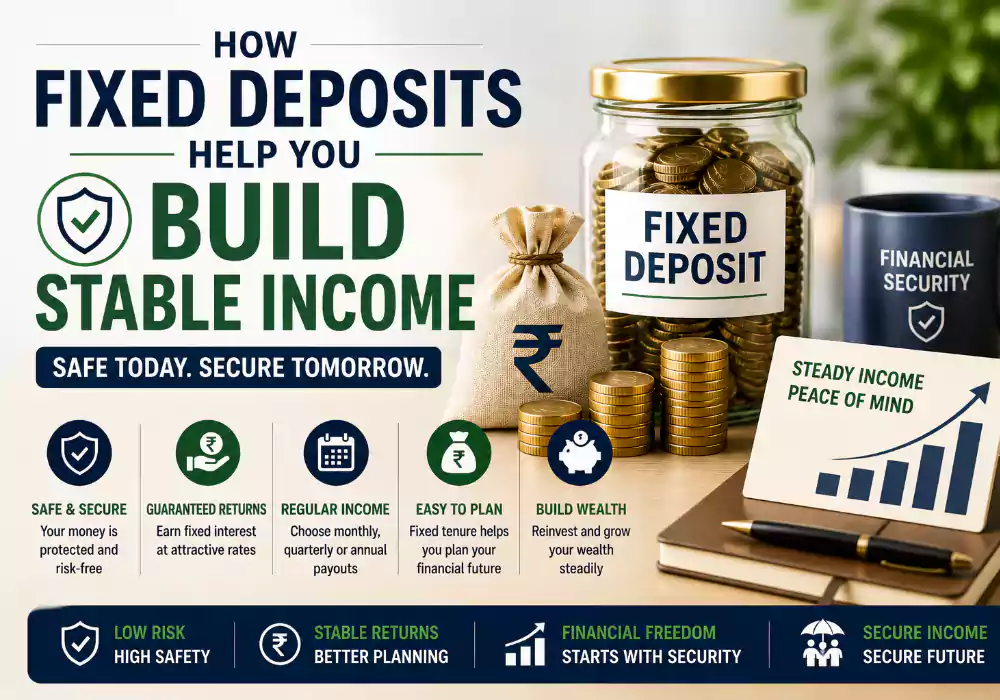
A fixed deposit is basically you lending your money to a bank or financial institution for a fixed period—say 1 year, 3 years, or 5 years—and in return, they pay you a fixed interest rate. The rate doesn’t change, no matter what happens in the market.
That’s it. No complicated charts, no Greek symbols, no “market sentiment” affecting your returns overnight.
When I first started, I treated FDs like a place to “park” money I didn’t know what to do with. Over time, I realized they’re actually a powerful tool for generating predictable income—if you use them the right way.
Why People (Including Me) Underestimate FDs
Here’s an honest confession: for years, I dismissed FDs as “low return, boring, not worth it.” I was chasing higher returns through mutual funds and stocks, which is great for long-term growth, but terrible if you need stability or regular income.
Then a few things happened in my life:
- My income became irregular for a few months (freelance work, you know how it goes)
- I had a financial goal (a planned trip + emergency buffer) that I didn’t want exposed to market risk
- I wanted some part of my portfolio that I didn’t have to think about
That’s when FDs started making real sense—not as my only investment, but as the stable backbone of my income strategy.
How FDs Actually Help You Build Stable Income
Let me break this down the way I wish someone had explained it to me back then.
1. Guaranteed Returns, No Guesswork
With FDs, you know exactly how much you’ll earn on day one. If you invest ₹1,00,000 at 7% for one year, you know you’ll get ₹7,000 as interest (before tax), assuming it’s a simple FD.
There’s no “depends on the market” disclaimer here. That predictability alone is worth a lot, especially if you’re someone (like me) who gets a little anxious checking investment apps every day.
2. You Can Choose How You Receive the Income
This is the part most people don’t realize until they actually open an FD.
You can choose:
- Cumulative FD – interest gets added to your principal and paid out at maturity (good for growth)
- Non-cumulative FD – interest gets paid out monthly, quarterly, or annually (good for regular income)
When I needed extra monthly cash flow during a low-income phase, I switched part of my savings into a monthly payout FD. It wasn’t a huge amount, but that small predictable amount landing in my account every month genuinely helped with budgeting.
3. FD Laddering: The Strategy That Changed How I Use FDs
This is probably the single most useful thing I learned, and I wish I’d known it from day one.
Instead of putting all your money into one FD with one maturity date, you split it across multiple FDs with different tenures. This is called FD laddering.
Example from my own experience:
I had ₹3,00,000 to invest. Instead of locking it all in a 3-year FD, I split it like this:
- ₹1,00,000 in a 1-year FD
- ₹1,00,000 in a 2-year FD
- ₹1,00,000 in a 3-year FD
Here’s why this worked so well for me:
- Every year, one FD matures, giving me access to funds if needed
- If interest rates go up, I can reinvest the matured amount at the new (higher) rate
- I’m not stuck with all my money locked away for years
It’s a simple trick, but it gave me both stability and flexibility—something a single large FD never could.
Step-by-Step: How to Set Up FDs for Stable Income
If you’re starting from scratch, here’s the exact process I’d recommend (and roughly what I followed):
Step 1: Decide Your Goal First
Before opening any FD, ask yourself: do you need regular income, or are you building a lump sum for later?
- Need monthly income? → Go for non-cumulative FD with monthly payout
- Building for a future goal? → Cumulative FD makes more sense
Step 2: Compare Interest Rates Across Banks
Don’t just walk into your regular bank and assume it’s the best rate. Interest rates vary, sometimes significantly, between banks and especially with small finance banks (which often offer higher rates than larger banks).
I personally use comparison sections on apps like Groww, Paytm Money, and BankBazaar to quickly check current FD rates across multiple banks before deciding.
Step 3: Check the Tenure Options
Most banks offer flexible tenures—from 7 days to 10 years. For income-focused FDs, I usually stick to 1–3 year ranges, since rates are often decent and the money isn’t locked up forever.
Step 4: Decide Between Cumulative and Non-Cumulative
This depends entirely on your goal (refer back to Step 1). I personally keep a mix—some FDs for income, some for growth.
Step 5: Open the FD (Online Is Easier Than You Think)
Almost every major bank lets you open an FD through their mobile app or net banking in under 5 minutes. No paperwork, no branch visit needed in most cases.
I’ve opened FDs through SBI YONO, HDFC’s app, and even directly through Groww (which partners with banks for FDs). The process was smoother than I expected.
Step 6: Set Up FD Laddering From the Start
If you’re investing a lump sum, don’t put it all in one FD. Split it across different tenures right from the beginning—it’s much easier than trying to “fix” this later.
Step 7: Track Maturity Dates
This sounds obvious, but I forgot about an FD once and it auto-renewed at a much lower rate than what was available at the time. Lesson learned the hard way.
Now I set calendar reminders for every FD maturity date, about a week before, so I can decide whether to renew, withdraw, or reinvest elsewhere.
How I Used FDs During a Low-Income Period
Let me share a specific situation that really showed me the value of FDs.
A couple of years ago, I went through a 4-month stretch where my freelance income was inconsistent—some months were good, some were almost zero.
I had about ₹2,40,000 sitting in a savings account earning barely 3% interest. I moved ₹1,80,000 of it into a 1-year FD with a monthly payout option at around 6.5%.
That gave me roughly ₹975 per month as guaranteed income—not life-changing, but it covered a chunk of my recurring bills (internet, subscriptions, etc.) without me having to touch my principal.
It wasn’t about the amount. It was about having something predictable when everything else felt uncertain. That psychological comfort alone was worth it.
Mistakes I Made With FDs (So You Don’t Have To)
I’ll be honest about where I went wrong, because these mistakes are common and easily avoidable.
1: Putting Everything in One Long-Term FD
Early on, I put a large chunk of money into a 5-year FD because the rate looked attractive. Then, a year later, I needed part of that money for an emergency.
Breaking the FD early meant a penalty, and I lost a noticeable chunk of the interest I would have earned. Lesson: never lock 100% of your funds in long tenures without keeping some liquidity.
2: Ignoring Tax Implications
FD interest is fully taxable as per your income tax slab. I didn’t account for this initially, and when tax season came, I was surprised by how much of my “guaranteed income” got reduced after tax.
If you’re in a higher tax bracket, it’s worth comparing FDs with other fixed-income options like debt mutual funds or tax-saving FDs (which have their own lock-in but offer tax benefits under certain sections).
3: Not Comparing Rates Before Renewal
When my FDs matured, the bank’s “auto-renewal” option kicked in at a lower rate than what was currently available in the market. I lost out simply because I didn’t check before renewal.
Now, I always compare current rates before deciding to renew or move funds elsewhere.
4: Forgetting About Inflation
This one’s important. If inflation is running at 6% and your FD gives you 6.5%, your real return (after adjusting for inflation) is barely 0.5%. FDs are great for stability and safety, but they’re not designed to beat inflation aggressively.
I now treat FDs as the “stable income” portion of my portfolio, while keeping other investments (like mutual funds or equity) for long-term growth that can outpace inflation.
Who Should Use FDs for Stable Income?
Based on my own experience and conversations with friends and family, FDs work especially well for:
- Retirees who need predictable monthly income without market risk
- Freelancers or those with irregular income, as a buffer during low-income months
- People building an emergency fund that needs to be safe but still earn something
- Conservative investors who prioritize capital safety over high returns
- Anyone saving for a short-term goal (1-3 years) where market volatility isn’t worth the risk
If you’re young and have decades before retirement, FDs shouldn’t be your only investment—but having even 10-20% of your portfolio in FDs for stability isn’t a bad idea at all.
Some Tips I Picked Up Along the Way
Don’t ignore digital-only banks/NBFCs – platforms like Bajaj Finance FD or Shriram Finance often offer attractive rates, though it’s worth checking their credit ratings (look for AAA-rated options for safety).
Senior citizens get higher rates – if you’re managing finances for parents or grandparents, make sure they’re claiming the senior citizen FD rate, which is usually 0.25%-0.50% higher.
Small finance banks often offer better rates – banks like Equitas, Ujjivan, and AU Small Finance Bank frequently offer higher FD rates than larger banks, and deposits up to ₹5 lakh are insured under DICGC, same as larger banks.
Use FD calculators before investing – most bank apps and platforms like Groww or ET Money have FD calculators that show you exact maturity amounts. I always run numbers before committing.
Sweep-in FDs are underrated – some banks offer a feature where excess balance in your savings account automatically converts into an FD and back when needed. I started using this with my HDFC account, and it’s a nice “set and forget” way to earn slightly more without locking funds rigidly.
1. Can fixed deposits provide monthly income?
Yes, non-cumulative FDs offer monthly interest payouts.
2. Are FDs safe for retirees?
Yes, they are one of the safest investment options for stable income.
3. What is the best FD for regular income?
Non-cumulative FD with monthly payout is ideal.
4. Is FD income taxable?
Yes, interest earned is fully taxable.
5. How much income can I earn from FD?
It depends on the investment amount, interest rate, and tenure.