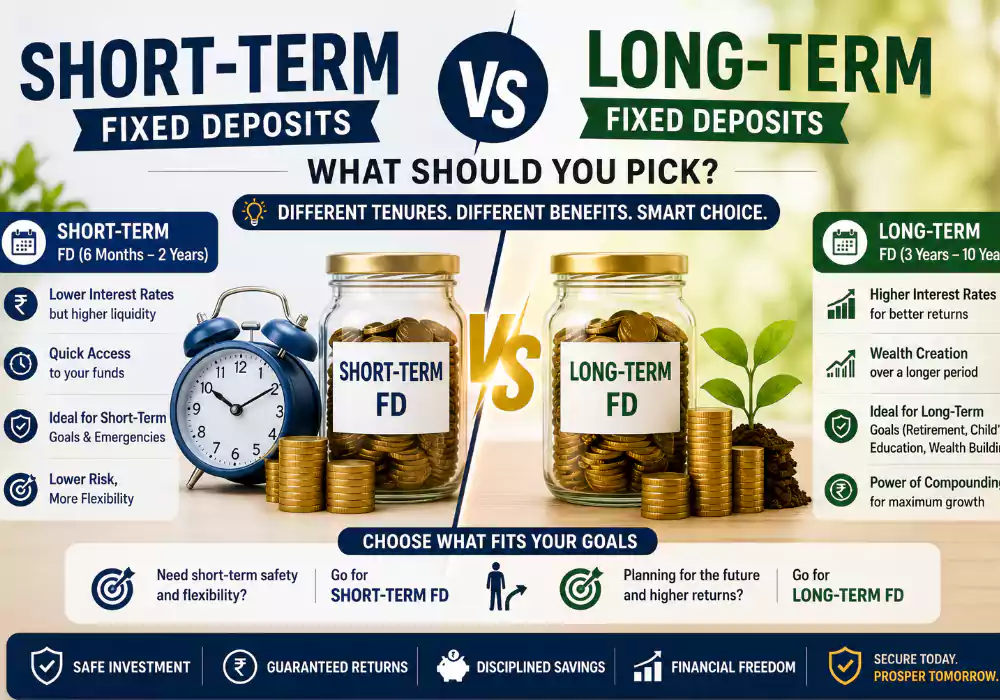
Short-Term vs Long-Term Fixed Deposits: What Should You Pick?

Fixed Deposits (FDs) are one of the most popular investment options in India, offering guaranteed returns, capital safety, and flexible tenures. But one key decision many investors struggle with is:

Should you choose a short-term FD or a long-term FD?

The answer isn’t one-size-fits-all. It depends on your financial goals, liquidity needs, interest rate outlook, and tax situation.

Short-Term vs Long-Term Fixed Deposits: What Should You Pick?

Understanding Short-Term Fixed Deposits

Short-term fixed deposits are investment instruments designed for investors who want safe returns over a shorter investment horizon. In the comparison of Short-Term vs Long-Term Fixed Deposits, short-term FDs are generally chosen for liquidity, flexibility, and quick access to funds. These deposits usually range from a few days to less than one year, making them suitable for emergency savings, temporary parking of surplus cash, and short-term financial goals.

Unlike long-term investments that lock funds for several years, short-term fixed deposits provide greater financial flexibility while still offering guaranteed returns. Investors often use short-term FDs during uncertain market conditions or when interest rates are expected to rise. Since the investment period is shorter, investors can reinvest their money at potentially better rates in the future.

Banks and financial institutions offer multiple short-term FD options with fixed interest rates and flexible payout methods. Although the returns may be slightly lower compared to long-term fixed deposits, short-term FDs remain attractive because of their low risk and predictable maturity value. Many conservative investors prefer them as a safer alternative to volatile market-linked investments.

When evaluating Short-Term vs Long-Term Fixed Deposits, short-term FDs are ideal for maintaining liquidity while earning better returns than regular savings accounts. They are especially useful for salaried individuals, retirees, and businesses looking for temporary investment opportunities with minimal risk exposure.

Features of Short-Term FDs

Short-term fixed deposits come with several features that make them a preferred investment option for conservative investors. One of the most important features is the shorter lock-in period, which allows investors to access their funds relatively quickly. In the discussion of Short-Term vs Long-Term Fixed Deposits, this flexibility is one of the major advantages of short-term FDs.

Another key feature is guaranteed returns. Investors know the exact interest rate and maturity amount at the time of investment, which helps with financial planning and budgeting. Short-term fixed deposits are also low-risk investments because they are not affected by stock market fluctuations or economic volatility.

Most banks provide flexible tenure options ranging from 7 days to 12 months, allowing investors to customize their investment duration according to their financial goals. Investors can also choose different interest payout options such as monthly, quarterly, or maturity-based payments.

Short-term FDs generally require a lower minimum investment amount, making them accessible to a wide range of investors. Additionally, they can often be renewed automatically upon maturity, ensuring continued savings growth.

Another attractive feature is liquidity. While premature withdrawal may involve a penalty, investors still have easier access to funds compared to long-term fixed deposits. This makes short-term FDs suitable for emergency funds, short-term savings goals, and temporary surplus cash management.

When comparing Short-Term vs Long-Term Fixed Deposits, short-term FDs stand out for their convenience, safety, predictable returns, and flexibility. These features make them an ideal choice for individuals seeking stable returns without committing their money for several years.

Typical Tenure and Interest Rates

The tenure and interest rates of short-term fixed deposits vary depending on the bank, market conditions, and economic policies. In the comparison of Short-Term vs Long-Term Fixed Deposits, the tenure is one of the most significant factors influencing returns and investment decisions.

Short-term fixed deposits usually have tenures ranging from 7 days to 12 months. Some banks may also categorize deposits up to 24 months as short-term, depending on their product structure. Investors who want quick liquidity and low commitment periods often prefer these FD plans for temporary financial goals.

Interest rates on short-term FDs are generally lower than long-term FD rates because the investment duration is shorter. However, during periods of rising interest rates, short-term deposits may become more attractive because investors can reinvest their funds at higher rates after maturity. This flexibility is a major advantage when evaluating Short-Term vs Long-Term Fixed Deposits.

Banks typically offer different interest rates based on the chosen tenure. Very short-term deposits may earn modest returns, while deposits closer to one year often provide comparatively better rates. Senior citizens usually receive additional interest benefits on fixed deposits, increasing the overall return potential.

Interest on short-term FDs may be compounded quarterly or paid periodically depending on the selected payout option. Investors should also consider tax implications on FD interest income when calculating actual returns.

Overall, short-term fixed deposits provide a balance between liquidity and stable earnings, making them suitable for investors seeking safe investment options with predictable short-term returns.

Benefits of Choosing Short-Term Deposits

Short-term fixed deposits offer several benefits for investors who prioritize liquidity, safety, and financial flexibility. In the comparison of Short-Term vs Long-Term Fixed Deposits, short-term deposits are often preferred by individuals who want quick access to funds while still earning guaranteed returns.

One of the biggest benefits is liquidity. Since the tenure is shorter, investors can access their money sooner without being locked into a long-term commitment. This makes short-term FDs ideal for emergency savings, travel funds, planned expenses, or temporary surplus cash management.

Another major advantage is reduced interest rate risk. If market interest rates rise, investors with short-term deposits can reinvest their funds at higher rates after maturity. This flexibility gives short-term FDs an advantage during changing economic conditions.

Short-term deposits also provide capital protection and stable returns. Unlike equity investments, they are not exposed to stock market volatility, making them suitable for conservative investors and risk-averse individuals. Investors know the maturity amount in advance, which supports better financial planning.

In the debate of Short-Term vs Long-Term Fixed Deposits, short-term FDs are also beneficial for first-time investors who want a low-risk introduction to fixed-income investments. They usually require lower investment amounts and are easy to open through online banking platforms.

Additionally, short-term deposits can be used as part of an FD laddering strategy to maintain liquidity while optimizing returns. With guaranteed earnings, flexible tenure options, and lower financial commitment, short-term fixed deposits remain a reliable and practical investment choice for many investors.

Understanding Long-Term Fixed Deposits

Long-term fixed deposits are investment instruments designed for investors who want stable returns over an extended period. In the comparison of Short-Term vs Long-Term Fixed Deposits, long-term FDs are usually preferred for wealth preservation, retirement planning, and long-term financial security. These deposits generally have tenures ranging from 5 to 10 years and often provide higher interest rates compared to short-term options.

Long-term fixed deposits are popular among conservative investors because they offer guaranteed returns and protection from market volatility. By locking funds for a longer duration, investors can secure stable interest earnings regardless of changing economic conditions. Many investors also use long-term FDs to create disciplined savings habits and predictable future income.

Unlike short-term deposits that focus on liquidity, long-term FDs prioritize higher returns and financial stability. Investors who do not require immediate access to funds often choose long-term fixed deposits to maximize earnings through compounding interest. Since the interest remains fixed throughout the tenure, investors are protected from future interest rate declines.

In the discussion of Short-Term vs Long-Term Fixed Deposits, long-term FDs are particularly suitable for individuals with long-term financial goals such as retirement, children’s education, or wealth management. They also provide peace of mind because the maturity amount can be calculated in advance.

Many banks offer additional benefits for senior citizens investing in long-term fixed deposits, including higher interest rates and flexible payout options. With guaranteed income, low investment risk, and predictable returns, long-term fixed deposits continue to be a dependable investment option for conservative savers.

Features of Long-Term FDs

Long-term fixed deposits offer several features that make them attractive for investors seeking stable and predictable returns. One of the most important features is the longer investment tenure, which usually ranges from 5 to 10 years. In the comparison of Short-Term vs Long-Term Fixed Deposits, this extended duration allows investors to lock in fixed interest rates for many years.

Another major feature is higher interest earning potential. Since the money remains invested for a longer period, investors often benefit from better FD interest rates and the power of compounding. This makes long-term FDs suitable for wealth preservation and long-term savings goals.

Long-term fixed deposits also provide guaranteed returns, ensuring that investors know the exact maturity amount in advance. Unlike market-linked investments, long-term FDs are not affected by stock market fluctuations, making them a low-risk investment option.

Many banks offer monthly, quarterly, annual, or cumulative interest payout choices, giving investors flexibility in managing their income. Senior citizens often receive additional interest benefits, increasing the overall returns on long-term deposits.

Another important feature is tax-saving eligibility. Certain long-term fixed deposits with a 5-year lock-in period qualify for deductions under applicable tax laws, making them attractive for tax planning purposes.

When comparing Short-Term vs Long-Term Fixed Deposits, long-term FDs stand out because of their stable income generation, higher return potential, and disciplined savings structure. These features make them ideal for retirement planning, future financial goals, and conservative investment portfolios.

Long-Term FD Interest Rate Advantages

One of the primary reasons investors choose long-term fixed deposits is the advantage of higher interest rates. In the comparison of Short-Term vs Long-Term Fixed Deposits, long-term FDs often provide better returns because banks reward investors who commit their funds for extended periods.

Long-term fixed deposits allow investors to lock in a fixed interest rate for several years, protecting them from future interest rate reductions. This stability is particularly beneficial during declining rate environments, where newly issued deposits may offer lower returns. Investors who secure higher long-term FD rates can enjoy predictable earnings throughout the investment tenure.

Another advantage is the compounding effect. Since the investment remains untouched for a longer duration, interest earnings continue to grow over time. Compounded returns significantly increase the maturity amount, making long-term FDs useful for retirement planning and wealth accumulation.

In the discussion of Short-Term vs Long-Term Fixed Deposits, long-term FDs are especially attractive for investors seeking steady passive income and stable growth. Some banks also offer special long-term FD schemes with enhanced rates for senior citizens and loyal customers.

Long-term deposits can also help investors avoid frequent reinvestment risk. Unlike short-term FDs that require regular renewal, long-term deposits secure returns for an extended period without repeated investment decisions.

Although liquidity is lower compared to short-term fixed deposits, the higher interest earnings often compensate for the reduced flexibility. For conservative investors who value safety and predictable returns, long-term FD interest rate advantages make them an important component of long-term financial planning.

Tax Benefits on Long-Term Fixed Deposits

Long-term fixed deposits are not only valued for stable returns but also for their tax-saving opportunities. In the comparison of Short-Term vs Long-Term Fixed Deposits, tax-saving long-term FDs provide additional financial advantages for investors looking to reduce taxable income while earning guaranteed returns.

Certain fixed deposits with a mandatory 5-year lock-in period qualify for tax deductions under applicable income tax regulations. Investors can claim deductions on the invested amount up to the permitted limit, making these deposits a popular tax-saving investment option. These FDs are commonly offered by banks as tax-saving fixed deposit schemes.

Apart from tax deductions, long-term fixed deposits also encourage disciplined investing because premature withdrawal is usually not allowed during the lock-in period. This helps investors maintain long-term financial commitments and build savings gradually.

In the debate of Short-Term vs Long-Term Fixed Deposits, tax-saving FDs are particularly attractive for salaried individuals and conservative taxpayers who prefer low-risk investment products. Unlike equity-linked tax-saving instruments, long-term tax-saving FDs provide guaranteed returns and capital safety.

However, investors should remember that while the principal investment may qualify for tax deductions, the interest earned on fixed deposits is generally taxable according to the investor’s income tax slab. Proper tax planning is therefore important when investing in long-term deposits.

Long-term fixed deposits combine stable returns, safety, and tax-saving opportunities, making them suitable for retirement planning, financial security, and wealth preservation. For investors seeking predictable income along with tax efficiency, long-term tax-saving FDs remain a preferred investment choice.

Short-Term vs Long-Term Fixed Deposits

The comparison of Short-Term vs Long-Term Fixed Deposits is important for investors trying to balance liquidity, returns, and financial security. Both types of fixed deposits provide guaranteed returns and capital protection, but they differ significantly in terms of tenure, interest rates, flexibility, and investment objectives. Short-term FDs are generally suitable for temporary savings goals and emergency funds, while long-term FDs are preferred for retirement planning and long-term wealth preservation.

Choosing between short-term and long-term fixed deposits depends on several factors such as current interest rate trends, inflation expectations, liquidity requirements, and risk tolerance. Investors seeking quick access to funds often prefer short-term deposits because they provide flexibility and easier reinvestment opportunities. On the other hand, investors who want stable and predictable income over many years may benefit more from long-term fixed deposits.

Another important factor in the debate of Short-Term vs Long-Term Fixed Deposits is interest rate stability. Long-term FDs can lock in attractive interest rates for extended periods, while short-term deposits allow investors to adapt quickly to changing market conditions. Both investment options have their own advantages depending on individual financial goals and investment horizons.

Understanding the differences between these FD types can help investors create a balanced savings strategy. By carefully evaluating liquidity needs, inflation risk, tax implications, and expected returns, investors can select the fixed deposit option that aligns best with their financial planning objectives.

Difference in Interest Rates

One of the major differences in Short-Term vs Long-Term Fixed Deposits is the interest rate structure. Banks generally offer different FD interest rates depending on the deposit tenure. Long-term fixed deposits usually provide higher interest rates because investors commit their money for a longer duration, while short-term FDs often offer slightly lower returns due to their shorter maturity periods.

The logic behind higher long-term FD rates is that banks can utilize the deposited funds for extended lending activities. Investors willing to lock their funds for several years are rewarded with better returns and the benefits of compounding interest. This makes long-term fixed deposits attractive for wealth accumulation and retirement planning.

Short-term fixed deposits, however, provide flexibility during changing interest rate cycles. If market rates rise, investors can reinvest their matured deposits at higher rates relatively quickly. This advantage becomes important during inflationary periods or when central banks increase policy rates.

In the comparison of Short-Term vs Long-Term Fixed Deposits, investors should also understand that long-term rates are not always significantly higher. Sometimes banks may offer competitive short-term FD rates during periods of high liquidity demand or economic uncertainty.

Interest payout frequency also affects total returns. Long-term cumulative FDs benefit more from compound growth compared to short-term non-cumulative deposits. Investors should compare annual percentage yield, compounding frequency, and taxation before selecting an FD tenure.

Ultimately, the choice between short-term and long-term FD interest rates depends on financial goals, expected future interest rate movements, and liquidity requirements. Understanding these differences helps investors maximize returns while maintaining financial flexibility.

Liquidity and Accessibility Compared

Liquidity is one of the most important factors when comparing Short-Term vs Long-Term Fixed Deposits. Short-term fixed deposits generally provide better liquidity because the investment tenure is shorter, allowing investors to access their funds more quickly. These deposits are ideal for emergency savings, temporary cash management, and short-term financial goals where immediate accessibility is important.

Long-term fixed deposits, in contrast, involve locking funds for several years. While premature withdrawal is usually allowed, it may attract penalties and reduced interest earnings. This lower liquidity makes long-term FDs less suitable for investors who may require immediate access to their money during the investment period.

Another aspect of accessibility is reinvestment flexibility. Short-term deposits mature sooner, enabling investors to adapt their investment strategy according to changing market conditions and interest rates. This flexibility is particularly beneficial during periods of rising FD interest rates.

In the discussion of Short-Term vs Long-Term Fixed Deposits, long-term FDs are more appropriate for investors with stable financial situations and long-term savings goals. They help create disciplined investing habits by reducing the temptation to withdraw funds frequently.

Modern banking has improved accessibility for both FD types through online account opening, automatic renewal options, and digital banking services. Investors can easily monitor maturity dates, interest earnings, and renewal choices using mobile banking applications.

While short-term fixed deposits prioritize liquidity and flexibility, long-term deposits focus on stable long-term growth. Investors should evaluate their future cash flow needs and emergency fund requirements before selecting the right fixed deposit tenure for their financial strategy.

Risk and Stability Factors

Fixed deposits are widely considered safe investment instruments because they offer guaranteed returns and capital protection. However, the comparison of Short-Term vs Long-Term Fixed Deposits reveals different levels of exposure to certain financial risks such as interest rate risk, reinvestment risk, and inflation risk.

Short-term fixed deposits carry lower long-term interest rate risk because investors can quickly reinvest funds at updated market rates. If interest rates rise, short-term FD investors can benefit sooner from better returns. However, they also face reinvestment risk if rates decline at the time of renewal.

Long-term fixed deposits provide greater income stability because the interest rate remains fixed for several years. Investors are protected from falling market interest rates and can enjoy predictable returns throughout the tenure. This stability makes long-term FDs suitable for retirement planning and conservative investment portfolios.

In the comparison of Short-Term vs Long-Term Fixed Deposits, long-term deposits may carry higher inflation risk because future purchasing power could decline if inflation rises significantly during the investment period. Short-term deposits reduce this risk by allowing more frequent portfolio adjustments.

Both FD types remain significantly safer than market-linked investments such as stocks or equity mutual funds. Deposits with reputed banks and regulated institutions provide high levels of security and financial reliability.

Ultimately, the balance between risk and stability depends on individual investment objectives. Investors seeking flexibility and lower reinvestment exposure may prefer short-term fixed deposits, while those prioritizing stable long-term income may benefit more from long-term FDs.

Impact of Inflation on FD Returns

Inflation plays a crucial role in determining the real returns from fixed deposits. In the debate of Short-Term vs Long-Term Fixed Deposits, inflation risk can significantly affect the purchasing power of investment earnings over time. Even though fixed deposits provide guaranteed returns, rising inflation may reduce the actual value of those returns.

Short-term fixed deposits are generally less exposed to long-term inflation risk because investors can reinvest their money at newer and potentially higher interest rates more frequently. This flexibility allows investors to respond to changing economic conditions and inflation trends.

Long-term fixed deposits, however, may face greater inflation challenges. If inflation rises sharply after locking in a fixed interest rate, the real return on investment may decline substantially. Although investors continue earning the agreed FD rate, the purchasing power of the maturity amount may decrease over time.

In the comparison of Short-Term vs Long-Term Fixed Deposits, investors should compare FD interest rates with current and expected inflation rates before making investment decisions. A fixed deposit generating returns lower than inflation may not effectively grow wealth in real terms.

Some investors manage inflation risk through FD laddering strategies, where multiple deposits with different maturities are created. This approach balances liquidity, reinvestment opportunities, and stable returns.

Despite inflation concerns, fixed deposits remain valuable for capital safety and predictable income. Investors seeking higher inflation-adjusted returns may combine FDs with other investment products for portfolio diversification. Understanding inflation’s impact helps investors choose the right FD tenure and maintain better long-term financial stability.

Which Fixed Deposit Is Better for Your Financial Goals?

Choosing between Short-Term vs Long-Term Fixed Deposits depends entirely on your financial goals, risk tolerance, liquidity needs, and investment timeline. Both FD types provide guaranteed returns and capital safety, but they serve different financial purposes. Short-term fixed deposits are suitable for temporary savings goals, emergency funds, and investors seeking flexibility. Long-term fixed deposits, on the other hand, are more suitable for retirement planning, wealth preservation, and stable long-term income generation.

Before selecting an FD tenure, investors should evaluate factors such as expected expenses, inflation, future interest rate trends, and tax implications. Investors with immediate liquidity needs may prefer short-term deposits, while those focused on future financial stability may benefit from long-term fixed deposits.

A balanced investment strategy may also include a combination of both short-term and long-term FDs. This approach can help maintain liquidity while maximizing stable returns. Understanding personal financial objectives is the key to selecting the right fixed deposit investment strategy.

Best FD Option for Emergency Funds

Emergency funds require high liquidity and quick accessibility, making short-term fixed deposits one of the best choices in the comparison of Short-Term vs Long-Term Fixed Deposits. Investors often use short-term FDs to store emergency savings because they provide better returns than regular savings accounts while still offering relatively easy access to funds.

Short-term deposits typically mature within a few months to one year, ensuring that money is available when needed. Although premature withdrawal penalties may apply, the lock-in period is much shorter compared to long-term fixed deposits. This flexibility is essential during unexpected medical expenses, job loss, or urgent financial situations.

Another advantage of using short-term FDs for emergency funds is capital safety. Investors receive guaranteed returns without exposure to market volatility. Many banks also allow online FD withdrawals and auto-renewal options, improving convenience and accessibility.

Choosing FDs for Retirement Planning

Long-term fixed deposits are often preferred for retirement planning because they provide stable and predictable income over extended periods. In the discussion of Short-Term vs Long-Term Fixed Deposits, long-term FDs offer the advantage of locking in interest rates for many years, helping retirees maintain financial stability.

Retirement investors generally prioritize capital protection and consistent returns over aggressive growth. Long-term fixed deposits meet these needs by offering guaranteed maturity values and flexible interest payout options such as monthly or quarterly income.

Senior citizens also benefit from additional FD interest rates offered by many banks. This higher return potential can help supplement pension income and support regular living expenses during retirement years.

Long-term fixed deposits are especially suitable for conservative investors who prefer low-risk investment products. By combining long-term FDs with other retirement savings instruments, investors can build a balanced and secure retirement portfolio.

Fixed Deposits for Short-Term Savings Goals

Short-term savings goals such as vacations, weddings, education fees, or planned purchases often require safe and liquid investment options. In the comparison of Short-Term vs Long-Term Fixed Deposits, short-term FDs are ideal for these objectives because they provide guaranteed returns within a limited investment period.

Short-term fixed deposits help investors avoid unnecessary market risk while earning better interest than traditional savings accounts. Since the maturity period is shorter, investors can align the FD tenure with their expected financial requirement.

Another benefit is flexibility. Investors can renew short-term FDs or reinvest funds at updated interest rates depending on future financial needs. This adaptability is useful during uncertain economic conditions and fluctuating interest rate cycles.

For conservative savers, short-term fixed deposits provide financial discipline and predictable returns while ensuring quick access to funds when the savings goal approaches.

Long-Term FDs for Wealth Preservation

Long-term fixed deposits are commonly used for wealth preservation because they offer stable returns and protect capital over long durations. In the discussion of Short-Term vs Long-Term Fixed Deposits, long-term FDs appeal to investors seeking financial security and low-risk long-term savings solutions.

By locking funds for several years, investors benefit from compounding interest and predictable earnings. This helps preserve accumulated wealth without exposing investments to stock market volatility. Long-term FDs are particularly attractive for conservative investors nearing retirement or individuals prioritizing capital safety.

Another advantage is interest rate stability. Investors can secure attractive FD rates for many years, protecting themselves from future rate declines. Tax-saving fixed deposits also provide additional financial benefits under certain conditions.

Although liquidity is lower compared to short-term deposits, long-term FDs remain an effective tool for preserving wealth and maintaining long-term financial stability.

Factors to Consider Before Choosing an FD

Selecting the right fixed deposit requires careful evaluation of multiple financial factors. In the comparison of Short-Term vs Long-Term Fixed Deposits, investors should assess liquidity needs, expected returns, inflation risk, tax impact, and investment duration before making a decision.

Short-term FDs provide flexibility and easier access to funds, while long-term FDs offer higher return potential and income stability. Investors should also monitor current interest rate trends because FD rates change based on economic conditions and monetary policies.

Understanding personal financial goals is equally important. Investors saving for near-term expenses may prefer short-term deposits, whereas long-term financial planning may require longer FD tenures. Taxation and premature withdrawal penalties should also be evaluated because they can significantly affect actual returns.

Choosing the right fixed deposit strategy helps optimize returns while maintaining financial flexibility and stability.

Current FD Interest Rate Trends

FD interest rates are influenced by economic conditions, inflation levels, and central bank monetary policies. In the comparison of Short-Term vs Long-Term Fixed Deposits, understanding interest rate trends helps investors select the most suitable tenure for maximizing returns.

During rising interest rate cycles, short-term fixed deposits may provide greater flexibility because investors can reinvest at higher rates after maturity. Conversely, when rates are expected to decline, long-term FDs allow investors to lock in attractive returns for extended periods.

Banks frequently revise FD rates based on market liquidity and borrowing requirements. Investors should compare rates offered by different banks and financial institutions before investing.

Monitoring FD interest rate trends helps investors make informed decisions and balance return potential with investment stability.

Your Investment Horizon

Investment horizon refers to the period an investor plans to keep money invested. In the comparison of Short-Term vs Long-Term Fixed Deposits, the investment horizon plays a critical role in determining the right FD tenure.

Short-term fixed deposits are suitable for investors with near-term financial goals or uncertain cash flow needs. They provide liquidity and flexibility without requiring long-term commitment. Long-term fixed deposits, however, are more appropriate for retirement planning, wealth preservation, and future financial security.

Selecting an FD tenure aligned with your financial timeline helps avoid premature withdrawals and associated penalties. Investors should also consider future income needs, emergency expenses, and inflation before choosing between short-term and long-term deposits.

A well-planned investment horizon improves overall financial management and return optimization.

Tax Implications on FD Earnings

Taxation is an important factor when comparing Short-Term vs Long-Term Fixed Deposits because interest earned on FDs is generally taxable according to the investor’s income tax slab. Investors should evaluate post-tax returns rather than only focusing on advertised interest rates.

Tax-saving long-term fixed deposits may provide deductions on the invested amount under applicable tax regulations, making them attractive for conservative taxpayers. However, the interest income remains taxable even for tax-saving FDs.

Banks may deduct tax at source if FD interest exceeds the prescribed threshold. Investors should monitor total FD earnings across multiple banks to estimate tax liability accurately.

Understanding tax implications helps investors choose FD options that align with their financial planning and tax-saving strategies.

Premature Withdrawal Penalties

Premature withdrawal penalties are charges imposed when investors withdraw fixed deposits before maturity. In the comparison of Short-Term vs Long-Term Fixed Deposits, this factor becomes especially important for investors who may require unexpected access to funds.

Short-term FDs generally involve lower penalty exposure because the tenure is shorter. Long-term fixed deposits may attract higher penalties or reduced interest rates if withdrawn early. This can significantly impact overall returns.

Investors should carefully review bank policies regarding premature withdrawal before opening an FD account. Some banks also offer no-penalty or flexible fixed deposit schemes for improved liquidity.

Understanding withdrawal penalties helps investors avoid unnecessary financial losses and choose the most suitable FD tenure based on future liquidity needs.

Advantages and Disadvantages of Short-Term and Long-Term FDs

Both short-term and long-term fixed deposits offer unique benefits and limitations. In the comparison of Short-Term vs Long-Term Fixed Deposits, investors should evaluate factors such as liquidity, interest rates, inflation risk, and financial objectives before selecting the right option.

Short-term fixed deposits provide flexibility and quick access to funds, making them suitable for emergency savings and temporary financial goals. Long-term fixed deposits offer higher interest rates and stable long-term income, making them ideal for retirement planning and wealth preservation.

However, each option also has drawbacks. Short-term FDs may generate lower returns, while long-term FDs reduce liquidity and may face inflation-related challenges. Understanding these advantages and disadvantages helps investors build balanced and effective savings strategies.

Pros and Cons of Short-Term Fixed Deposits

Short-term fixed deposits offer several advantages including liquidity, flexibility, and reduced long-term commitment. In the discussion of Short-Term vs Long-Term Fixed Deposits, short-term FDs are preferred for emergency funds and short-term financial planning because investors can access funds relatively quickly.

Another advantage is reinvestment flexibility. Investors can renew short-term deposits at higher rates if market interest rates rise. Short-term FDs also involve lower inflation risk because the investment period is limited.

However, short-term fixed deposits generally provide lower interest rates compared to long-term deposits. Frequent renewals may also create reinvestment uncertainty during declining interest rate cycles.

Despite these limitations, short-term FDs remain a reliable investment choice for conservative investors seeking safety, liquidity, and predictable short-term returns.

Pros and Cons of Long-Term Fixed Deposits

Long-term fixed deposits provide higher interest rates, stable returns, and the benefits of compounding over extended periods. In the comparison of Short-Term vs Long-Term Fixed Deposits, long-term FDs are ideal for retirement planning, future savings goals, and wealth preservation.

Another major advantage is interest rate stability. Investors can secure attractive FD rates for several years, reducing reinvestment risk during falling rate environments. Tax-saving FD options also provide additional financial benefits.

However, long-term fixed deposits reduce liquidity because funds remain locked for extended durations. Premature withdrawals may result in penalties and lower returns. Inflation can also reduce the real value of long-term FD earnings over time.

Even with these drawbacks, long-term fixed deposits continue to be popular among conservative investors seeking stable and predictable long-term income.

Frequently Asked Questions (FAQs)

1. Which FD is better short-term or long-term?

It depends on your goal. Short-term for liquidity, long-term for higher returns.

2. Do long-term FDs give higher interest?

Yes, banks usually offer higher rates for longer tenures.

3. Can I break long-term FD anytime?

Yes, but penalties may apply.

4. Is short-term FD safe?

Yes, both short-term and long-term FDs are equally safe.

5. Should I invest all money in long-term FD?

No, diversification and liquidity are important.

Share your love

Leave a Reply

Your email address will not be published. Required fields are marked *

5 × three =