

I still remember the first time someone explained “average buying price” to me. It was at a chai stall, of all places, while a colleague was scrolling through his Zerodha app looking miserable. He’d bought a stock at 450, watched it crash to 300, and then bought more “to bring down the average.” I nodded along like I understood, but honestly, I had no clue what that meant or whether it was a smart move or a trap.
Years later, after making plenty of my own mistakes with this exact strategy, I finally get it. And I wish someone had sat me down earlier and explained it properly, because average buying price is one of those things that sounds simple on paper but quietly decides whether you walk away with profit or sit on a loss for years.
So let’s talk about it the way I wish someone had talked to me — no textbook language, just practical stuff based on what’s actually happened in my portfolio.
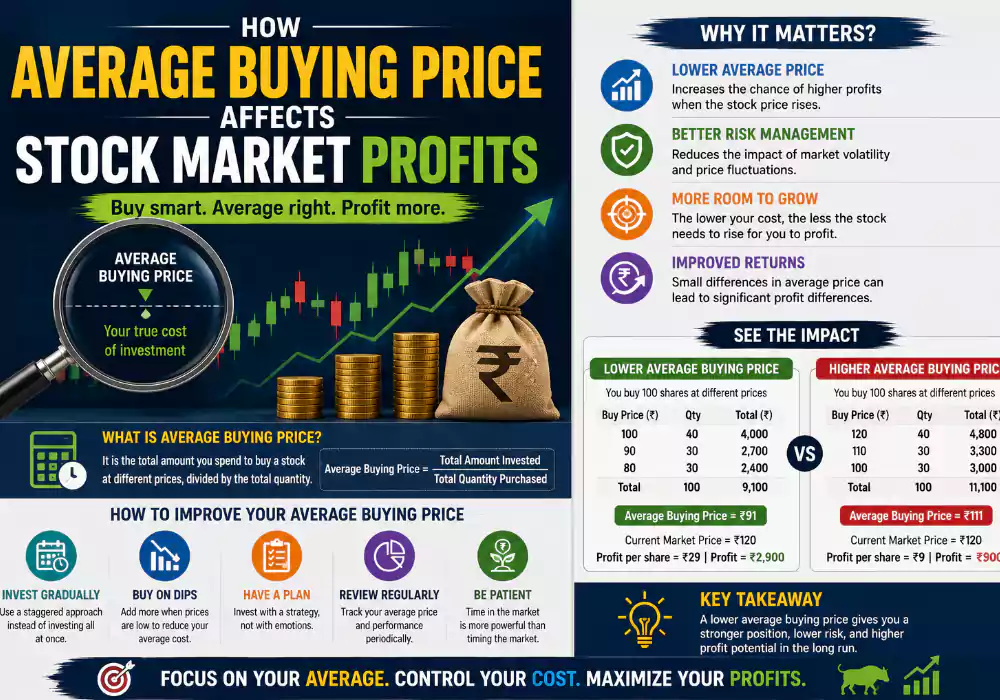
What Average Buying Price Actually Means
Your average buying price is basically the average cost of all the shares you own of a particular stock, even if you bought them at different times and different prices.
Say you buy 10 shares of a company at 100 each. Your average price is 100. Simple.
Now say the stock drops to 80, and you buy another 10 shares. Your total investment is (10×100) + (10×80) = 1800, divided by 20 shares, which gives you an average price of 90.
That’s it. That’s the whole concept. But the way this number moves — and how you react to it — has a huge effect on whether you make money or lose it.
Why This Number Matters So Much
Here’s the thing nobody tells beginners: your profit or loss isn’t measured against what you paid the first time. It’s measured against your average price.
If your average price is 90 and the stock is trading at 95, you’re in profit, even though your very first purchase was at 100 and technically still “underwater” if you looked at it in isolation. This single number becomes the line in the sand between gain and loss.
I learned this the hard way with a mid-cap stock a few years back. I’d bought it thinking it was a good buy, watched it fall, panicked, bought more at a lower price without really checking why it was falling, and ended up with an average price that still left me sitting in red for almost two years. The stock never recovered the fundamentals it lost, and averaging down just meant I had more money stuck in a sinking ship instead of less.
The Two Sides of Averaging — Down and Up
There are two directions you can average in, and they behave completely differently.
Averaging down means buying more shares when the price falls, to lower your average cost. This is the one everyone talks about, and it’s also the one that gets people into trouble most often.
Averaging up means buying more shares as the price rises, because the stock is doing well and you want more exposure. This one is less talked about but honestly safer in many cases, because you’re adding to a winner instead of trying to rescue a loser.
I’ve done both, and my experience tells me averaging up has worked out better for me far more often than averaging down ever did. But that doesn’t mean averaging down is always bad — it depends entirely on why the price dropped in the first place.
A Practical Example From My Own Portfolio
Let me walk you through an actual situation (with rounded numbers for simplicity, not exact figures from my demat statement).
I bought 50 shares of a company at 200 each. Total investment: 10,000.
A month later, the stock dropped to 160 because of a short-term sector-wide correction, not because the company itself had issues. I checked the quarterly results, nothing alarming, so I bought another 50 shares at 160.
New total investment: (50×200) + (50×160) = 18,000 New total shares: 100 New average price: 180
A few months later, the stock recovered to 210. Because my average was 180, not 200, I was sitting on a profit of 30 per share instead of just barely breaking even. That extra buying at the dip genuinely worked in my favor because the fundamentals hadn’t changed — only the price had, temporarily.
Now compare that to the mid-cap stock I mentioned earlier, where the price fell because the company’s earnings were actually weakening. I averaged down there too, but instead of recovering, the stock kept sliding because the underlying business was the problem, not the market mood. My average price kept getting “better” on paper, but the stock kept finding new lows below even that.
Same strategy, two completely different results. The difference was the reason behind the price drop.
Step-by-Step: How to Calculate Your Average Buying Price
If you want to do this manually instead of relying on your broker’s app (though most apps calculate it automatically), here’s the formula:
Step 1: List every purchase — number of shares and price per share.
Step 2: Multiply shares by price for each purchase to get the total cost of that purchase.
Step 3: Add up all the total costs.
Step 4: Add up the total number of shares across all purchases.
Step 5: Divide total cost by total shares. That’s your average price.
Most apps like Zerodha Kite, Groww, Upstox, and even the older ones like ICICI Direct or HDFC Securities show this automatically in your portfolio or holdings tab, usually labeled as “Avg.” or “Average Cost.” I’d still recommend knowing how to calculate it yourself, especially when you’re tracking multiple buy orders placed at different times, because it helps you actually understand what’s happening to your money instead of just glancing at a number.
Step-by-Step: Deciding Whether to Average Down
This is the part that actually matters more than the math. Anyone can do the calculation. The skill is in deciding whether averaging down is even a good idea in the first place.
Step 1: Ask why the price dropped. Is it the whole market correcting (like during a global event or interest rate news), or is it specific to this company (bad earnings, management issues, debt problems)? Market-wide dips are usually safer to average into. Company-specific problems are riskier.
Step 2: Check recent quarterly results. I always pull up the latest quarterly report before deciding. If revenue and profit are still growing or stable, that’s a decent sign. If they’re shrinking quarter after quarter, that’s a red flag.
Step 3: Look at the debt situation. A company drowning in debt that’s also losing market share is not a “buy the dip” candidate. It’s often just a slow bleed.
Step 4: Decide your maximum exposure beforehand. Before averaging down, I now set a mental (sometimes literal, written in my notes app) limit on how much more I’m willing to put into a stock. This stops me from emotionally throwing more money at something just because “it has to bounce back eventually.”
Step 5: Average in parts, not all at once. Instead of doubling your position in one shot, buy in smaller chunks as the price falls further, if it falls further. This way you’re not stuck with a worse average if the stock keeps dropping after your purchase.
Tools That Actually Help With This
I’m not someone who believes you need fifteen apps to manage investments, but a few have genuinely made tracking average price and decision-making easier for me:
- Zerodha Kite / Console – shows average buying price clearly in holdings, plus P&L tracking.
- Groww – good for beginners, simple visual breakdown of average cost vs current price.
- Screener.in – I use this to check a company’s quarterly numbers, debt levels, and historical performance before deciding to average down on anything.
- TickerTape – useful for quick health-check scores on stocks, which helps when you’re trying to judge whether a fall is temporary or structural.
- A basic Excel or Google Sheet – sounds boring, but I track every buy with date, price, and reason for buying. This has saved me from emotional decisions more than any app has.
Mistakes I’ve Made (So You Don’t Have To)
Mistake 1: Averaging down just because the price “looks cheap.” Cheap compared to what? I used to think a falling price automatically meant a bargain. It doesn’t. Sometimes a stock falls because it deserves to fall.
Mistake 2: Not setting a limit. I once kept adding to a position because I was convinced it “had to” turn around. It didn’t, for almost three years. I tied up capital that could’ve been working elsewhere.
Mistake 3: Confusing average price with break-even price. These aren’t the same once you factor in brokerage, taxes, and other charges. I assumed my profit started the moment price crossed my average, forgetting these small costs eat into that.
Mistake 4: Averaging down on momentum or hype stocks. This is dangerous territory. A stock that ran up purely on hype and then crashed usually doesn’t have strong fundamentals holding it up. Averaging down here is often just adding good money after bad.
Mistake 5: Ignoring sector trends. I once averaged into a stock without noticing the entire sector was facing headwinds — new regulations, in this case. The stock kept falling not because of company-specific issues, but because the whole industry was under pressure. Sector context matters as much as the company itself.
How Average Price Connects to SIPs and Long-Term Investing
If you invest through SIPs in mutual funds or do periodic stock purchases, you’re already using averaging without necessarily calling it that. This is sometimes referred to as rupee cost averaging.
Here’s why it works well over long periods: you’re buying more units when prices are low and fewer units when prices are high, which naturally brings your average cost down over time without you trying to time the market.
I do this with index funds, and honestly, it’s been far less stressful than actively trying to average down on individual stocks. The discipline is built into the process — I invest the same amount every month regardless of what the market is doing, and the averaging happens automatically.
For individual stocks though, averaging needs more thought because you’re betting on a single company’s fate, not a basket of companies like an index fund.
A Simple Way to Think About It
I now use a mental checklist before averaging into any stock:
- Has anything fundamentally changed about the business, or is this just market noise?
- Am I averaging because of logic, or because I don’t want to admit the first purchase was a mistake?
- Do I have a limit on how much more I’m willing to invest in this one stock?
- Would I buy this stock fresh today, at this price, if I had zero shares of it already?
That last question has saved me more than once. If the answer is no, averaging down is usually just stubbornness dressed up as strategy.
When Averaging Down Genuinely Worked For Me
I don’t want to make this sound like averaging down is always bad, because it isn’t. Besides the mid-cap example I mentioned earlier going wrong, I’ve had a banking stock fall nearly 20% during a broad market correction caused by global interest rate worries, nothing specific to the bank itself. I averaged down twice over two months, the sector recovered within six months, and my average price ended up being noticeably better than if I’d just held my original purchase. That position is still one of my better performing holdings today.
The pattern I’ve noticed across my own trades is that averaging down works best when the drop is driven by sentiment, not substance. When the business itself is sound and the price fall is about market mood, fear, or unrelated macro news, lowering your average can genuinely pay off. When the business itself is cracking, lowering your average just means you have more invested in something that may keep declining.
Common Questions I Get Asked
Does a lower average price guarantee profit? No. It only improves your break-even point. The stock still needs to recover to or above that average for you to be in profit.
Should I average down on every stock that falls? Not at all. Treat each fall individually. Some falls are buying opportunities, others are warnings.
Is there a limit to how many times I should average down? I personally cap it at two to three additional purchases on any single stock. Beyond that, if it’s still falling, something is probably wrong with my original thesis.
Does average price affect tax calculations? Yes, for tax purposes (especially long-term and short-term capital gains in India), the cost basis used is often calculated using specific methods depending on your broker and holding period, so it’s worth checking your contract notes or consulting a tax advisor for exact figures, since this part can get technical.
Wrapping This Up
Average buying price isn’t some advanced concept reserved for professional traders. It’s something every single person investing in stocks ends up dealing with, whether they realize it or not. The number itself is just arithmetic. The skill — and the part that actually affects your profits — is in understanding why a price moved before deciding to add more money to it.
My biggest takeaway after years of doing this myself: averaging down is a tool, not a rescue plan. It works beautifully when you’re buying a good business at a temporary discount. It backfires badly when you’re trying to convince yourself a mistake will eventually fix itself.
If there’s one habit worth building, it’s pausing before you hit that buy button a second time on a falling stock, and asking whether you’re investing with logic or just hoping the market proves you right. That pause has saved me more money than any averaging formula ever could.
1. What is average buying price in stocks?
Average buying price is the total amount invested divided by the total number of shares purchased. It determines your actual breakeven point in the stock market.
2. Is averaging down a good investment strategy?
Averaging down can work when the company has strong fundamentals and the price decline is temporary. It becomes risky when the business faces permanent problems.
3. How does dollar-cost averaging help investors?
Dollar-cost averaging reduces emotional investing and timing risk by investing fixed amounts regularly regardless of market conditions.
4. What is the difference between averaging down and averaging up?
Averaging down means buying more shares after prices fall, while averaging up means buying additional shares as prices rise.
5. Why is average buying price important for profits?
Your average buying price directly impacts how much profit you earn when selling shares. Lower average costs usually improve profit margins and reduce risk.