
I still remember the day my relationship manager at the bank asked me, “Sir, active fund lenge ya index fund?” and I just nodded along like I knew exactly what he meant. I didn’t. I went home, opened five different blogs, and somehow felt more confused after reading them than before.
That was almost eight years ago. Since then I’ve held both active and passive mutual funds in my own portfolio, made some genuinely silly mistakes, and learned a few things the hard way that I wish someone had just told me plainly back then.
So this isn’t going to be a textbook explanation copied from a finance dictionary. This is what I actually understood after putting my own money on the line, tracking my returns, comparing fact sheets at 11pm, and occasionally regretting a few decisions.
Quick note before we dive in: I’m not a certified financial advisor, just someone who’s been investing and writing about money for a while. Treat this as a starting point for your own research, not as personalized investment advice.
What Active Funds Actually Are
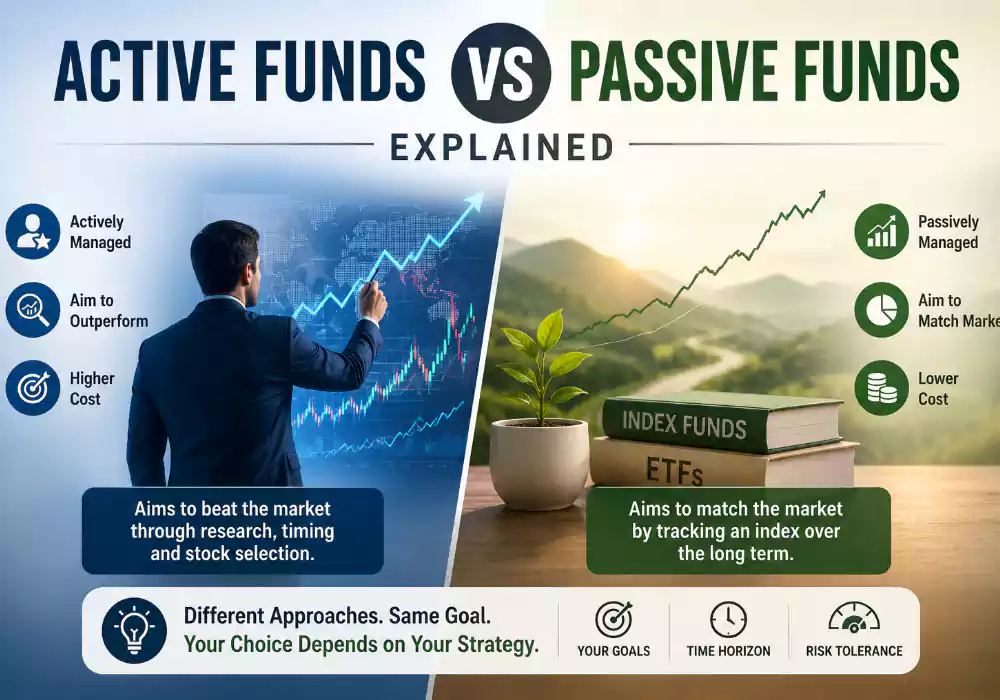
An active fund is run by a fund manager (and a team behind them) who is constantly making decisions. They’re picking which companies to buy, which ones to sell, when to hold cash, when to go heavy on a particular sector.
The whole pitch behind an active fund is simple: “We believe our research and judgment can beat the market average.” That’s it. That’s the entire sales pitch in one line.
When I bought my first active fund, I genuinely thought I was paying for a magic formula. I pictured a room full of analysts with screens covered in numbers, somehow predicting which stock would double next year. The truth is a lot more boring. It’s mostly disciplined research, valuation models, company visits, quarterly result analysis, and a fair amount of educated guessing dressed up in financial language.
What Passive Funds Actually Are
A passive fund doesn’t try to beat anything. It just copies an index.
So if you buy a Nifty 50 index fund, the fund simply holds the same 50 companies in roughly the same proportion as the Nifty 50 index itself. No stock picking. No manager trying to be clever. No bets on which sector will do well next year.
The fund’s only job is to track the index as closely as possible, minus a small fee. That’s literally the entire strategy.
When I bought my first index fund, I almost felt embarrassed telling people about it. It felt too simple. Like I wasn’t “properly investing,” just copying an exam paper instead of solving it myself. Turns out that feeling was completely misplaced, but it took me a couple of years to understand why.
The Difference, In Plain Words
Here’s the simplest way I explain this to friends who ask me over chai:
Active funds are like hiring a chef who decides the menu every single day based on what looks fresh at the market. Passive funds are like ordering the same thali every day because you know exactly what’s in it and you’re fine with that.
Neither is automatically the “smart” choice or the “lazy” choice. It depends on what you’re trying to get out of your money.
| Factor | Active Funds | Passive Funds |
|---|---|---|
| Strategy | Fund manager picks stocks | Mirrors an index |
| Cost (expense ratio) | Usually higher | Usually much lower |
| Goal | Try to beat the market | Match the market |
| Effort needed from manager | High | Very low |
| Predictability | Can vary a lot | Fairly predictable |
| Best suited for | Niche segments, smaller companies | Large, well-researched markets |
Why The Cost Difference Actually Matters (More Than People Think)
This is the part that genuinely changed how I invest, so stick with me here.
Active funds in India typically charge somewhere between 1% to 2.25% as an annual expense ratio. Passive index funds often charge somewhere between 0.1% to 0.4%.
That difference of 1% to 1.5% sounds tiny on paper. It is not tiny over twenty or thirty years.
Let me show you the maths with simple numbers, no fancy formulas.
Say you invest ₹10,000 a month for 25 years, and both your active fund and your passive fund happen to grow at exactly the same rate before fees, let’s say 12% annually.
If your active fund charges 1.8% as expense ratio, your actual growth rate after fees comes down to roughly 10.2%.
If your passive fund charges 0.2%, your actual growth rate stays around 11.8%.
Over 25 years, that 1.6% difference in fees alone can mean a gap of well over ₹40-50 lakhs in your final corpus, just from fees eating into compounding. Not because the active fund manager did a bad job, simply because fees compound just as powerfully as returns do, except in the wrong direction for you.
I genuinely didn’t appreciate this until I built a basic spreadsheet comparing my own active fund’s actual returns against the index it was supposed to compete with, after accounting for fees. The gap shocked me a little.
Does Paying More Actually Get You Better Returns?
This is the million-rupee question, quite literally.
A lot of independent research, including reports that track active fund performance against benchmark indices over rolling 10 to 15 year periods, consistently shows that a large majority of active funds fail to beat their own benchmark over the long run, especially in large-cap categories.
That doesn’t mean every active fund underperforms. Some genuinely do well, particularly skilled managers in segments like mid-cap, small-cap, or sector-specific funds where there’s more room for research and stock-picking to make a difference because these companies are less tracked by analysts.
But in large, well-tracked segments like the Nifty 50 or Sensex, it’s much harder for any manager to consistently spot something that thousands of other analysts haven’t already noticed. The market in those large companies is just too efficient and too closely watched.
This is exactly why a lot of seasoned investors I’ve spoken to, including a mutual fund distributor I trust, use a mixed approach: passive funds for large-cap exposure, and active funds where there’s more inefficiency to exploit, like mid-cap, small-cap, or international funds.
My Own Portfolio Story (Mistakes Included)
When I started investing, my entire portfolio was active funds. Every single rupee. I thought I was being “smart” by picking funds with the highest 3-year returns shown on comparison websites.
Mistake number one: I was chasing past performance, which is honestly one of the most common beginner mistakes in mutual fund investing. A fund that did brilliantly in the last 3 years isn’t guaranteed to repeat that in the next 3.
Two of my “star performer” funds from 2018 became completely average performers by 2021. Meanwhile, a boring index fund I added almost as an afterthought quietly delivered steady, predictable growth without any drama.
Mistake number two: I had five active funds across different fund houses, all of which were essentially holding the same large-cap stocks. I thought I was diversifying. I was actually just paying five different expense ratios for almost the same underlying portfolio. That’s called “fund overlap,” and it’s surprisingly common.
I checked this overlap using a free tool on a portfolio analysis platform, and honestly, the result was a bit embarrassing. Around 70% of my holdings across those funds were the same 15-20 companies.
What I changed eventually: I shifted my large-cap exposure mostly into a Nifty 50 index fund, kept one well-researched mid-cap active fund where the manager had a genuinely consistent long-term record, and added a small allocation to an international index fund for some global exposure.
This mix isn’t perfect, and I’m not claiming it’s the “best” portfolio structure for everyone. But it’s a lot more intentional than what I started with, and it’s a lot cheaper to maintain.
Step-By-Step: How To Decide Between Active And Passive For Yourself
Here’s the process I’d actually recommend walking through, based on what worked for me and what I’d do differently if starting over.
Step 1: Figure out which market segment you’re investing in. Large-cap, mid-cap, small-cap, international, or sector-specific. This single decision changes everything else.
Step 2: For large-cap and broad market exposure, lean passive. Large companies are heavily researched by hundreds of analysts. It’s genuinely hard for any single fund manager to consistently outsmart that level of collective scrutiny. A low-cost index fund tracking Nifty 50 or Sensex often does the job efficiently here.
Step 3: For mid-cap, small-cap, or niche sectors, consider active. These segments are less tracked, less efficient, and leave more room for skilled research to genuinely add value. This is where a good active fund manager can actually earn their fee.
Step 4: Check the expense ratio before anything else. Open the fund’s fact sheet (available on the AMC’s website or platforms like Value Research Online), and look at the “Total Expense Ratio” or TER. Compare it against similar funds in the same category.
Step 5: Look at rolling returns, not just point-to-point returns. A fund that looks great because of one lucky year can look very different over rolling 5-year or 10-year windows. Most fund comparison tools let you toggle this view.
Step 6: Check for portfolio overlap if you hold multiple funds. Use a free overlap checker tool (several mutual fund tracking apps offer this) to see if you’re accidentally duplicating the same stocks across different funds and paying multiple fees for it.
Step 7: Match the fund choice to how much you want to monitor it. Active funds occasionally change managers, strategies, or even category classifications. If you’re not someone who enjoys checking fund updates regularly, passive funds need a lot less babysitting.
Step 8: Decide on a split, don’t treat it as all-or-nothing. Most people I know who’ve been investing for 10+ years eventually settle into some blend of active and passive, rather than going 100% one way. There’s no rule that says you must pick a side.
Tools And Platforms That Actually Helped Me
A few apps and websites genuinely made this process easier instead of more confusing:
Value Research Online is where I check expense ratios, rolling returns, and fund ratings before buying anything new.
Groww and Coin by Zerodha both let you compare fund performance graphs side by side, which is handy when you’re deciding between two similar options.
The AMC’s own fact sheet (usually a downloadable PDF updated monthly) tells you exactly which stocks the fund is holding right now, which is the most honest source of truth.
SEBI’s Riskometer label on every fund document gives a quick sense of how risky the fund is classified, which is worth glancing at before investing, especially for beginners.
None of these tools will make the decision for you, but they remove a lot of the guesswork.
Common Mistakes To Avoid
Chasing last year’s top performer. A fund’s recent rank on a “best funds” list changes constantly. What mattered to me far more was consistency over a 7-10 year period, not who’s leading this quarter.
Ignoring the expense ratio because it “seems small.” As shown earlier, even a 1% difference compounds into a massive number over decades.
Assuming passive automatically means “safe.” A Nifty 50 index fund still falls when the market falls. Passive just means it follows the market exactly, both up and down. It’s not a safety net.
Holding too many active funds with overlapping portfolios. This was my biggest personal mistake, and it took me almost two years to notice and fix it.
Switching funds too often based on short-term performance. Every time you exit and re-enter, you potentially trigger capital gains tax and lose out on compounding momentum.
Not checking whether your “active” fund is secretly behaving like an index fund anyway. Some active funds stay so close to their benchmark that they’re basically charging active fund fees for passive-like performance. This is sometimes called a “closet index fund,” and it’s worth checking the portfolio composition to avoid this trap.
Quick Detour: Index Funds vs ETFs (People Mix These Up A Lot)
Before we move further, I want to clear up something that confused me for a long time too. “Passive” doesn’t just mean index mutual funds. It also includes ETFs (Exchange Traded Funds), and the two aren’t quite the same thing, even though both track an index.
An index mutual fund works like any other mutual fund. You buy and sell units directly through the AMC or a platform, at the day’s closing NAV (Net Asset Value). No demat account is strictly required, and you can set up a SIP easily.
An ETF, on the other hand, trades on the stock exchange just like a regular company share. You need a demat and trading account to buy one, and the price moves throughout the day instead of being fixed once at market close.
I personally started with index mutual funds because I already had SIPs running and didn’t want the hassle of placing buy orders manually. Later, I added a couple of ETFs for specific exposure, like a gold ETF, mainly because the expense ratio was slightly lower than the equivalent fund-of-fund option.
If you’re someone who likes the discipline of automated monthly SIPs and doesn’t want to track market timing, index mutual funds are usually the easier starting point. If you’re comfortable placing trades yourself and want to take advantage of intraday price movement occasionally, ETFs can work out cheaper, though liquidity can sometimes be a concern for less popular ETFs, so always check the trading volume before buying.
Frequently Asked Questions
Are passive funds completely risk-free? No. A passive fund carries the same market risk as the index it tracks. If the index drops 15%, your passive fund drops roughly the same amount. Passive only means low cost and predictable behaviour, not low risk.
Can an active fund manager consistently beat the index every year? Some managers beat the benchmark in certain years, and a smaller number manage to do it consistently over 7-10 year stretches. Beating it every single year without exception is extremely rare and not something to expect or bank on.
Is it bad to hold both active and passive funds together? Not at all. In fact, combining both, using passive for the core large-cap allocation and active for niche segments, is a fairly common approach among long-term investors I’ve interacted with.
Do passive funds require any monitoring at all? Minimal, but not zero. You should still check occasionally that the fund is tracking its index closely (this is called “tracking error”) and that the expense ratio hasn’t crept up unexpectedly.
What’s a reasonable starting point for a beginner? Many beginners I’ve spoken with start with a single large-cap index fund through a SIP, get comfortable with the process for 6-12 months, and only then explore active funds in other categories once they understand how to read a fact sheet and compare expense ratios.
This part is often overlooked, so here’s the simple version.
For equity mutual funds in India, both active and passive funds are taxed the same way. Gains held for less than a year are taxed as short-term capital gains, and gains held longer are taxed as long-term capital gains, with current rules allowing a certain exemption threshold annually. Tax treatment can change with budget announcements, so it’s worth double-checking the latest rules before making big decisions purely for tax reasons.
One area where active funds have an edge for now is ELSS (tax-saving funds under Section 80C), since passive ELSS options are still fairly limited compared to active ELSS funds, though that’s slowly changing too.
So, Which One Should You Actually Pick?
Honestly? Probably both, in different proportions depending on your goals.
If you want a simple, low-maintenance core for your portfolio, especially for large-cap exposure, passive index funds make a lot of sense. Low cost, predictable, and you’re not relying on any single person’s judgment.
If you’re comfortable doing a bit of homework and want exposure to segments where skilled stock-picking genuinely has room to add value, like mid-cap or small-cap categories, a carefully chosen active fund can be worth the higher fee.
What I’d avoid is picking purely based on which one sounds more impressive at a dinner conversation. I made that mistake for the first few years of my investing journey, and switching to a more thoughtful, cost-aware approach made a noticeable difference in how my portfolio actually performed.