
I still remember the first stock I ever bought. I was 23, I’d just gotten my first proper paycheck, and a coworker mentioned some company was “about to blow up.” I didn’t check the balance sheet. I didn’t even know what a balance sheet was. I just opened my trading app and put in almost half my savings.
Three months later, that stock had dropped 40%. I sold in a panic, told myself I’d “never invest again,” and spent the next year keeping everything in a savings account earning basically nothing.
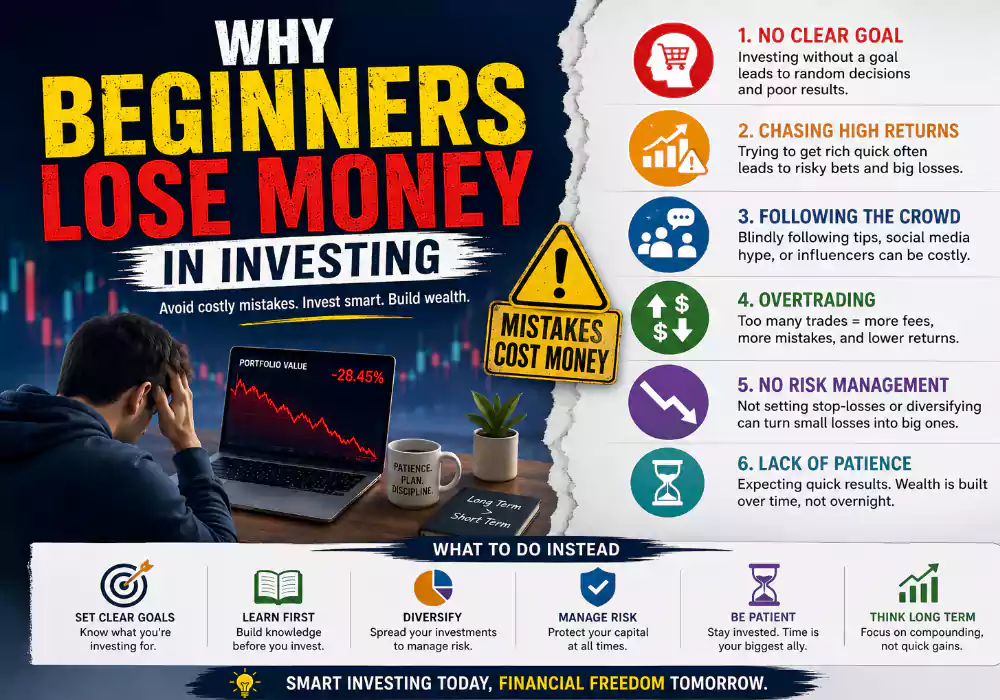
That story isn’t unique. If you talk to almost anyone who started investing in their twenties, they have some version of it. A bad pick, a panic sell, a “guru” they followed off a cliff. The frustrating part is that most of these losses weren’t because the market is rigged or because beginners are bad with money. They lost money because nobody ever walked them through the basics before they jumped in.
This article is the conversation I wish someone had with me before I opened that trading app. No fluff, no jargon dump, just the actual reasons beginners lose money and what to do instead.
It’s Rarely the Market’s Fault
Here’s something that took me years to accept: the stock market, on average, goes up over long periods of time. Index funds tracking something like the S&P 500 or Nifty 50 have historically delivered solid long-term returns. So if the market trends upward over decades, why do so many beginners still end up losing money?
The honest answer is behavior, not bad luck. Investing is one of those rare fields where the math is simple but the psychology is brutal. You’re fighting your own brain at every step — fear, greed, impatience, ego. Beginners lose money because they let emotions drive decisions that should be driven by a plan.
Let’s break down exactly where that goes wrong.
Mistake 1: Investing Before You Have a Safety Net
This was my first mistake, and it’s probably the most common one I see.
A lot of beginners get excited about investing and pour money into stocks or crypto before they have any emergency fund. Then life happens — a medical bill, a job loss, a car repair — and they’re forced to sell investments at the worst possible time, often at a loss, just to cover an emergency.
I had a friend who put her entire bonus into mutual funds, then six weeks later needed money for a sudden hospital visit. She had to redeem her funds early, during a dip, and lost a chunk of what she’d put in. Not because the funds were bad, but because the timing was forced on her.
The fix: Build a cushion of 3 to 6 months of expenses in a regular savings account or a liquid fund before you invest a single rupee or dollar elsewhere. This isn’t boring advice you can skip — it’s the thing that keeps you from being forced to sell investments under pressure.
Mistake 2: Chasing Tips Instead of Understanding What You Own
The stock my coworker recommended? I genuinely didn’t know what the company did beyond a vague idea. I bought it because someone I trusted said it was going up.
This happens constantly, especially now with social media. Someone on a finance forum or a video app says a stock or coin is “about to moon,” and beginners pile in without checking anything. When the hype fades, the price crashes, and the people who bought late are the ones holding the losses.
Tips aren’t inherently bad. The problem is acting on them without understanding why the recommendation makes sense, what the actual business or asset does, or what could go wrong.
A simple rule I follow now: If I can’t explain in two or three plain sentences why I’m buying something, I don’t buy it. No exceptions.
Mistake 3: Trying to Time the Market
Beginners often think successful investing means buying at the lowest point and selling at the highest. It sounds smart in theory. In practice, nobody — not professional fund managers, not the talking heads on financial news, nobody — can consistently predict short-term market movements.
I tried this for about a year. I’d wait for a “dip” to buy, then watch the price climb without me because I was too busy waiting for it to drop further. Or I’d sell after a small gain, convinced the market was about to crash, only to watch it climb another 20%.
What actually worked better was the boring approach: investing a fixed amount regularly, regardless of what the market was doing. This is usually called a Systematic Investment Plan (SIP) in mutual funds, or dollar-cost averaging in the US.
Step-by-step way to start this:
- Pick an amount you’re comfortable investing every month, even if it’s small.
- Choose a low-cost index fund or diversified mutual fund through a platform like Groww, Zerodha Coin, Vanguard, or Fidelity, depending on where you’re based.
- Set up an automatic transfer so the investment happens on the same date every month, without you having to remember or decide.
- Leave it alone. Don’t check it every day.
- Increase the amount whenever your income increases.
This removes the guessing game entirely. You’re not trying to predict the market — you’re just steadily buying in at different prices over time, which smooths out the highs and lows.
Mistake 4: Putting All the Eggs in One Basket
Another classic. Beginners often go all-in on one stock, one sector, or one type of asset because it’s performed well recently.
I once put almost 70% of my portfolio into tech stocks because that’s what was trending in the news. When the sector corrected, my whole portfolio took a hit at once. If I had spread that money across different sectors, or just bought a broad index fund, the damage would have been much smaller.
Diversification isn’t a fancy concept. It just means not betting everything on one outcome.
Practical way to diversify as a beginner:
- Mix different asset types: stocks, bonds, maybe a bit of gold or property funds.
- Within stocks, don’t put everything in one industry.
- Consider index funds or ETFs, which automatically spread your money across dozens or hundreds of companies in one purchase.
Mistake 5: Ignoring Fees Because They Seem Small
This one is sneaky because the damage is invisible day to day.
When I started, I had money in a few actively managed mutual funds with expense ratios around 2%. That sounds tiny. But over 20-30 years, a 2% annual fee compared to a 0.2% index fund fee can eat up a significant chunk of your total returns. Compounding works both ways — for your gains and for the fees quietly eating into them.
What to actually check before investing in any fund:
- The expense ratio (lower is generally better for passive funds)
- Exit load or early withdrawal penalties
- Brokerage or transaction fees on the platform you use
Apps like Zerodha, Groww, Robinhood, and most modern brokers display this clearly now, so there’s no excuse to skip checking it.
Mistake 6: Checking the Portfolio Obsessively
I’ll admit this one is hard to avoid because trading apps are designed to be checked constantly. Push notifications, daily percentage changes in red and green, it’s almost addictive.
The problem is that checking your portfolio every hour makes you more likely to react emotionally to short-term noise. A stock dropping 3% in a day means almost nothing over a 10-year horizon, but if you’re watching it live, it feels like a crisis.
I started limiting myself to checking investments once a week, then eventually once a month. My decision-making got noticeably calmer once I stopped treating my portfolio like a live scoreboard.
Mistake 7: Panic Selling During a Downturn
This is the big one. Almost every beginner who’s been investing for more than a year has a story about selling at the bottom out of fear.
During one market correction, I watched my portfolio drop nearly 18% in a couple of weeks. I sold a chunk of it, convinced it would keep falling. It recovered fully within four months. I had locked in a loss that, if I’d just stayed put, would have turned back into a gain.
Markets go through corrections regularly. It’s not a malfunction, it’s how markets behave. The investors who do well long-term are usually the ones who don’t touch their money during the scary parts.
A few things that help with this:
- Only invest money you won’t need for at least 5 years.
- Remind yourself that a drop on paper isn’t a loss unless you sell.
- Look at historical charts of past corrections and recoveries — it helps put short-term drops in context.
Mistake 8: Following Influencers Without Checking Their Track Record
Financial content online has exploded, and a lot of it is genuinely useful. But a good chunk of it is people with flashy lifestyles selling courses or pushing specific stocks or coins they were paid to promote.
I once followed someone who claimed they’d turned a small amount into six figures trading options. I tried to copy a few of their trades. I lost money on almost every single one because I didn’t have their experience, their risk management, or honestly any proof their claims were even accurate.
Questions worth asking before trusting any finance influencer:
- Do they explain the reasoning, or just the result?
- Are they selling something (a course, a signal group, a subscription)?
- Do they talk about their losses too, or only their wins?
People who are upfront about both their wins and losses tend to be more trustworthy than people who only post highlight reels.
Mistake 9: Investing Without a Goal
This sounds basic, but a lot of beginners invest without ever defining what the money is for. No goal means no strategy, and no strategy means decisions get made on vibes.
When I finally sat down and wrote out actual goals — a house down payment in 7 years, retirement decades out, an emergency cushion — it completely changed how I invested. Money for the house went into safer, more stable options since I needed it sooner. Retirement money went into long-term growth investments since I had decades for it to recover from any dips.
Quick way to set this up yourself:
- List your financial goals with rough timelines (1 year, 5 years, 20+ years).
- Match the investment type to the timeline — shorter goals need safer, more stable options; longer goals can handle more risk.
- Keep separate, clearly labeled accounts or folders for each goal so you’re not tempted to dip into your retirement fund for a vacation.
Mistake 10: Not Understanding Risk vs. Reward
A lot of beginners equate “higher potential return” with “better investment,” without weighing the risk attached to it.
Crypto is a good example. The potential upside gets all the attention, but the volatility and risk of loss rarely gets the same airtime in casual conversation. I put a small amount into a coin once purely because of hype, with zero understanding of what gave it value. It dropped over 60% within months. Lesson learned: never invest in something purely because the upside sounds exciting if you don’t understand the downside too.
A useful habit: before investing in anything, ask “what’s the worst realistic outcome here, and can I handle that?” If the answer is no, it’s not the right investment for you right now, no matter how good the upside sounds.
Mistake 11: Skipping Research Tools That Are Already Free
A surprising number of beginners never use the free research tools available to them. Things like:
- Fund fact sheets that show past performance, holdings, and fees
- Stock screener tools on platforms like Screener.in, Yahoo Finance, or Morningstar
- Annual reports and investor presentations, which are usually easier to read than people expect
- Robo-advisors like Betterment or Wealthfront, which can build a diversified portfolio automatically based on your goals and risk tolerance
You don’t need to become a financial analyst. But spending even 20 minutes reading a fund’s basic fact sheet before investing can save you from a lot of avoidable mistakes.
A Simple Beginner-Friendly Investing Plan
If I were starting completely from scratch again, here’s the order I’d follow:
- Build an emergency fund covering 3-6 months of expenses, kept somewhere accessible, not invested in anything volatile.
- Pay down high-interest debt before investing seriously. There’s little point earning 10% on investments while paying 20%+ on credit card debt.
- Define your goals and timelines so every investment has a clear purpose.
- Start with low-cost, diversified index funds or ETFs rather than picking individual stocks right away.
- Automate your contributions through a SIP or recurring transfer so consistency doesn’t depend on willpower.
- Increase your investment amount gradually as your income grows, rather than jumping in with everything at once.
- Review your portfolio quarterly or twice a year, not daily.
- Rebalance occasionally if one part of your portfolio has grown too large compared to the rest.
- Keep learning gradually — read one good book, follow one or two credible sources, and avoid information overload.
- Stay invested through downturns unless your goals or risk tolerance have genuinely changed.
Mistakes to Avoid, Recap
Just to put it all in one place since this is the part people usually want to screenshot:
- Don’t invest money you might need within the next year or two.
- Don’t buy something just because someone online said it’s about to go up.
- Don’t put more than a small percentage of your portfolio into a single stock or coin.
- Don’t ignore fees, even when they look small on paper.
- Don’t check your portfolio every single day.
- Don’t sell out of fear during a downturn unless your situation has actually changed.
- Don’t follow influencers who only show wins and never explain their reasoning.
- Don’t invest without knowing what you’re buying and why.
What I’d Tell My Younger Self
If I could go back to that 23-year-old with his first paycheck, I’d tell him to slow down. Not to avoid investing, but to spend a few weeks understanding the basics before putting in actual money. I’d tell him that boring, consistent investing in diversified funds will likely outperform exciting stock picks based on tips from coworkers. I’d tell him that losing money early isn’t the end of the world, as long as he learns from it instead of giving up entirely.
Investing isn’t about being a genius or predicting the next big winner. It’s mostly about avoiding unforced errors, staying consistent, and giving your money enough time to grow. The beginners who lose the most money usually aren’t the ones who made bad picks — they’re the ones who let fear, hype, or impatience make decisions for them.
Start small if you need to. Use the free tools available. Automate what you can. And give yourself permission to learn as you go, because every experienced investor you admire started out just as clueless as you feel right now.
1. Why do most beginner investors lose money?
Most beginners lose money because they lack financial education, chase quick profits, and make emotional decisions. They often invest without understanding risk management, market volatility, or proper asset allocation, which leads to poor investment outcomes.
2. Is investing risky for beginners?
Investing always carries some level of risk, but beginners increase that risk by not diversifying or investing without a plan. With proper financial planning, risk tolerance awareness, and long-term investing strategies, investing becomes much safer.
3. How can new investors avoid losses?
New investors can reduce losses by starting small, diversifying their portfolio, avoiding emotional investing, and focusing on long-term goals. Using SIP investing and learning basic financial literacy also helps reduce beginner mistakes.
4. What is the safest investment for beginners?
Safer options for beginners often include diversified mutual funds, index funds, and SIP-based investing strategies. These reduce individual stock risk and help maintain balance during market volatility.
5. Should beginners invest during a market crash?
Market crashes can be stressful, but they are also part of long-term investing cycles. Beginners should avoid panic selling and instead focus on staying invested or investing gradually if they have a long-term horizon.