
Three years ago, I was paying minimum amounts on two credit cards, a personal loan, and a “buy now pay later” gadget I barely used. Every payday felt like watching water drain out of a bathtub while someone kept the tap only half open. I’d pay, the balance would barely move, and somehow there was always a new charge waiting.
That’s the debt trap. It’s not just owing money — it’s the feeling that no matter what you do, you’re not getting anywhere. I lived in that loop for about two years before I sat down one Sunday night, opened a notebook, and got brutally honest with myself about what was happening.
What followed wasn’t magic. It was a slow, sometimes boring, occasionally frustrating process that eventually got me out of roughly $14,000 of consumer debt in under two years while still going out for dinner once in a while and not living like a hermit. I want to walk you through exactly what worked, what didn’t, and the mistakes that cost me months I didn’t need to lose.
What the Debt Trap Actually Feels Like
People talk about debt in spreadsheets and percentages, but the trap itself is emotional before it’s mathematical.
You check your balance and feel a small wave of dread. You avoid opening certain banking app notifications. You tell yourself “I’ll deal with it next month” more times than you’d like to admit. Meanwhile, interest keeps compounding quietly in the background, like a slow leak you can’t quite locate.
The mechanics are simple enough: when you only pay the minimum on a credit card or high-interest loan, most of that payment goes toward interest, not the actual balance you borrowed. So your debt shrinks at a snail’s pace while the lender collects steady profit. This is exactly why minimum payments are designed the way they are — they keep you in the system longer.
Once I understood that one fact, something clicked. I wasn’t bad with money because I was careless (though I made plenty of careless choices too). I was stuck because the structure of minimum payments was working against me by design.
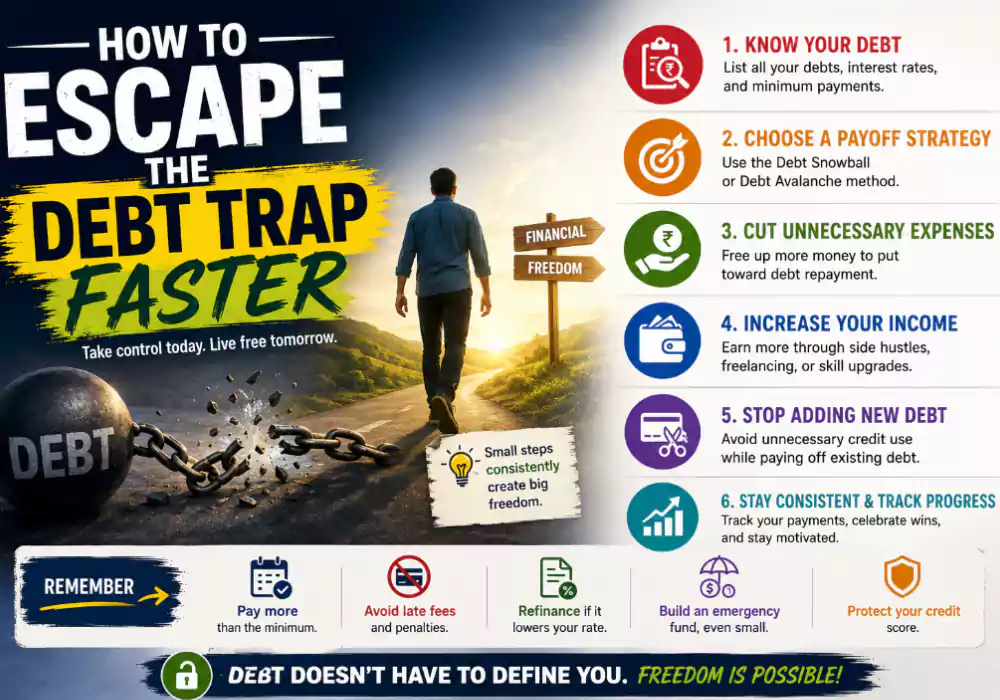
Step 1: Write Down Every Single Debt You Have
This sounds basic, but most people in the debt trap have never actually listed everything out in one place. I hadn’t either.
I grabbed a notebook (you can use a spreadsheet, a notes app, or a budgeting app — whatever you’ll actually use) and wrote down:
- Who I owed money to
- The total balance
- The interest rate
- The minimum monthly payment
- The due date
When I laid it all out, I had five separate debts. Two credit cards, a personal loan, a deferred payment plan for a laptop, and a small balance I owed a friend. Seeing them all in one column instead of scattered across five different apps and statements was the first time I felt like I had any control at all.
If you only do one thing after reading this article, do this step. You can’t fight what you can’t see clearly.
Step 2: Choose a Payoff Strategy That Fits Your Personality
There are two well-known approaches, and people argue about which one is “better” constantly. Honestly, the best one is whichever one you’ll stick with.
The debt snowball method has you pay off your smallest balance first while making minimum payments on everything else. Once that smallest debt is gone, you roll its payment into the next smallest, and so on. It’s motivating because you get quick wins early.
The debt avalanche method has you attack the debt with the highest interest rate first, regardless of size. Mathematically, this saves you more money over time because you’re cutting off the most expensive debt fastest.
I’m a numbers person, so I tried the avalanche method first. My highest-interest card was also my largest balance, and after three months of throwing extra money at it with barely visible progress, I felt deflated and almost gave up entirely.
So I switched to the snowball method. I paid off the small loan I owed my friend in one lump sum, then knocked out the laptop payment plan within six weeks. Those two wins gave me enough momentum to stay disciplined for the bigger balances afterward.
Lesson learned: the “optimal” math strategy doesn’t matter if it makes you quit. Pick the one that keeps you motivated, even if it costs you a little extra in interest along the way.
Step 3: Build a Tiny Cushion Before You Go All In
This step felt counterintuitive at the time. I wanted to throw every spare cent at debt immediately. But a friend who works in personal finance told me something that stuck with me: “If you don’t have any cushion, the next surprise expense becomes new debt.”
She was right. Before going aggressive on payoff, I saved a small emergency fund — around $500 to start. Not because $500 fixes everything, but because it covers the small surprises: a car repair, a medical co-pay, a broken phone screen. Without that buffer, any unexpected cost in the past would have gone straight onto a credit card, undoing progress.
Once that small fund existed, I redirected everything extra toward debt with far less anxiety, because I knew a flat tire wouldn’t send me backward.
Step 4: Audit Your Spending Like You’re Auditing a Business
This part stung a little. I went through three months of bank and card statements and categorized every transaction. Groceries, subscriptions, takeout, transport, entertainment, impulse buys.
A few things surprised me:
I was paying for two streaming services I hadn’t opened in weeks. I had a gym membership I used twice a month but was paying for as if I went daily. And takeout coffee and lunch added up to more than my electricity bill some months — which honestly felt embarrassing once I saw the total in black and white.
I didn’t cut everything. I’m not going to tell you to give up your morning coffee forever, because that kind of advice rarely lasts. Instead, I trimmed the things I genuinely didn’t value and kept the ones that made daily life enjoyable.
Practical version of this step:
- Pull three months of statements.
- Sort spending into categories.
- Mark anything you forgot you were paying for.
- Cancel or pause subscriptions you haven’t used in 30 days.
- Pick one or two spending habits to scale back, not eliminate entirely.
This single audit freed up close to $180 a month for me, which went straight toward debt.
Step 5: Increase Income Without Burning Out
Cutting expenses only goes so far, especially if your spending is already lean. At some point, increasing income matters more than cutting another coffee.
I didn’t quit my job or start some elaborate side business. I picked up freelance writing gigs on weekends, the kind that paid per article. Some weekends I earned an extra $150-$250, which went entirely toward debt, untouched by daily expenses.
Other options that worked for people I know going through similar struggles: selling unused items around the house, tutoring online, food delivery on weekends, or picking up overtime shifts when available. None of these are glamorous, but they don’t need to be permanent — they’re a bridge to get out of the trap faster.
The key mental shift here was treating extra income as debt-only money, not lifestyle money. The moment I let a side-hustle payment slip into “fun spending,” progress slowed down noticeably.
Step 6: Automate Your Payments So Willpower Isn’t the Deciding Factor
Willpower is unreliable. Some weeks I had it, some weeks I didn’t, especially after a stressful day at work when ordering food felt like the only comfort available.
So instead of relying on motivation every payday, I automated transfers. The day my salary landed, a fixed amount moved automatically into my debt payoff account before I could second-guess it.
This single habit removed the daily decision-making. I wasn’t deciding whether to pay extra on debt each month — it had already happened before I even checked my balance.
Tools and Apps That Actually Helped
A few tools made this process noticeably smoother. I’m not saying these are the only options, but they worked well for me and for people I’ve recommended them to:
Budgeting apps like YNAB (You Need A Budget) and Mint-style trackers helped visualize where money was going each week, not just at month-end.
Debt payoff calculators — many banks and personal finance sites offer free ones — let me see exactly how many months I’d shave off by adding even $50 extra to a payment. Watching that number drop the moment I adjusted a payment amount was strangely satisfying.
Round-up savings apps that automatically round up purchases and move the difference into savings helped build that small emergency cushion without me noticing the deductions much.
Calendar reminders for due dates sound basic, but missed payment fees added unnecessary cost more than once before I set this up properly.
None of these tools fixed anything by themselves. They just removed friction and made consistency easier, which mattered more than any single feature.
Mistakes I Made (So You Don’t Have To)
I want to be upfront about the missteps, because most debt advice online skips this part and pretends the journey was smooth.
Mistake one: I closed a credit card too early, thinking it would simplify things. It actually hurt my credit utilization ratio temporarily because my available credit dropped while balances on other cards stayed the same. I didn’t understand how credit scoring worked at the time.
Mistake two: I tried to attack everything at once during the first month — extra payments on all five debts simultaneously. It spread my extra money so thin that none of the balances moved meaningfully, and I lost motivation within weeks. Focusing extra payments on one debt at a time worked far better.
Mistake three: I ignored a 0% balance transfer offer because I assumed it was a scam or a trick. After researching it properly, transferring one high-interest balance to a 0% introductory card (and paying it off before the promotional period ended) saved me close to $300 in interest. Not every offer like this is good, but dismissing all of them without checking the terms cost me money.
Mistake four: I didn’t track progress visually for the first four months. Once I started marking a simple chart on my wall showing the total debt shrinking, the visible progress kept me going on weeks when motivation was low.
How Long It Actually Took
I’m not going to pretend this happened in three months, because that’s not a fair expectation for most people. From the day I listed everything out to the day my last balance hit zero, it took 22 months.
The first six months felt slow and a little discouraging. Months seven through fourteen had visible momentum once two smaller debts disappeared. The last eight months were almost mechanical — automated payments, occasional extra freelance income, and patience.
Your timeline will depend on your total debt, your income, and how much you can honestly free up monthly. What matters more than speed is consistency that doesn’t burn you out halfway through.
Common Mistakes to Avoid Along the Way
A quick recap of things that tend to derail people, based on my own experience and conversations with others working through similar situations:
- Paying minimums only and assuming “it’ll sort itself out eventually” — it won’t, because interest compounds against you.
- Attacking too many debts at once instead of focusing extra payments on one at a time.
- Skipping the small emergency cushion, which leads to new debt the moment something unexpected happens.
- Letting side-hustle or bonus income blend into regular spending instead of sending it straight to debt.
- Closing credit accounts without understanding the impact on your credit utilization.
- Comparing your timeline to someone else’s “I paid off $30,000 in six months” story without acknowledging their income, support, or circumstances were different from yours.
A Quick Example of How the Numbers Played Out
Numbers make this easier to picture, so here’s a simplified version of my own situation, rounded for clarity.
I owed $300 to a friend, $1,200 on a laptop payment plan, $4,500 on Card A at 22% interest, $5,800 on Card B at 19% interest, and a $2,200 personal loan at 14% interest. Total: roughly $14,000.
Using the snowball method, I paid off the $300 friend loan in one month using savings I already had set aside. The laptop plan took six weeks once I redirected the $180 a month freed up from canceled subscriptions, plus a chunk of freelance income.
After those two were gone, I had an extra $140 a month (from the laptop’s old minimum payment) to throw at Card A. That’s when momentum picked up. Card A took about nine months once I combined the freed-up minimum payments, the spending audit savings, and occasional freelance bursts.
Card B took longer, close to eight months, partly because I transferred part of the balance to a 0% promotional card and focused on clearing it before the introductory period ended. The personal loan ran in the background the entire time on a fixed monthly payment, finishing around month twenty.
Seeing these numbers broken down like this made the whole plan feel less abstract. It wasn’t one giant $14,000 mountain — it was five smaller climbs, each with its own finish line.
Frequently Asked Questions
Should I stop using credit cards completely while paying off debt?
I didn’t cut mine up, but I did stop carrying them in my wallet for a while. I kept one card for genuine emergencies and left it at home, which created just enough friction to stop impulse swipes without cutting off my credit history entirely.
Is debt consolidation a good option?
It can help if you qualify for a lower interest rate than what you’re currently paying, since it simplifies multiple payments into one. But it’s not a fix on its own — if spending habits don’t change, the same balances tend to creep back up within a year or two. I looked into it for Card B and decided a balance transfer worked better for my situation than a full consolidation loan.
What if my income isn’t enough to make extra payments at all?
This was genuinely tough for me during a couple of slow freelance months. When extra payments weren’t possible, I focused purely on covering minimums without missing due dates and protecting the small emergency cushion. Progress paused, but it didn’t reverse, which mattered more than speed during those stretches.
How do I stay motivated when progress feels invisible?
Tracking visually helped me more than anything else — a simple chart, a spreadsheet with a shrinking total, or an app that shows the debt-free date moving closer. Watching a number change, even slowly, kept me from feeling like the effort was disappearing into nothing.
A Quick Word on Mindset
Getting out of the debt trap is part numbers, part psychology. The math is fairly simple once you lay it out. The harder part is staying consistent on the weeks when motivation disappears, when a friend invites you on a trip you can’t afford, or when an unexpected bill shows up.
What helped me most wasn’t a clever trick — it was treating debt payoff like a long, slow walk rather than a sprint. Some months I moved fast, some months barely at all, but I never let myself go fully backward once the cushion fund was in place.
If you’re in the middle of this right now, checking your banking app with that familiar knot in your stomach, know that the trap loosens its grip the moment you write everything down and pick one method to follow consistently. It doesn’t happen overnight, but it does happen.
1. What is the fastest way to get out of debt?
The fastest way to escape debt is to combine smart budgeting with aggressive repayments. Paying more than the minimum EMI amount, reducing unnecessary expenses, and focusing on high-interest debt can speed up the repayment process.
Many people use the debt avalanche method because it reduces total interest costs faster. Increasing income through side hustles or freelance work can also improve cash flow and shorten repayment time.
2. Should I pay off small debts first?
Paying off small debts first is called the debt snowball method. This strategy helps create quick financial wins and keeps borrowers motivated during repayment.
However, if your goal is to save more money on interest, focusing on high-interest debt first may be more effective. The best repayment strategy depends on your financial behavior and personal motivation.
3. Is debt consolidation a good idea?
Debt consolidation can help if it lowers your interest rate or simplifies multiple monthly payments into one EMI. It may improve budgeting and reduce financial stress for some borrowers.
However, debt consolidation only works when combined with disciplined spending habits. Continuing unnecessary borrowing after consolidation can create even bigger financial problems.
4. How much income should go toward debt repayment?
Financial experts often recommend using a manageable portion of income toward debt payments while still maintaining basic living expenses and emergency savings.
If you are trying to escape the debt trap faster, increasing debt payments temporarily can help reduce loan balances and interest costs more quickly.
5. Can I save money while paying off debt?
Yes, building small emergency savings while repaying debt is important. Without savings, unexpected expenses may force you to borrow again and restart the debt cycle.
Balancing debt repayment with emergency fund planning improves long-term financial stability and reduces money-related stress.