
A few years back, I needed money for two completely different reasons within the same year. One was for renovating a leaky bathroom. The other was for a medical bill that landed on my desk way faster than I expected.
For the bathroom, I took a loan against my fixed deposit. For the medical bill, I ended up with a personal loan from an app on my phone, approved within hours.
I didn’t plan it that way. It just happened that one situation called for a secured loan and the other for an unsecured one. And honestly, at the time, I didn’t fully understand the difference. I just filled out forms and signed where the bank told me to.
Looking back, understanding the gap between secured and unsecured loans would have saved me some stress, a bit of money on interest, and one slightly embarrassing phone call with my bank’s loan officer where I asked a question that probably sounded silly.
So this article is the one I wish someone had handed me before all that. No jargon-heavy textbook explanations. Just what I’ve actually seen, used, and occasionally messed up.
The Simple Difference, Without the Bank Lingo
Here’s the easiest way I explain this to my cousin every time he asks (which is often):
A secured loan needs you to put something valuable on the table as backup. Your house, your car, your gold, your fixed deposit. If you can’t repay, the lender has the right to take that thing and sell it to recover their money.
An unsecured loan doesn’t ask for any of that. The lender trusts your income, your credit score, and your repayment history instead of an asset. No collateral changes hands.
That’s it. That’s the entire foundation. Everything else, the interest rates, the loan amount, the approval speed, the risk level, all branches out from this one core idea.
My Bathroom Loan: A Secured Loan Story
When my bathroom needed work, I had a fixed deposit sitting in my bank account that I wasn’t planning to touch for another two years. Breaking it early meant losing the interest I’d already earned.
My bank suggested a loan against that FD instead. I’ll be honest, I was skeptical at first. It felt like borrowing my own money and paying interest on it, which sounds a little silly when you say it out loud.
But here’s what actually happened. The interest rate was close to 2% above what my FD was earning. So if my FD gave 6.5%, my loan cost around 8.5%. Compare that to a personal loan, which at the time was running close to 13-14% for someone with my credit profile.
The approval took less than a day because the bank already had my FD as a guarantee. I didn’t need income proof, employer letters, or anything dramatic. Just a signed form and a quick verification call.
That’s the upside of secured loans in one example. Lower rates, faster approval, less paperwork drama, because the lender’s risk is already covered by your asset.
My Medical Bill Loan: An Unsecured Loan Story
Now the second situation was nothing like the first. I didn’t have time to pledge anything, and honestly, I didn’t have many assets lying around that were liquid enough to use as collateral on short notice.
I downloaded a lending app that a friend had used before, filled in my PAN, Aadhaar, salary slips, and bank statements, and got approval within four hours. Money hit my account by the next morning.
No collateral. No asset verification. Just my credit score and salary history doing the talking.
The catch? The interest rate was noticeably higher, and the loan amount I qualified for was smaller than what I could’ve gotten with something pledged against it.
This is the trade-off with unsecured loans. Speed and convenience, but you pay for it through higher interest and tighter loan limits.
Breaking Down the Core Differences
Let me lay this out the way I’d explain it over coffee, not the way a textbook would.
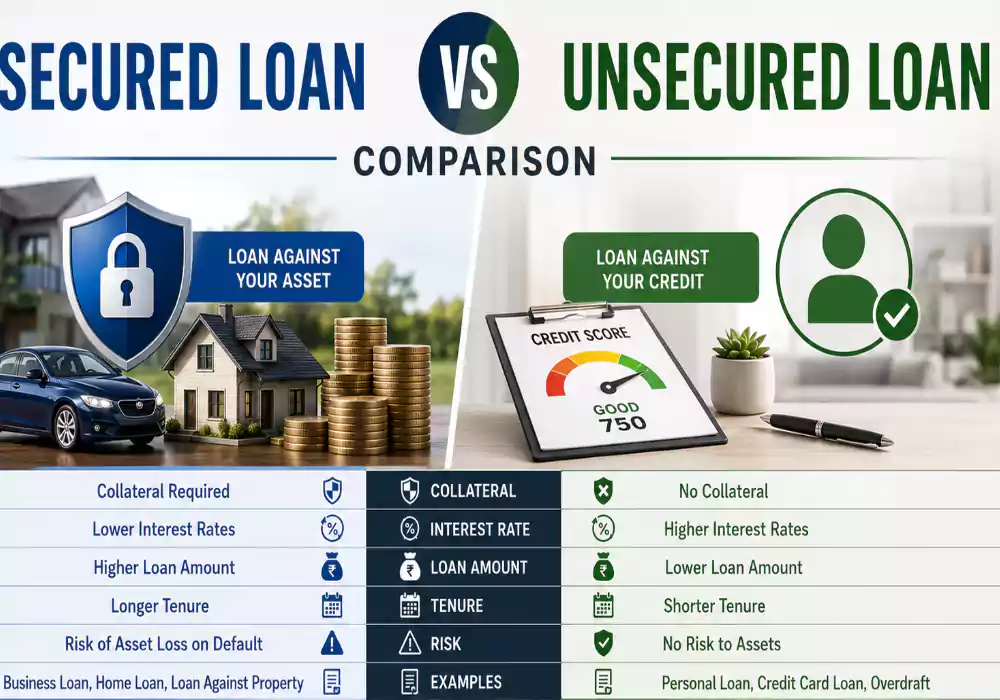
Collateral requirement Secured loans need an asset. Home, car, gold, FD, insurance policy, sometimes even shares. Unsecured loans need none of that.
Interest rates Secured loans usually sit lower because the lender has a safety net. Unsecured loans run higher because the lender is taking on more risk by trusting your word and your credit history alone.
Loan amount Secured loans tend to allow larger amounts since the asset backing it can be valued and the bank knows exactly what they can recover if things go sideways. Unsecured loans are usually capped lower, often tied closely to your monthly income.
Approval speed This one surprised me. I assumed pledging an asset would slow things down because of paperwork. In my experience it was actually faster for the FD-backed loan since the bank already held my asset details. Unsecured loans through traditional banks can take longer because they’re verifying your income and employment from scratch. Though apps and digital lenders have flipped this script with near-instant approvals for unsecured loans too.
Tenure Secured loans, especially home loans, can stretch for fifteen, twenty, even thirty years. Unsecured loans rarely go beyond five to seven years.
Risk if you default This is the part people underestimate. Miss payments on a secured loan and the lender can seize and sell your asset. Miss payments on an unsecured loan and they can’t take anything physical from you immediately, but it tanks your credit score hard, and they can pursue legal recovery routes, including sending the account to collections agencies.
Documentation Secured loans need asset-related paperwork, valuation reports for property, registration papers for vehicles, FD receipts, and so on. Unsecured loans lean more on income proof, bank statements, tax returns, and your credit report.
A Quick Comparison Table
| Factor | Secured Loan | Unsecured Loan |
|---|---|---|
| Collateral | Required | Not required |
| Interest rate | Lower | Higher |
| Loan amount | Usually higher | Usually lower |
| Approval time | Fast if asset is pre-verified | Fast with digital lenders, slower with traditional banks |
| Tenure | Long term (up to 30 years) | Short to mid term (1-7 years) |
| Risk on default | Asset can be seized | Credit score damage, legal recovery |
| Common examples | Home loan, car loan, gold loan, loan against FD | Personal loan, credit card, education loan (some), business loan |
When a Secured Loan Actually Makes Sense
I’ve noticed a pattern after watching friends, family, and my own situations play out.
Secured loans work well when:
- You need a large amount of money. Buying a house or a car almost always means going secured because the amount is too big for most unsecured products to cover.
- You already own an asset sitting idle. Gold jewelry, an FD, or a property that’s not generating income right now can be put to work.
- You want a lower interest rate and can comfortably commit to a long repayment period.
- You have a steady, predictable income and aren’t worried about the asset being at risk.
A friend of mine took a gold loan during a slow patch in his business. He didn’t want to sell his wife’s jewelry, but pledging it for a few months at a low interest rate got him through a cash crunch without losing the gold permanently. He repaid it in four months and got the jewelry back. That’s a textbook good use of a secured loan.
When an Unsecured Loan Actually Makes Sense
Unsecured loans shine in different situations.
- You need money quickly and don’t have time to go through asset valuation and paperwork.
- You don’t own any significant asset to pledge, or you don’t want to risk the one you have.
- The amount you need is moderate, something a personal loan or credit line can comfortably cover.
- You have a good credit score, which keeps the interest rate from ballooning too much.
My medical bill situation fits this perfectly. I needed funds within hours, not days. I had no intention of pledging anything for a one-time emergency, and my credit score was decent enough to get a reasonable rate.
Step-by-Step: How I Decide Which Loan to Go For
Whenever I’m faced with a borrowing decision now, I run through this checklist before applying anywhere.
Step 1: Figure out the actual amount needed Don’t round up “just in case.” I made that mistake once, borrowed extra for a renovation, and ended up paying interest on money that sat unused in my account for months.
Step 2: Check if you have an asset you’re comfortable pledging Not every asset should be pledged. I wouldn’t pledge a house I’m currently living in unless absolutely necessary. But an FD that’s not earning much, or gold that’s just sitting in a locker, is a different story.
Step 3: Compare interest rates across both loan types Apps like BankBazaar, Paisabazaar, and even your own bank’s website usually show indicative rates for both secured and unsecured products. I always check at least three lenders before deciding.
Step 4: Look at your credit score You can check this for free through apps like CRED, PaisaBazaar, or directly through CIBIL’s website. A higher score means better rates on unsecured loans especially, since that’s the main thing lenders judge you on.
Step 5: Match the tenure to the purpose Short-term needs shouldn’t go into long-term loans, and big-ticket purchases shouldn’t be squeezed into short repayment windows that strain your monthly budget.
Step 6: Read the fine print on foreclosure and processing fees This one bit me once. I prepaid a personal loan early, thinking I’d save on interest, only to find a foreclosure penalty that ate into most of my savings. Always check this before signing.
Step 7: Apply, but only after comparing at least two to three lenders Don’t go with the first offer just because it’s convenient. A five-minute comparison can save thousands over the loan’s life.
How to Apply for a Secured Loan (The Practical Walkthrough)
Based on my own experience, here’s roughly how it goes:
- Choose the asset you want to pledge, FD, property, gold, or vehicle.
- Approach your bank or a lender that deals with that specific asset type.
- Submit asset documents, FD receipt, property papers, gold appraisal, or vehicle registration.
- Wait for valuation. Banks usually send an appraiser for gold or property within a couple of days.
- Once valued, the bank tells you the maximum loan amount, typically a percentage of the asset’s worth, not the full value.
- Sign the agreement, which includes a clause about what happens if you default.
- Funds get disbursed, often within 24 to 72 hours depending on the asset type.
How to Apply for an Unsecured Loan (The Practical Walkthrough)
This one moved much faster for me, especially through digital platforms.
- Check your credit score first. Anything below 650 usually means higher rates or rejection from traditional banks.
- Compare a few lenders, banks, NBFCs, and lending apps, using comparison platforms.
- Submit income proof, bank statements, PAN, and Aadhaar.
- The lender runs a credit check and verifies your repayment history.
- If approved, you’ll get a sanctioned amount based on your income, not an asset value.
- Review the interest rate, processing fee, and prepayment terms carefully.
- Accept the offer and the amount usually lands in your account within hours to a couple of days.
Mistakes I’ve Made (So You Don’t Have To)
Mistake one: Borrowing more than needed I touched on this earlier, but it’s worth repeating. Extra borrowed money doesn’t just sit there for free. It costs you interest every single day it’s unused.
Mistake two: Not checking foreclosure charges I assumed prepaying a loan early was always a smart move. Sometimes the penalty wipes out most of the benefit. Always do the math first.
Mistake three: Ignoring my credit score before applying I applied for an unsecured loan once without checking my score. Got rejected, and that rejection itself left a small dent on my credit report. Always check your score before applying anywhere.
Mistake four: Pledging an asset I wasn’t fully comfortable losing A relative once pledged a small piece of land for a business loan that didn’t work out. Losing that land hurt far more than the business loss itself. Only pledge what you can genuinely afford to part with if things go wrong.
Mistake five: Comparing only the interest rate, not the total cost Processing fees, insurance add-ons, and documentation charges can quietly add 1-2% to your actual cost. Always ask for the total cost breakup, not just the headline rate.
Common Myths I Believed Before I Knew Better
Myth: Secured loans are always cheaper, no matter what Not always true. If the asset valuation is low or the lender adds heavy processing charges, a secured loan can end up costing more than expected. Always compare actual numbers, not assumptions.
Myth: Unsecured loans are riskier for the lender, so they don’t care about your repayment behavior They absolutely care. Your credit score and repayment history are the only safety net they have, so they scrutinize this closely.
Myth: You need a high income to get a secured loan Not necessarily. Since the asset is the main guarantee, income matters less than it does for unsecured loans.
Myth: Defaulting on an unsecured loan has no consequences since there’s no asset involved This one’s dangerous to believe. Your credit score takes a serious hit, future borrowing becomes harder, and lenders can still take legal action to recover dues.
Tools and Apps That Genuinely Helped Me
A few platforms I’ve personally used or referred people to:
- PaisaBazaar and BankBazaar for comparing interest rates across multiple lenders in one place.
- CRED for tracking credit score changes and getting alerts on due dates.
- Your bank’s mobile app for checking FD-backed or gold loan eligibility without visiting a branch.
- CIBIL’s official website for pulling your credit report directly, which is more reliable than third-party estimates sometimes.
None of these are sponsored mentions. I just use them regularly enough that they’ve become part of my routine whenever money decisions come up.
A Quick Scenario to Tie It Together
Let’s say you need 5 lakh rupees. You own an FD worth 6 lakh sitting idle, and your credit score is around 720.
If you go secured, you’d likely pay somewhere between 8-10% interest, get the amount quickly, and your FD continues earning interest in the background since most lenders allow you to keep it active even while pledged.
If you go unsecured, with a 720 score, you might land somewhere between 12-15% interest, slightly faster paperwork in some cases, but a higher monthly EMI for the same amount.
In this exact scenario, secured wins on cost. But if that FD was your only emergency cushion and you didn’t want to touch it for any reason, the slightly higher cost of an unsecured loan might still be worth the peace of mind.
This is the honest answer to “which one is better.” It depends on your situation, not a universal rule.
Questions People Usually Ask Me
Can I switch from an unsecured loan to a secured one later? Not directly, but you can take a secured loan and use it to pay off the unsecured one if the math works out in your favor. Some people do this to lower their overall interest burden.
Does a secured loan affect my credit score differently than an unsecured one? Both affect your score similarly when it comes to timely repayment. The difference shows up only if you default, since secured loans involve asset seizure rather than just credit score damage.
Is a gold loan considered safer than a home loan? Both are secured, but a gold loan usually involves a smaller amount and shorter tenure, making it easier to manage if your situation changes unexpectedly.
Can students get secured loans? Education loans are sometimes secured for larger amounts, especially studying abroad, where parents pledge property. Smaller education loans are often unsecured, based on the student’s or co-applicant’s credit profile.
What happens if the asset value drops after I’ve taken a secured loan? This mainly affects gold loans during price fluctuations. Lenders sometimes ask for a top-up payment or partial repayment if the asset value drops significantly below the loan amount.
My Honest Takeaway
After going through both experiences personally, here’s where I’ve landed.
If you have an asset that’s idle and you’re comfortable with the risk, a secured loan almost always works out cheaper and allows for a bigger amount. It made sense for my bathroom renovation, and it’s made sense for friends dealing with business cash flow or education expenses.
If speed matters more than cost, or you simply don’t have anything to pledge, an unsecured loan gets the job done without putting any asset on the line. It saved me during the medical emergency, no questions asked about what I owned, just whether I could repay.
Neither one is universally better. The right choice depends on your timeline, what you own, how comfortable you are with risk, and what the money is actually for.
Before signing anything, run the numbers, check your credit score, compare at least a couple of lenders, and read the fine print on fees and foreclosure charges. That one habit alone will save you more money than picking the “right” loan type ever will.
If there’s one thing I’d want you to walk away with, it’s this: don’t let a bank’s recommendation be the only voice in the room. Compare, calculate, and choose based on your own numbers, not someone else’s sales target.
1. Which is safer, secured or unsecured loans?
Unsecured loans are safer in terms of protecting assets because no collateral is involved. Secured loans carry the risk of losing property or valuables if repayments fail.
2. Why are secured loans cheaper?
Lenders face lower risk because they can recover losses through collateral. That security allows them to offer lower interest rates.
3. Can I get an unsecured loan with a low credit score?
It is possible, but interest rates may be very high. Some lenders may reject the application entirely.
4. What happens if I default on a secured loan?
The lender may legally seize the pledged collateral and sell it to recover the outstanding amount.
5. Which loan type is best for emergencies?
Unsecured loans are usually better for emergencies because they provide faster approval and quicker access to funds.