

A few months back, my uncle called me in a bit of a panic. He’d just got his retirement payout—a decent lump sum—and three different relatives were giving him three different pieces of advice. His brother-in-law said “buy gold, beta, it never fails.” His neighbor swore by a plot of land he’d bought near the new highway. And his bank manager, of course, pushed him toward a fixed deposit with a “special senior citizen rate.”
He asked me, “Which one is actually right?”
And honestly? I didn’t have a one-line answer for him, because I’ve made money (and lost opportunities) in all three of these. I’ve sat on gold that just sat there doing nothing for years. I’ve owned a piece of land that I still haven’t been able to sell three years later. And I’ve also had fixed deposits that quietly grew while I wasn’t even thinking about them.
So instead of giving my uncle a quick answer, I sat down with him for almost two hours and basically walked him through everything I’ve learned the hard way. This article is pretty much that conversation, written down.
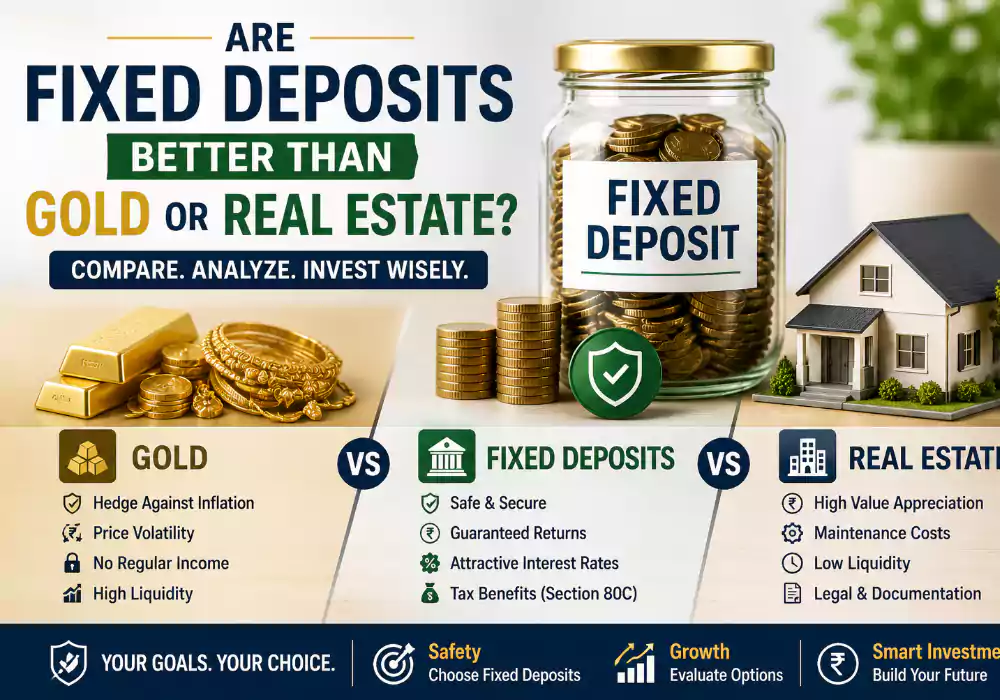
Why This Question Even Comes Up
Most of us grew up watching our parents do one of two things with extra money—buy gold for weddings and “bad times,” or buy land/property because “land never loses value.” Fixed deposits were always there too, but they were seen as boring. The thing your dad puts money in and forgets about.
Now, with FD interest rates actually looking attractive again (some banks and NBFCs were offering 7-7.5% on 1-3 year FDs as of early 2026), and gold prices having gone on a wild run, and real estate prices in a lot of cities feeling either overheated or stuck depending on where you look—people are genuinely confused about where to park their money.
There’s no universal “best” answer here. But there is a way to think about it that actually helps you decide for YOUR situation. Let me break down what I’ve actually experienced with each one.
My Experience With Fixed Deposits
I opened my first FD when I was 24, mostly because my dad told me to. I put in ₹50,000 for one year at around 6.5% interest. When it matured, I got about ₹53,250 back. Nothing exciting happened. No drama. That’s basically the whole point of an FD.
Over the years, I’ve used FDs for a few specific things:
Emergency fund parking. I keep about 6 months of expenses in a mix of savings account and short-term FDs (like 91-day or 6-month FDs) that I can break if needed. Banks like HDFC, ICICI, and SBI all let you break an FD early, though you lose some interest as penalty—usually around 0.5-1%.
Tax-saving FDs. I did a 5-year tax-saver FD once under Section 80C. Lesson learned the hard way—these are LOCKED for 5 years, no breaking them early, no exceptions. I needed that money for a medical situation in year 3 and couldn’t touch it. Big mistake. Now I only put money in tax-saver FDs that I’m 100% sure I won’t need.
Laddering for predictable goals. When I knew I’d need money for my sister’s wedding in roughly 2 years, I split the amount into three FDs of different tenures (1 year, 18 months, 2 years) so they’d mature around the time I needed cash, instead of locking everything for 2 years straight.
The Honest Pros of FDs
- You know EXACTLY what you’ll get on day one. No guessing.
- Covered by DICGC insurance up to ₹5 lakh per bank per depositor—so even if the bank goes under, your money (up to that limit) is safe.
- Super easy to open now—I did one entirely through the SBI YONO app in about 4 minutes.
- No emotional stress. You’re not checking prices every day like with gold or stocks.
The Honest Cons
- Returns barely beat inflation, sometimes don’t beat it at all after tax. If you’re in the 30% tax bracket, a 7% FD effectively gives you about 4.9% post-tax. If inflation is running at 5-6%, you’re basically treading water or losing real value.
- TDS kicks in if interest crosses ₹40,000 in a year (₹50,000 for senior citizens), which means more paperwork at tax time.
- It feels “safe” but that safety comes at the cost of growth. Your money isn’t really working hard for you.
My Experience With Gold
Gold is interesting because in India, it’s never JUST an investment—it’s emotional, cultural, all of that. My mom has gold that was given to her at her wedding, and she’ll never sell it no matter what the price does. That’s not an investment decision, that’s sentiment, and that’s fine.
But I’m talking about gold as an investment here, separate from jewelry.
In 2019, I bought Sovereign Gold Bonds (SGBs) through Zerodha during one of the RBI tranches. I put in about ₹1 lakh. These bonds give you 2.5% annual interest PLUS the price movement of gold, AND if you hold till maturity (8 years), the capital gains are tax-free. That last part is honestly one of the best-kept secrets in Indian investing.
Gold has had an incredible run—prices have moved up significantly over the past few years due to global uncertainty, central banks buying gold, and a weaker rupee. My SGB investment has appreciated nicely, on paper.
But here’s what I learned:
Physical gold has hidden costs. When my wife wanted to buy gold coins for an occasion, we went to a local jeweler. The “making charges” and slight price markup meant we were paying roughly 8-10% more than the actual gold price. Selling it back later, the jeweler offered less than what we paid, even though gold prices had gone UP. There’s always a buy-sell spread eating into your returns with physical gold.
Digital gold isn’t always what it seems. I tried digital gold through a popular payment app once—buying small amounts over a few months. It was convenient, but I later read that digital gold platforms in India aren’t directly regulated by SEBI or RBI the way mutual funds or SGBs are. I eventually moved that money into a Gold ETF instead, which trades on the stock exchange and is more transparent.
Gold ETFs are the easiest way I’ve found. Something like Nippon India ETF Gold BeES—you buy it through your regular demat account just like a stock, no storage worry, no purity concerns, and you can sell anytime during market hours.
The Honest Pros of Gold
- Acts as a hedge—when stock markets crash or there’s global tension, gold often goes up. It balanced out my portfolio nicely during a rough patch in 2022.
- Liquid—you can sell gold (ETF or even jewelry) relatively quickly compared to real estate.
- SGBs give extra interest on top of price appreciation, plus tax-free gains at maturity.
- Doesn’t require huge capital—you can start with even ₹5,000-10,000.
The Honest Cons
- Gold doesn’t “produce” anything. A company can grow profits, a property can earn rent—gold just sits there hoping its price goes up.
- Physical gold has making charges, storage risk (I keep mine in a bank locker, which costs ₹2,000-3,000/year), and purity concerns.
- Prices can be flat for YEARS. Between 2013 and 2018, gold prices in India barely moved. People who bought at the 2012 peak felt stuck for almost a decade.
- SGBs have an 8-year lock-in for full tax benefit (though there’s an exit window after 5 years).
My Experience With Real Estate
Okay, this is where I have my most painful and most rewarding stories at the same time.
In 2018, my wife and I bought a small 2BHK flat in a developing suburb near Pune. We took a home loan from HDFC for about 70% of the value. At the time, everyone said “property prices always go up, you can’t lose.”
Reality check: for the first 4 years, the value of that flat barely moved. Some neighboring projects even had unsold inventory, which kept resale prices suppressed. Meanwhile, I was paying EMI, society maintenance, property tax, and doing repairs—all while the asset wasn’t “growing” in any visible way.
Then around 2023-2024, infrastructure development picked up nearby (a metro line extension got approved), and suddenly the same flat’s value jumped quite a bit. So in hindsight, it worked out—but it took almost 6 years, and a LOT of that gain was due to factors completely outside my control (government infra projects), not anything I did.
I also tried buying a small plot of land separately as an “investment” in 2021. That one has been a headache. Here’s why:
Real estate isn’t liquid at all. I’ve had this land listed for sale for almost 8 months now. We’ve had a few lookers, two “serious” buyers who backed out at the last moment over price negotiation, and it’s just sitting there. If I needed that money urgently, I’d be stuck.
There are ongoing costs even when you’re not living there. Property tax, basic maintenance to keep the land from being encroached (yes, this is a real thing—we had to put up a boundary fence after hearing about land disputes in the area), and occasional travel just to “check on it.”
Paperwork and legal verification matter A LOT. Before buying, I paid a local lawyer about ₹8,000 to verify the title, check for any loans/disputes on the land, and confirm the seller’s ownership. This felt like an unnecessary expense at the time, but I’ve heard horror stories of people buying land that had pending litigation or was sold to multiple buyers. That ₹8,000 was probably the smartest money I spent in that whole deal.
The Honest Pros of Real Estate
- Tangible—you can see it, touch it, sometimes live in it or rent it out.
- Can generate rental income on top of price appreciation (my flat is now rented out for about 4% of its value annually, on top of whatever the property itself appreciates).
- Leverage—you can buy a ₹50 lakh property with a ₹15 lakh down payment using a home loan, which means your actual returns on YOUR money can be amplified if prices go up.
- Often appreciates well in areas with genuine infrastructure development.
The Honest Cons
- Very illiquid. Selling can take months, sometimes years.
- High transaction costs—stamp duty, registration (often 5-7% of property value combined), brokerage if you use an agent (usually 1-2%).
- Maintenance, property tax, and legal hassles are ongoing.
- Prices don’t ALWAYS go up. Plenty of areas have stagnant or even declining property values, especially overbuilt suburbs or areas where promised infrastructure never materialized.
- Hard to diversify—putting ₹50 lakh into one property means all your eggs are in one (literal) basket, in one location.
So… Which One Is Actually “Better”?
Here’s the thing I told my uncle, and I genuinely believe it: the question isn’t which one is better, it’s which one is better FOR WHAT PURPOSE.
Let me break this down with a simple way to think about it:
If you need the money within 1-3 years:
Go with FDs (or a mix of FDs and liquid mutual funds). You need certainty and liquidity, not growth potential. Gold and real estate are both too unpredictable in short windows.
If you want a hedge against inflation/crisis and some liquidity:
Gold (preferably ETFs or SGBs, not piles of jewelry) makes sense as 5-10% of your overall portfolio. Not more than that, in my opinion, because it doesn’t generate income.
If you have a large lump sum, a long time horizon (7+ years), and you’re okay with illiquidity:
Real estate can work, but ONLY if you’re buying in an area with real growth drivers—upcoming infrastructure, job creation, population growth. Don’t buy land “because it’s cheap” in some far-off area hoping it’ll magically become valuable.
If you’re building an emergency fund:
100% FD or a liquid fund. Don’t even think about gold or real estate for this. You need this money to be there, untouched, predictable, whenever life throws a curveball.
Step-by-Step: How I’d Actually Allocate Money Today (If I Were Starting Fresh)
If someone handed me, say, ₹10 lakh today and asked me to split it sensibly, here’s roughly how I’d think about it (this isn’t financial advice tailored to YOUR situation—just how I personally reason through it):
Step 1: Set aside 3-6 months of expenses first. This goes into a savings account or short-term FD. Non-negotiable, do this before anything else.
Step 2: Decide your time horizon for the remaining money. Is this for retirement 25 years away? A house down payment in 5 years? A goal in 1-2 years?
Step 3: For short-term goals (under 3 years), use FDs or debt mutual funds. Predictability matters most here.
Step 4: For medium to long-term goals, consider a mix. Personally, I keep a small slice (around 5-10%) in gold ETFs/SGBs as a hedge, a chunk in equity mutual funds (via SIPs through apps like Groww or Coin by Zerodha) for growth, and FDs for the stable portion.
Step 5: Only consider real estate if you have a large enough corpus that buying property doesn’t mean putting ALL your money into one illiquid asset. As a rough personal rule, I wouldn’t put more than 40-50% of my net worth into one property, no matter how good the deal looks.
Step 6: Review once a year, not every day. I check my FD maturity dates, gold ETF value, and property situation maybe once or twice a year. Checking daily just creates anxiety, especially with gold and stock-linked investments.
Common Mistakes I’ve Seen (and Made)
1: Putting everything into one asset class because it did well recently. When gold rallies, everyone wants gold. When property prices jump in a city, everyone wants to buy there. This is just chasing recent performance, and it usually backfires.
2: Ignoring the tax angle. FD interest is taxed at your slab rate every year, even if you don’t withdraw it. SGBs held to maturity are tax-free on gains. Real estate has indexation benefits on long-term capital gains (if held over 24 months) which can significantly reduce tax. These differences add up a LOT over time, and most people don’t factor this in until tax season hits them.
3: Underestimating the “hidden” costs. With gold, it’s making charges and storage. With real estate, it’s stamp duty, registration, brokerage, maintenance, and property tax. With FDs, it’s the tax on interest eating into real returns. None of these investments are as “clean” as they look on paper.
4: Buying land/property based on a “tip” without verification. I cannot stress this enough—get a lawyer to check the title documents, encumbrance certificate, and ownership history before paying even a token amount. The ₹5,000-10,000 you spend on legal verification is nothing compared to what you could lose in a fraudulent or disputed deal.
5: Locking money in tax-saver FDs or SGBs without checking the lock-in period. I learned this one personally and it genuinely caused stress during a tight financial month. Always read the lock-in terms BEFORE investing, not after.
6: Treating gold jewelry as an “investment.” It’s fine to own jewelry for personal/cultural reasons, but don’t count on it as part of your investment portfolio’s growth—the making charges alone usually mean you’re starting at a loss compared to the actual gold price.
What I Told My Uncle
In the end, here’s roughly what we worked out for him. He had about ₹25 lakh from his retirement payout. We split it like this:
- ₹6 lakh into FDs across two banks (staying under the ₹5 lakh DICGC insurance limit per bank) for guaranteed monthly interest income, since he needed regular cash flow.
- ₹3 lakh into Gold ETFs, mainly as a hedge, since he already has some family jewelry he doesn’t want to touch.
- The remaining ₹16 lakh stayed in a mix of debt mutual funds and a senior citizen savings scheme (SCSS), which currently offers a solid government-backed interest rate with quarterly payouts.
He didn’t buy any new property, and honestly, at his age and with his need for regular income, that made sense. Real estate would’ve tied up his money when he needs steady cash flow the most.
1. Is FD safer than gold and real estate?
Yes, FDs are the safest as they provide guaranteed returns with minimal risk.
2. Which investment gives highest returns?
Real estate and gold may offer higher returns than FDs, but with higher risk.
3. Can I invest in all three options?
Yes, diversification helps reduce risk and improve overall returns.
4. Is gold better than FD during inflation?
Yes, gold performs better during inflation, while FD returns may lag.
5. Is real estate a good investment in India?
Yes, for long-term investors with sufficient capital and patience.