
The Rise of UPI in Everyday Life
A few years ago, most of us still carried enough cash to pay for groceries, tea, fuel, and small purchases. Today, many people step out of their homes carrying nothing more than a smartphone. A quick QR scan has replaced digging through wallets for change. Whether it is a cup of coffee, a vegetable purchase, a cab ride, or a utility bill, UPI has become the preferred payment method for millions of Indians.
The numbers behind this growth are staggering. UPI processed more than 228 billion transactions in 2025 and handled nearly ₹300 trillion worth of payments, showing just how deeply it has become integrated into daily life. UPI now accounts for the overwhelming majority of digital payment volumes in India. These figures highlight a major shift in consumer behavior, where digital payments are no longer an alternative but the default choice.
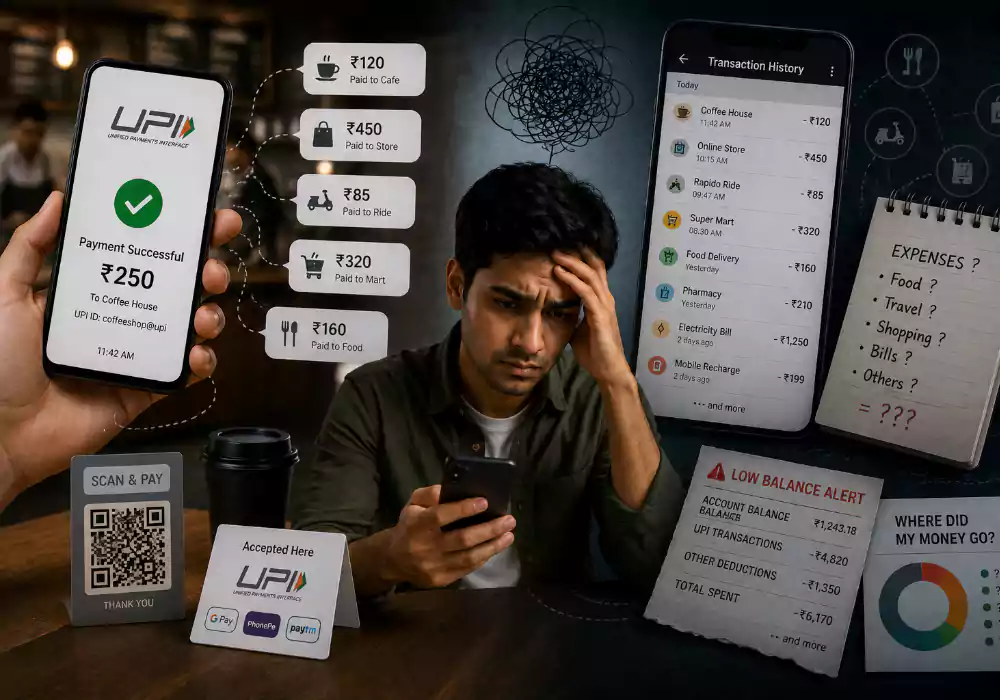
The convenience is undeniable. You can send money instantly, split bills, pay merchants, and transfer funds without visiting a bank or ATM. Yet this convenience comes with a hidden challenge that many people discover only when reviewing their bank balance at the end of the month. Spending through UPI often feels invisible compared to spending physical cash. That is exactly why so many people wonder where their money went despite making only “small” purchases throughout the month.
How UPI Became the Default Payment Method
The success of UPI is rooted in simplicity. Instead of entering long account numbers, people can pay using mobile numbers, QR codes, or UPI IDs. This reduced friction dramatically. Small merchants, roadside vendors, local stores, and large retailers all adopted the technology.
As acceptance grew, consumer habits changed. Paying digitally became faster than paying with cash. The result was a complete transformation of spending behavior. Today, even purchases worth less than ₹20 are commonly completed through UPI.
The Convenience That Changed Spending Habits
Convenience changes behavior more than most people realize. When something becomes easier, we naturally do more of it. UPI has removed many of the barriers that once made us pause before spending.
Earlier, if you had ₹500 in your wallet, you could physically see your remaining money shrinking throughout the day. Now, a few taps complete a transaction, and the psychological impact is much smaller. This creates a situation where spending feels painless, even though the financial impact remains the same.
Why Tracking Cash Was Easier for Many People
Many people assume that digital records should make tracking spending easier than cash. In theory, that is true. Every UPI transaction leaves a record. Yet in practice, many users find it harder to understand where their money goes.
The reason is psychological. Cash creates a visible and tangible experience. Handing over currency creates a stronger sense of loss than scanning a QR code. Behavioral finance researchers often refer to this as the “pain of paying.” When that pain decreases, spending tends to increase.
I noticed this myself when I switched almost entirely to digital payments. My monthly expenses did not explode overnight. Instead, dozens of tiny purchases quietly accumulated. Snacks, subscriptions, convenience purchases, food deliveries, and impulse buys gradually increased without attracting attention.
The Psychological Impact of Physical Money
Physical money forces awareness. You count it, organize it, and watch it disappear. UPI removes these visual cues. While this makes transactions smoother, it also makes them easier to forget.
That forgotten spending often becomes the biggest reason people struggle to track their finances accurately.
The Hidden Challenge of Frictionless Payments
One of the greatest strengths of UPI is also one of its biggest budgeting challenges. Payments happen almost instantly. There is no waiting period, no card swipe delay, and no need to count cash.
This frictionless experience encourages frequent micro-spending. A ₹30 tea, a ₹60 snack, a ₹120 ride, and a ₹250 food order may seem insignificant individually. Combined across weeks, they can become a surprisingly large amount.
Tiny Transactions Add Up Quickly
Many people focus only on large expenses such as rent, EMIs, insurance premiums, and utility bills. Yet financial leaks often occur through small daily purchases.
Imagine spending:
| Expense | Daily Cost | Monthly Cost |
|---|---|---|
| Tea & Snacks | ₹80 | ₹2,400 |
| Online Food Orders | ₹150 | ₹4,500 |
| Impulse Shopping | ₹100 | ₹3,000 |
Suddenly, seemingly harmless purchases add up to nearly ₹10,000 a month.
Multiple Apps Create Multiple Records
Another challenge is fragmentation. Some people use Google Pay, PhonePe, Paytm, bank apps, and credit card-linked UPI accounts simultaneously.
When spending data is scattered across multiple platforms, gaining a complete picture becomes difficult. Reviewing only one app often provides an incomplete view of total spending.
My Personal Experience With UPI Overspending
I remember checking my bank statement after a particularly busy month and feeling confused. I had not purchased any expensive gadgets or taken a vacation. Yet my savings were noticeably lower.
After reviewing my UPI history, the answer became obvious. The issue was not a single large purchase. It was hundreds of small ones.
Coffee meetings. Quick grocery stops. Ride-hailing services. Last-minute online orders. Digital subscriptions. Convenience purchases.
Individually, each transaction looked harmless. Together, they represented a significant portion of my monthly budget.
Small Payments That Escaped Attention
What surprised me most was how many transactions I had forgotten entirely. Because each payment took only seconds, many never registered as meaningful expenses.
That experience taught me that awareness is often more important than income when managing money effectively.
Common Reasons UPI Spending Feels Harder to Track
Frequent Low-Value Purchases
Small purchases rarely trigger concern. Most people question a ₹5,000 expense. Few question a ₹50 expense. Yet recurring low-value purchases can create substantial monthly costs.
AutoPay and Recurring Payments
Many streaming services, memberships, and utility payments now use UPI AutoPay. These automatic deductions are convenient but easy to overlook.
Months can pass before someone realizes they are paying for services they rarely use.
Split Spending Across Platforms
When spending occurs through multiple apps and accounts, visibility decreases. Tracking becomes more complicated because no single dashboard captures everything.
Lack of Real-Time Budget Monitoring
Most users check account balances rather than spending categories. Knowing your balance is helpful, but it does not explain where your money went.
Without category-based tracking, spending patterns remain hidden.
Signs Your UPI Spending Is Getting Out of Control
Certain warning signs indicate that digital spending may be becoming difficult to manage.
Monthly Account Surprises
If you regularly wonder why your bank balance is lower than expected, that is often a signal that spending awareness needs improvement.
Growing Number of Impulse Purchases
Impulse purchases thrive in frictionless environments. When buying something requires only a few taps, the decision-making process becomes shorter.
If you frequently purchase items you did not plan to buy, it may be time to review your spending habits more closely.
How to Track UPI Spending Effectively
The good news is that UPI spending can be managed effectively with a few simple systems.
Step 1 – Review Weekly Transaction History
Instead of waiting until month-end, spend 10 minutes each week reviewing transactions.
Look for:
- Repeated purchases
- Unexpected charges
- Subscription renewals
- Impulse spending patterns
Weekly reviews prevent small issues from becoming large problems.
Step 2 – Categorize Expenses
Create categories such as:
- Food
- Transportation
- Shopping
- Bills
- Entertainment
- Health
- Savings
Categorization reveals spending patterns that raw transaction lists cannot show.
Step 3 – Set Spending Limits
Assign monthly limits to discretionary categories.
For example:
| Category | Monthly Limit |
| Food Delivery | ₹3,000 |
| Entertainment | ₹2,000 |
| Shopping | ₹4,000 |
Limits provide clear boundaries and improve decision-making.
Step 4 – Use Budgeting Tools
Many apps now automatically analyze bank transactions and generate spending reports.
Useful options include:
- Google Pay spending insights
- PhonePe transaction history
- Bank-provided expense trackers
- Personal finance apps
These tools simplify monitoring and reduce manual effort.
Best Apps and Tools for Monitoring UPI Expenses
Technology that enables spending can also help control it.
Google Pay offers transaction records and spending history. PhonePe provides detailed payment logs. Many banking applications now include expense categorization and spending analytics.
Some users also prefer dedicated budgeting applications that connect multiple accounts and provide a consolidated financial view.
The key is consistency. Even the best tool becomes ineffective if it is used only occasionally.
Mistakes People Make While Managing UPI Payments
One common mistake is assuming that small transactions do not matter. Over time, these purchases often create the largest budget leaks.
Another mistake is ignoring transaction notifications. Many people swipe away alerts without reviewing them. Those alerts can serve as valuable reminders of spending activity.
A third mistake is relying solely on memory. Human memory is surprisingly unreliable when it comes to daily financial decisions. Records are always more accurate than recollections.
Some people also fail to separate needs from convenience spending. Just because a payment is easy does not mean it is necessary.
Creating a Sustainable Digital Spending System
The goal is not to stop using UPI. Digital payments save time, improve convenience, and simplify many aspects of financial life. The objective is to combine convenience with awareness.
A practical system might include:
- Weekly transaction reviews.
- Monthly category analysis.
- Spending limits for discretionary purchases.
- Subscription audits every three months.
- Automatic transfers to savings immediately after salary credit.
These habits create visibility without requiring excessive effort.
As UPI continues expanding across India, awareness becomes increasingly important. UPI processed more than 24,000 crore transactions during FY 2025-26 and now handles roughly 85% of India’s digital payment volume, demonstrating how central it has become to everyday financial activity.
1. Why does UPI spending feel less painful than cash spending?
UPI payments feel less painful because digital transactions remove the physical experience of handing over money. This reduces emotional awareness during purchases.
2. How can I track my UPI expenses better?
You can use budgeting apps, review bank statements weekly, categorize expenses, and set spending limits for better financial control.
3. Are cashback rewards encouraging overspending?
Yes, cashback rewards often create psychological incentives that encourage users to spend more frequently than necessary.
4. What is budget leakage in digital payments?
Budget leakage refers to small repeated expenses that slowly drain savings without users realizing the total impact.
5. Which calculators should I interlink in finance articles?
You can interlink tools like:
- Savings Goal Calculator
- Budget Calculator
- SIP Calculator
- Emergency Fund Calculator
- Debt Payoff Calculator