
I didn’t notice it happening. That’s the part nobody warns you about.
One month, my bank statement looked fairly normal. Three months later, I was staring at a credit card bill wondering where an extra $400 had gone. No big purchases. No emergencies. Just a string of small “yeses” I’d said to things I saw while scrolling — a skincare set here, a kitchen gadget there, a discount code from someone I follow who does workout videos.
That’s when it hit me: my phone wasn’t just eating my time anymore. It was quietly eating my budget too.
If you’ve ever opened a banking app and thought “wait, when did I buy that?” — this article is for you. I’m going to walk through how social media actually changes spending behavior, why it works on basically everyone (not just impulsive people), and the exact steps I used to get my money back under my control without deleting every app and living like a hermit.
It’s Not Just “Ads.” It’s Something Sneakier
When people think about social media and money, they usually picture banner ads or sponsored posts. Those exist, sure. But the bigger shift is quieter than that.
It’s the way a platform learns your habits and slowly nudges your decisions without ever feeling like a sales pitch.
Think about the last time you watched a string of short videos. One person shows their morning routine. Another shows a “get ready with me” using a specific brand. Another casually mentions a product mid-story, almost like a friend would. None of it feels like an advertisement. It feels like content. That’s exactly why it works so well.
Traditional advertising asks for your attention directly. Social media spending influence sneaks in disguised as entertainment, recommendation, or community.
Why Our Brains Fall For This (Even Smart, Careful People)
I used to think I was too financially aware to fall for this stuff. I track my expenses. I use a budgeting app. I’ve read personal finance books. And yet, my spending crept up anyway.
Here’s the psychology behind it, in plain language:
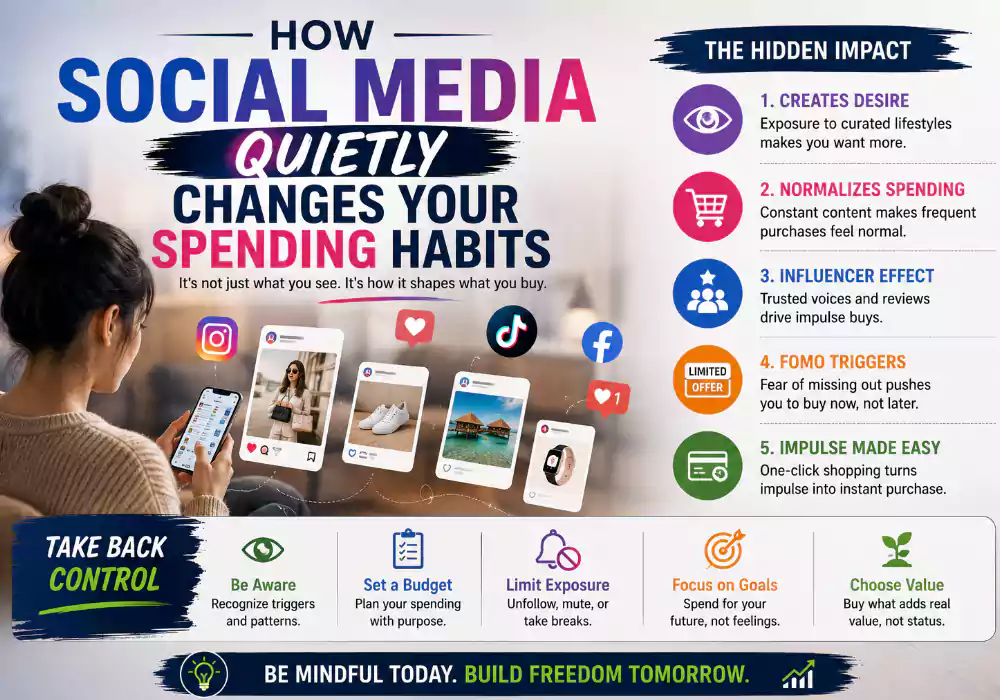
1. Social proof feels safer than it should. When you see dozens of people using or praising a product, your brain treats that as evidence it’s worth buying — even though those posts are often paid placements, not honest reviews.
2. FOMO is engineered, not accidental. Phrases like “selling out fast,” “back in stock for 24 hours,” or countdown stickers on Stories create urgency. Urgency shuts down the part of your brain that normally pauses to ask, “Do I actually need this?”
3. Frictionless buying removes your natural pause. In the past, you’d see a product, then have to go find it, compare prices, and check out separately. Now you tap once, your saved card info fills in, and the purchase is done in seconds. That tiny gap where you used to reconsider? It’s gone.
4. Influencers feel like friends, not salespeople. You don’t ignore a friend’s suggestion the way you’d ignore a billboard. Influencer marketing exploits that trust, even when there’s a disclosed partnership.
5. Dopamine hits keep you scrolling — and buying. Every like, comment, or “ooh that’s cute” reaction gives a small dopamine boost. Adding “buy” to that loop just extends the reward cycle.
None of this means you’re weak-willed or bad with money. It means the system is built to work on basically anyone with a phone and a thumb.
The Platform Features Quietly Driving This
Once I started paying attention, I noticed the specific features designed to turn scrolling into spending. Here are the big ones.
Instagram and Facebook Shopping Tags
Posts with little shopping bag icons let you tap straight into a product page without leaving the app. It feels casual, almost like window shopping — except there’s no walking away and “thinking about it” on the drive home.
TikTok Shop
This one caught me off guard the most. A video about a “life-changing” kitchen tool or skincare item leads straight into a shoppable cart, often with limited-time pricing shown right on screen. The entertainment and the sales pitch are stitched together so tightly it’s hard to tell where one ends and the other begins.
Pinterest “Shop the Look”
Pinterest already feels like planning mode — moodboards, wishlists, home makeovers. That mindset makes you more open to spending because you’re already imagining yourself owning the thing.
Influencer Discount Codes
A code like “SARAH15” feels personal, like you’re getting an insider deal. In truth, it’s a tracking tool that tells the brand exactly how many sales came from that creator — and it nudges you to buy now rather than wait.
Buy Now, Pay Later (BNPL) Integration
Apps like Klarna, Afterpay, and Affirm are increasingly built directly into checkout flows from social ads. Splitting a $120 purchase into four $30 payments makes it feel smaller than it is. I’ve made this mistake myself — three “small” BNPL payments stacked up to more than I would have spent on one upfront purchase, and I almost forgot about a couple of them entirely.
Algorithmic Retargeting
Look at a pair of shoes once, and suddenly they follow you across three different apps for a week. This isn’t a coincidence — it’s a system designed to wear down your hesitation through repetition.
My Own Wake-Up Call (and the Mistake That Triggered It)
Here’s the moment that made me sit up and actually deal with this.
I follow a handful of fitness creators because, well, I enjoy working out and like seeing new routines. One of them posted about a recovery tool — a fancy massage gun — with a “today only” discount code.
I didn’t research other brands. I didn’t check reviews outside the comment section (which, by the way, is often filled with replies from the brand’s own marketing team or bots). I just bought it because the urgency felt convincing and the creator felt trustworthy.
It arrived. It was fine. Not amazing, not bad — just fine. A similar tool, with better reviews, was sitting on a general retail site for less money, with no rush, no countdown clock.
That single purchase wasn’t the actual problem. The pattern was. Once I looked back over three months, I counted eleven similar “spontaneous yes” purchases triggered directly by something I scrolled past. None individually huge. Together, they added up to more than my entire grocery budget for a month.
That was my lesson: social media spending damage rarely comes from one big mistake. It comes from a dozen small ones you don’t add up until you’re forced to.
A Few Everyday Scenarios You’ll Probably Recognize
Once I started noticing this pattern in my own life, I started noticing it everywhere — in conversations with friends, in comment sections, even in casual chats at the gym. A few scenarios kept coming up over and over.
The fitness supplement loop. A trainer posts a transformation video with a protein powder or pre-workout tucked into the caption. The before-and-after photos do the persuading; the product just happens to be along for the ride. A friend of mine bought four different “fat-burning” supplements over six months, all from different creators, none of which she finished. That’s easily $150 to $200 spent chasing a result that mostly comes down to sleep, food, and consistency — none of which come in a tub with a discount code.
The investing-app referral push. Finance content on social media has exploded, and a lot of it is genuinely educational. But a chunk of it is referral-driven — creators get paid when you sign up for a trading app or a credit card through their link. I’ve clicked a few of these links myself out of curiosity, and the onboarding flow is built to get you to deposit money fast, often with a “bonus” for funding your account within 24 to 48 hours. That urgency is the same playbook as a flash sale, just wearing a suit.
The Pinterest home makeover spiral. This one is sneaky because it doesn’t feel like shopping — it feels like planning. You save a few images of a cozy living room, then somehow you’re three tabs deep comparing throw pillows you didn’t know you wanted twenty minutes ago. Pinterest’s “shop the look” buttons turn inspiration boards into shopping carts without much friction in between.
The “doctor-approved” health product clip. Short health and wellness clips often borrow credibility from someone in scrubs or a lab coat, even when the product being promoted has little independent evidence behind it. I’ve fallen for this with a sleep gummy that did roughly nothing besides taste like candy. The packaging looked legitimate. The science behind the claims, when I actually looked it up later, was thin at best.
None of these examples mean the products are scams or the creators are dishonest. It just means the format — short, emotionally engaging, time-pressured — is built to skip the part of decision-making where you’d normally compare options or sleep on it.
A Short Experiment That Made the Pattern Obvious
After my massage gun moment, I ran a small experiment for one week, mostly out of curiosity rather than discipline.
Each night, I wrote down two numbers: my total screen time on shopping-enabled apps, and anything I’d added to a cart or bought that day, even if I didn’t complete the purchase.
By day three, the connection was hard to ignore. On the two days with the highest screen time (both over two and a half hours on Instagram and TikTok combined), I’d added something to a cart both times. On the two lowest screen-time days, I added nothing and spent nothing extra.
It wasn’t a scientific study — just one person, one phone, one week. But it lined up with what researchers studying digital marketing have found for years: more exposure to shoppable content reliably increases impulse buying, even when people don’t feel like they’re being sold to.
That little experiment is honestly what convinced my brain, not just my budgeting app. Numbers on a spreadsheet are persuasive, but watching the pattern play out day by day made it impossible to brush off as a coincidence.
Step-by-Step: How I Audited My Social Media Spending
If you want to actually fix this instead of just feeling guilty about it, here’s the process that worked for me. It takes about 30–45 minutes total, spread across a week.
Step 1: Pull three months of transactions
Open your banking app or credit card statement. Go back at least 90 days. You’re not judging yourself here — just collecting data.
Step 2: Tag anything tied to a social platform
Mark any purchase that started because you saw it on Instagram, TikTok, Pinterest, YouTube Shorts, or through an influencer code. Be honest, even if it feels small.
Step 3: Add up the total
This is the part that usually shocks people. For me, it was around $380 over three months — money I hadn’t planned for and barely remembered spending.
Step 4: Identify the trigger pattern
Was it late-night scrolling? Stress scrolling after a rough day? Lunch break boredom? My biggest trigger was scrolling in bed before sleep — low willpower, high suggestibility.
Step 5: Mute or unfollow the worst offenders
You don’t need to quit social media. You just need to remove the specific accounts that consistently push products at you. I unfollowed two accounts and muted (not unfollowed, just muted) three more that I still wanted to see occasionally but not constantly.
Step 6: Turn off saved payment information on shopping-enabled apps
This single step alone cut my impulse purchases significantly. When checkout requires manually typing your card number, that tiny bit of friction gives your brain a chance to ask, “Do I want this enough to do this extra step?”
Step 7: Set a 24-hour rule for anything over $25
If something catches your eye, save it to a wishlist or screenshot it, then wait a day. About 70% of the time, I simply forgot about it or lost interest. That’s a strong signal it wasn’t a need — it was a moment of persuasion.
Step 8: Create a small “fun spending” budget
Instead of trying to ban all spontaneous purchases (which never works long-term for me), I set aside $50 a month specifically for impulse buys. It removes the guilt and keeps spending contained to a number I’ve already approved.
Tools and Apps That Actually Helped
I’m not someone who believes an app alone fixes a habit, but the right tool makes the process easier to stick with.
- YNAB (You Need A Budget): Helped me categorize “social media impulse” as its own line item, which made the pattern impossible to ignore.
- Rocket Money: Good for spotting recurring subscriptions you forgot you signed up for through an ad or influencer promo.
- Apple Screen Time / Android Digital Wellbeing: Set app limits specifically on the platforms where I noticed the most shopping triggers.
- A simple notes app wishlist: Sounds basic, but writing down “saw this, want this” instead of buying instantly created the pause I needed.
- Browser extensions that block one-click checkout autofill: Even disabling autofill for card details on your phone’s settings adds friction in a useful way.
None of these tools stop the marketing from existing. They just slow you down long enough to make a choice instead of a reaction.
Mistakes to Avoid
A few things I’d tell anyone starting this process, based on what tripped me up:
Don’t quit social media cold turkey expecting permanent change. I tried this once. I deleted Instagram for two weeks, felt great, then reinstalled it and fell right back into old patterns within days because I never addressed the actual triggers — just avoided them temporarily.
Don’t assume influencer recommendations are unbiased just because they “seem honest.” Even creators who genuinely like a product are often compensated to talk about it. That doesn’t make them dishonest people — it just means their opinion isn’t a neutral product review.
Don’t ignore small purchases because they “don’t count.” A $12 purchase here and there feels harmless. Eight of them in a month is almost $100 you didn’t plan for.
Don’t rely on willpower alone. Willpower runs out, especially when you’re tired, stressed, or scrolling late at night. Structural changes — removing saved cards, muting triggering accounts — work better than just “trying harder.”
Don’t shame yourself for falling for it. These systems are built by teams of people whose entire job is increasing conversion rates. Falling for persuasive design isn’t a character flaw; it’s a predictable outcome of well-designed marketing meeting an everyday brain.
A Few Questions People Ask Me About This
Is it bad to buy anything I see on social media? Not at all. Plenty of products genuinely are useful, and discovering them online isn’t the problem. The issue is buying on impulse, without comparing options or giving yourself time to think it over. The 24-hour rule mentioned earlier fixes most of that without making you avoid shopping altogether.
Should I just delete Instagram and TikTok? You can if you want a clean break, but for most people that’s not sustainable long-term. Muting specific accounts, turning off saved payment details, and setting screen time limits tend to work better because they address the actual triggers instead of avoiding the platform entirely.
How do I know if an influencer post is sponsored? Look for labels like “paid partnership,” “#ad,” or “sponsored” near the caption — most platforms require this disclosure by law in many countries. Even without a label, treat any post that includes a discount code or referral link as marketing, not a neutral opinion.
What if I already have debt from impulse purchases? Start by tallying what’s tied to social media specifically, separate from other debt. Seeing that number broken out tends to motivate change faster than a vague sense of “I spend too much.” From there, tackling it with a normal debt payoff plan — smallest balance first, or highest interest first — works the same way it would for any other balance.
Do ad blockers or “no-shopping” browser extensions actually help? They help a little, mostly by removing visual clutter and some tracking-based retargeting ads. But most social media shopping happens inside the app itself, not through banner ads, so the bigger wins come from account-level changes like muting, screen time limits, and removing saved cards.
Building Habits That Actually Last
Once the initial audit is done, the goal shifts from “fixing a problem” to maintaining awareness long-term. A few things that have stuck for me:
- I check my “social media spending” tag in my budgeting app once a month, just to catch patterns early.
- I follow fewer shopping-heavy accounts and more accounts that genuinely interest me without a sales angle.
- I treat any “limited time” or “selling out fast” message as a signal to slow down, not speed up.
- I keep that small fun-money budget so I don’t feel deprived, which honestly makes it easier to ignore the rest.
The goal isn’t to never buy anything you see online. Some of those products are genuinely useful, and discovering them through social media isn’t inherently bad. The goal is making sure you’re the one deciding to buy — not a countdown timer, a trusted-looking face, or a frictionless checkout button deciding for you.
1. Does social media really affect spending habits?
Yes, social media strongly influences spending habits through targeted advertising, influencer marketing, and emotional triggers. Platforms are designed to encourage impulse buying by showing trending products, lifestyle content, and personalized ads based on user behavior. Over time, this can lead to emotional spending and poor budgeting habits.
2. Why do influencers make people spend more money?
Influencers create trust-based relationships with their audiences, which makes product recommendations feel more personal and authentic. Many followers buy products because they want to copy a lifestyle, improve social status, or follow online trends. This is a common strategy used in influencer marketing psychology and digital consumer behavior.
3. What is emotional spending?
Emotional spending happens when people shop to improve their mood instead of meeting financial needs. Stress, boredom, sadness, and social pressure are common triggers. Social media increases emotional spending by constantly exposing users to advertisements, luxury lifestyles, and shopping trends. You can also read “How to Stop Emotional Spending” for more insights.
4. How does social comparison affect financial decisions?
Social comparison makes people compare their lifestyle, income, and possessions with others online. This often creates pressure to spend more on fashion, gadgets, travel, or subscriptions just to feel successful or accepted. Over time, this behavior may lead to lifestyle inflation and reduced savings.
5. Why is impulse buying more common on social media?
Social media platforms use fast scrolling content, flash sales, and one-click shopping features that encourage instant gratification. These systems reduce the time users spend thinking before making purchases, which increases impulse buying online and convenience spending.