

I still remember the first time my portfolio dropped 12% in a week. My stomach did that weird drop-elevator thing, and I checked my phone about forty times a day, just watching the numbers turn redder. That was a few years back, during one of those sudden corrections that show up out of nowhere – one day everything’s fine, and the next, financial news channels are using words like “bloodbath” and “meltdown.”
Back then, my first instinct was to do what most beginners do – panic, freeze, or worse, sell. I didn’t sell everything, thankfully, but I did stop my SIPs (systematic investment plans) for two months because I was scared the market would keep falling. Looking back, that was probably one of the costliest mistakes of my investing life, not because I lost money, but because I missed out on buying good assets at a discount.
It took me a few more corrections – and a lot of reading, mistakes, and conversations with people smarter than me – to understand something simple but powerful: market corrections aren’t the enemy. They’re actually one of the best opportunities for long-term investors to average their costs down and build wealth faster.
In this article, I want to walk you through exactly what I’ve learned (the hard way, mostly) about using corrections to your advantage. No jargon-heavy lectures, just practical, ground-level insights from someone who’s lived through a few of these cycles.
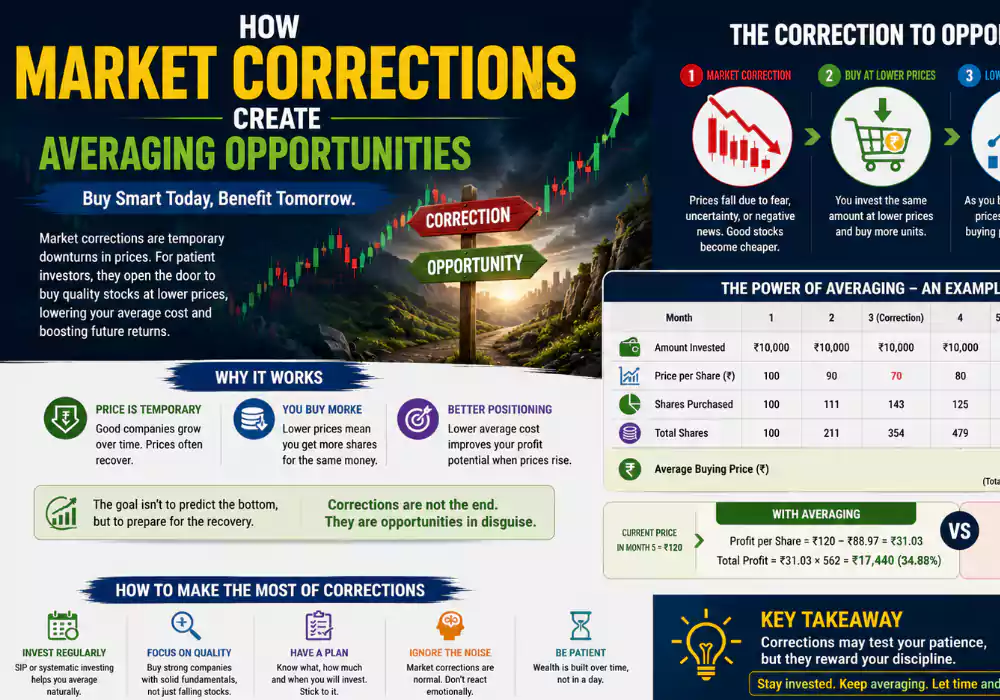
What Exactly Is a Market Correction?
Let’s keep this simple. A market correction is generally when a stock, index, or the broader market drops by 10% or more from its recent high. It’s different from a “crash” (which is sharper and faster, often 20%+ drops in a short time) and different from a full-blown bear market (a prolonged decline, usually 20%+ over months).
Corrections happen way more often than people think. If you look at historical data on indices like the S&P 500, Nifty 50, or Sensex, corrections of 10-15% happen almost every year or two. Most of the time, they recover within months, sometimes weeks.
The problem isn’t the correction itself – it’s how we react emotionally to it.
Why Corrections Are Secretly a Gift for Long-Term Investors
Here’s the mindset shift that changed everything for me: when prices fall, you’re not losing money unless you sell. What you’re actually getting is a chance to buy quality assets – stocks, mutual funds, ETFs – at a lower price than before.
Think about it like this. If your favorite grocery store suddenly put everything on a 15% discount sale, would you panic and run away? No, you’d probably stock up on the things you already use and trust.
The stock market works the same way, except most people do the opposite of what they’d do at a grocery store. They buy more when prices are high (because everyone’s excited) and sell or stop buying when prices are low (because everyone’s scared).
This is exactly where “averaging” comes in.
What Does “Averaging” Actually Mean?
In simple terms, averaging means buying more units of an investment when the price drops, which brings down your average purchase cost over time.
Let’s say you invest ₹10,000 a month into an index fund.
- Month 1: NAV is ₹100 → you get 100 units
- Month 2: Market corrects 15%, NAV drops to ₹85 → you get about 117 units
- Month 3: NAV recovers to ₹95 → you get about 105 units
Your average cost per unit across these three months works out lower than if the price had simply stayed flat the whole time. When the market eventually recovers and grows, your overall returns end up better because you bought extra units during the dip.
This is the magic of what’s commonly called “averaging down” or, in SIP language, “rupee cost averaging” (or “dollar cost averaging” if you’re investing in US markets).
My Own Experience With Averaging During a Correction
I’ll share a specific example from my own portfolio, just to make this less theoretical.
A while back, I had been investing in a Nifty 50 index fund through a monthly SIP. The market went through a correction of around 18% over about six weeks due to global uncertainty (rate hikes, geopolitical tension – you know the usual suspects).
Instead of pausing my SIP like I’d done the first time I experienced something like this, I did the opposite. I kept my regular SIP running, and I also added a lump sum I had been saving in my emergency fund’s “extra” bucket – using money I didn’t need anytime soon – to top up my investment during the dip.
Eighteen months later, when the market had not only recovered but moved higher, that lump sum addition had grown by over 30%, simply because I bought it cheap during the panic phase.
Compare that to the time I stopped my SIP out of fear – I literally lost out on units I could have bought cheap, and when the market recovered, I had to buy the same fund at a higher price. That mistake taught me more than any finance book ever did.
Step-by-Step: How to Use Market Corrections to Average Smartly
Okay, let’s get practical. Here’s the approach I personally follow now, step by step.
Step 1: Keep an Emergency Fund Separate From Investment Money
Before you even think about averaging during a correction, make sure you have 3-6 months of expenses saved separately in a liquid fund, savings account, or fixed deposit. This is non-negotiable.
Why? Because the worst thing you can do is invest money you’ll need soon, then be forced to sell during a downturn just to cover bills. I learned this lesson from a friend who had to sell his stocks at a loss during a correction because he needed cash for a medical emergency. Don’t let that be you.
Step 2: Continue Your Existing SIPs – Don’t Pause Them
This sounds obvious, but it’s the step most people fail at. When the market drops, the temptation to pause your SIP or systematic investment is huge. Resist it.
Your SIP is designed to buy more units when prices are low and fewer units when prices are high. Pausing it during a correction defeats the entire purpose of the strategy.
Step 3: Identify If You Have “Extra” Money to Deploy
Look at your finances and ask honestly – do I have surplus cash sitting idle that isn’t earmarked for emergencies or short-term goals? If yes, a correction can be a good time to deploy some of it gradually.
I personally keep what I call a “dip fund” – a small amount set aside specifically for buying during corrections. It’s not my emergency fund, and it’s not money I need for anything else. It just sits there until the market gives me a reason to use it.
Step 4: Average in Gradually, Not All at Once
This is where I made another mistake early on. During one correction, I put almost my entire dip fund in within two days because I was convinced the bottom had been hit. The market fell another 8% after that.
Nobody can time the exact bottom – not me, not financial experts on TV, not anyone. So instead of going all-in at once, I now spread my “extra” buying across multiple weeks. For example, if I have ₹50,000 to deploy, I might split it into 4-5 tranches of ₹10,000 each, spaced a week or two apart.
This way, even if the market keeps falling for a while, I’m averaging down further instead of feeling stuck having bought everything at one price point.
Step 5: Focus on Quality, Not Just “Cheap”
Just because something has fallen 20% doesn’t automatically make it a good buy. I’ve made the mistake of averaging into a stock simply because it looked “cheap,” only to watch it fall another 40% because the underlying business was genuinely struggling.
Corrections affect the entire market, including good companies and weak ones together. Use the dip to buy things you’d have wanted to own anyway at a fair price – index funds, established businesses with strong fundamentals, or diversified mutual funds – rather than randomly picking whatever has fallen the most.
Step 6: Track Your Average Cost
Most brokerage apps and platforms (Zerodha, Groww, Upstox, ET Money, Fidelity, Robinhood, Vanguard – whatever you use) show your average buying price for each holding. Keep an eye on this number.
Watching your average cost drop during a correction, and then watching the price recover above that average later, is honestly one of the most satisfying things in investing. It’s proof that patience and discipline pay off.
Step 7: Reassess, Don’t Obsess
You don’t need to check your portfolio every hour during a correction. I know that’s easier said than done, but constantly watching the numbers fall only adds stress without changing the outcome.
I personally check my portfolio maybe once a week during volatile periods, just enough to stay informed without letting it consume my mental energy.
Tools and Apps That Make This Easier
A few tools I’ve genuinely found useful for managing this process:
For tracking SIPs and mutual funds: Apps like Groww, ET Money, and Coin by Zerodha make it simple to see your average NAV, total invested amount, and current value at a glance.
For stocks and ETFs: Zerodha Kite, Upstox, and Robinhood (for US markets) let you see average buy price clearly on your holdings page.
For tracking overall net worth and asset allocation: Apps like INDmoney or Kuvera (in India) and Personal Capital / Empower (in the US) give a bird’s-eye view across all your investments, which helps you decide how much “extra” money you can deploy during a dip without messing up your overall allocation.
For setting up automatic SIPs that won’t get paused emotionally: Most brokers and AMCs let you set up auto-debit SIPs. Honestly, automating this removes the emotional decision-making entirely, which is a good thing during volatile times.
A Simple Example to Make This Click
Let’s say two people, Priya and Rohan, both invest ₹5,000 a month in the same index fund for a year.
The market has a rough patch in months 4 through 7, falling about 20% before recovering by month 12.
Priya keeps investing every month, no matter what.
Rohan panics in month 4, stops his SIP, and restarts only in month 9 once he feels “safe” again.
By the end of the year, Priya has more total units than Rohan, a lower average cost per unit, and a noticeably higher portfolio value – simply because she kept buying during the dip while Rohan sat on the sidelines.
This isn’t a guaranteed outcome every single time, markets don’t always behave so neatly, but historically, this pattern plays out often enough that it’s worth paying attention to.
Mistakes to Avoid While Averaging During Corrections
Let me list out the mistakes I’ve personally made or seen others make, so you don’t have to repeat them.
Mistake 1: Using emergency money to “buy the dip.” This is risky. If you need that money in the next few months and the correction drags on longer than expected, you could be forced to sell at a loss.
Mistake 2: Trying to time the exact bottom. Nobody consistently does this. Spread your buying out instead of trying to be a hero.
Mistake 3: Averaging into weak or fundamentally broken investments. A falling price alone doesn’t make something a good buy. Always ask why it’s falling.
Mistake 4: Checking your portfolio obsessively. This increases anxiety and often leads to impulsive decisions, like selling out of fear at the worst possible time.
Mistake 5: Stopping SIPs out of fear. This is probably the single biggest opportunity cost I’ve personally experienced. Don’t let fear override a long-term plan that’s working.
Mistake 6: Going all-in with a lump sum the moment the market drops. Even if you have surplus cash, deploying it gradually tends to work out better psychologically and financially than dumping it all in one shot.
Mistake 7: Ignoring your asset allocation. If a correction makes you put too much money into one asset class (say, equities) while neglecting debt or gold, your portfolio might become riskier than you’re comfortable with. Keep an eye on the bigger picture.
When Averaging Might NOT Be the Right Move
I want to be honest here – averaging during a correction isn’t a magic formula for guaranteed profit, and it’s not always the right call.
If the company or sector you’re invested in is going through fundamental, structural problems (not just a market-wide dip, but actual business trouble – declining revenue, unsustainable debt, management issues), continuing to average down can actually hurt you. This is sometimes called “catching a falling knife.”
Also, if you genuinely need the money in the short term (within 1-3 years), it might be safer to stay in less volatile assets rather than trying to average into equities during a dip, since there’s no guarantee of a quick recovery.
This is also a good place for a quick disclosure – I’m not a certified financial advisor, just someone who’s been investing and learning for several years. What’s worked for me might not perfectly fit your situation, so it’s worth talking to a qualified advisor or doing your own research before making big financial decisions, especially with lump sum amounts.
How I Personally Prepare for the Next Correction
Corrections will keep happening – that’s just how markets work, in India, the US, or anywhere else. Instead of dreading the next one, here’s how I prepare now:
- I keep my emergency fund fully separate and untouched.
- I maintain a small “dip fund” specifically for corrections, usually 5-10% of my total investable surplus.
- I never pause my SIPs, no matter what the news headlines say.
- I’ve set calendar reminders to review (not panic-check) my portfolio monthly.
- I remind myself that volatility is the price we pay for long-term growth – it’s not a bug in the system, it’s a feature of it.
A Quick Word on Mindset
Honestly, the biggest shift for me wasn’t learning a new strategy or finding a better app. It was changing how I felt about red days in the market.
I used to see a falling portfolio as a personal failure. Now I see it as a sale – a temporary discount on assets I already believed in for the long run. That mental shift made it so much easier to stick with a plan instead of making emotional decisions I’d regret later.
It also helped to look at historical charts of past corrections – 2008, 2015, 2018, 2020, 2022 – and see how, time and again, markets that dropped sharply eventually recovered and moved to new highs. Past performance doesn’t guarantee future results, of course, but it does offer some perspective when things feel scary in the moment.
1. What is the best strategy during a market correction?
Continuing SIP investments, focusing on quality assets, and maintaining long-term discipline are among the best strategies during corrections.
2. Is market correction good for SIP investors?
Yes. Corrections help SIP investors buy more units at lower NAVs, improving long-term averaging benefits.
3. How long do market corrections usually last?
Historical data suggests many corrections last around 3 to 4 months, although durations vary depending on economic conditions.
4. Should investors stop investing during falling markets?
Stopping investments during corrections can reduce long-term compounding benefits. Consistent investing usually works better than emotional decision-making.
5. Why do experienced investors buy during corrections?
Experienced investors understand that quality stocks and mutual funds become available at more attractive valuations during corrections, creating long-term wealth-building opportunities.