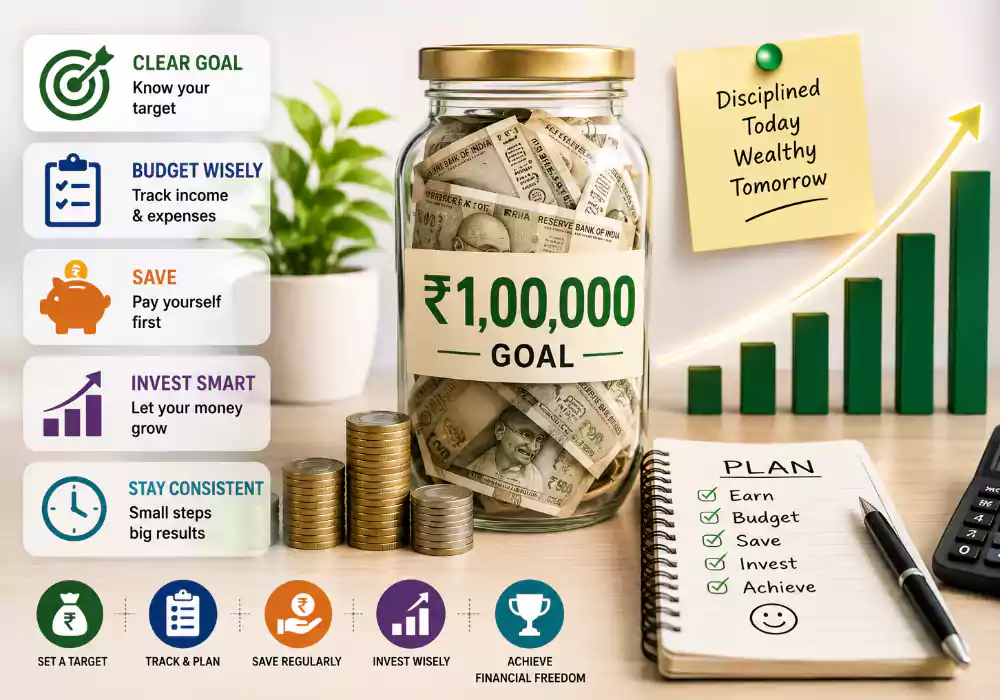
How to Save 1 Lakh Faster Than You Think

For many people, saving 1 lakh feels like a huge financial milestone that takes years to achieve. But the truth is, with the right money-saving habits, proper budget planning, and consistent action, reaching your first ₹1 lakh can happen much faster than you expect.

Most people assume they need a very high salary to build savings. In reality, your financial success depends more on your financial discipline, spending behaviour, and saving consistency than your income alone. Even small daily savings can grow into a large amount over time.

How to Save 1 Lakh Faster Than You Think

Why Saving ₹1 Lakh Matters

Your first ₹1 lakh is important because it creates financial confidence and opens the door to bigger goals like:

  • Building an emergency fund
  • Starting SIP investments
  • Paying off debt faster
  • Planning vacations
  • Buying a vehicle
  • Investing in property
  • Creating passive income sources

Once you save your first ₹1 lakh, future wealth-building becomes much easier because you develop strong personal finance habits and a long-term savings mindset.

The Biggest Myth About Saving Money

One of the most common financial myths is:

“I don’t earn enough to save money.”

The reality is that many high-income earners still struggle financially because of poor budgeting and uncontrolled spending. Meanwhile, people with moderate salaries often build wealth through smart saving strategies and disciplined financial planning.

If you regularly overspend on:

  • Food delivery apps
  • Online shopping
  • Unused subscriptions
  • Impulse purchases
  • Lifestyle upgrades

…you may unknowingly lose thousands of rupees every month.

Tracking these expenses is the first step toward building real savings.

You can also use a Budget Calculator or Expense Tracker Calculator on Calculator Gyani to understand where your money goes every month.

Small Changes Create Big Savings

Saving money does not require extreme sacrifice. Often, small financial improvements create massive long-term results.

Here are some simple examples:

Habit ChangeMonthly SavingsYearly Savings
Reducing food delivery₹2,000₹24,000
Cancelling unused subscriptions₹500₹6,000
Saving ₹200 daily₹6,000₹72,000

When combined with better budgeting and side income opportunities, these small changes can help you reach ₹1 lakh surprisingly fast.

Focus on Systems, Not Motivation

Most people fail financially because they depend on motivation instead of systems.

Smart savers automate their financial habits:

  • Automatic transfers to savings accounts
  • Monthly SIP investments
  • Fixed budgeting rules
  • Expense tracking routines

This approach removes emotional spending and builds long-term consistency.

If you are new to money management, you should also read:

These guides can help you avoid common financial mistakes that slow down wealth creation.

Your ₹1 Lakh Journey Starts Today

You do not need to become rich overnight. The goal is simple:

  • Spend less than you earn
  • Increase savings gradually
  • Build smarter financial habits
  • Stay consistent every month

Even starting with ₹100 per day can completely change your financial future over time.

Set a Clear ₹1 Lakh Savings Goal

One of the biggest reasons people fail to save money is because they save without a clear target. They simply put away whatever amount is left at the end of the month — and usually, nothing remains.

If you truly want to save ₹1 lakh faster, you need a specific savings goal, a realistic timeline, and a monthly action plan.

This is called goal-based saving, and it is one of the most effective personal finance strategies used by financially successful people.

Why Goal-Based Saving Works

When your savings goal is clearly defined, your brain treats it as a priority instead of an optional task.

For example:

  • “I want to save money” → vague goal
  • “I want to save ₹1 lakh in 12 months” → actionable goal

A specific target creates:

  • Better financial discipline
  • Higher motivation
  • Smarter spending decisions
  • Improved budgeting habits
  • Faster wealth accumulation

This is why financial planners recommend setting measurable short-term financial goals before starting investments.

Decide Your Savings Timeline

The first step is deciding how quickly you want to reach ₹1 lakh.

Your timeline depends on:

  • Monthly salary
  • Existing expenses
  • Debt obligations
  • Side income opportunities
  • Lifestyle choices

Here is a simple breakdown:

TimelineMonthly Savings Needed
6 Months₹16,667
12 Months₹8,333
24 Months₹4,167
36 Months₹2,778

As you can see, even smaller monthly contributions can help you reach ₹1 lakh with consistency.

If your salary is limited, extending the timeline makes the goal more realistic and sustainable.

You can estimate your target easily using the Savings Goal Calculator or Budget Calculator available on Calculator Gyani.

Use the Reverse Savings Method

Most people follow this formula:

Income − Expenses = Savings

But financially smart people use:

Income − Savings = Expenses

This strategy is called the pay yourself first method.

Instead of saving whatever remains after spending, you save first and adjust your lifestyle around the remaining amount.

For example:

  • Monthly salary = ₹40,000
  • Savings target = ₹8,000
  • Remaining spending budget = ₹32,000

This simple mindset shift improves:

  • Monthly savings consistency
  • Financial planning
  • Expense control
  • Long-term wealth creation

Break Big Goals Into Small Milestones

Saving ₹1 lakh may feel difficult initially, but smaller milestones make the process easier psychologically.

Example milestone plan:

MilestoneTarget Amount
First Goal₹10,000
Second Goal₹25,000
Third Goal₹50,000
Final Goal₹1,00,000

Celebrating smaller milestones helps maintain motivation and builds positive money habits.

Calculate Your Savings Percentage

A useful financial rule is to save at least:

  • 20% of income for financial growth
  • 30% if you want faster wealth creation

Example:

Monthly Salary20% SavingsAnnual Savings
₹25,000₹5,000₹60,000
₹50,000₹10,000₹1,20,000
₹75,000₹15,000₹1,80,000

Increasing your savings percentage is often more important than increasing income alone.

Don’t Keep Your Goal Only in Your Mind

Write your goal down physically or digitally.

You can create:

  • Monthly savings trackers
  • Budget spreadsheets
  • Expense journals
  • Automated reminders

This improves accountability and helps you monitor progress regularly.

Using tools like:

  • Expense Tracker Calculator
  • Monthly Budget Planner
  • SIP Calculator

…can simplify your money management process significantly.

Build a Goal Around Purpose, Not Just Numbers

People save faster when the goal has emotional meaning.

For example:

  • Emergency fund security
  • House down payment
  • Travel savings
  • Starting investments
  • Becoming debt-free
  • Financial independence

A meaningful financial goal increases long-term consistency far more than random saving.

Smart Tip: Combine Saving + Investing

If your timeline is longer than 2–3 years, consider combining savings with low-risk investments like:

This allows your money to grow through compounding instead of sitting idle in a regular savings account.

You can compare returns using:

  • SIP Calculator
  • Compound Interest Calculator
  • FD Calculator

Internal resources like these help readers make smarter financial decisions while improving engagement across your website.

Track Every Rupee You Spend

If you do not know where your money goes every month, saving ₹1 lakh will always feel difficult.

Most people underestimate their spending habits. Small daily expenses may seem harmless individually, but together they silently destroy your savings potential.

This is why expense tracking is one of the most powerful personal finance habits you can build.

When you track your money properly, you:

  • Identify wasteful spending
  • Improve budgeting discipline
  • Control impulse purchases
  • Save money faster
  • Build better financial awareness

In fact, many people increase their monthly savings by 20–30% simply by tracking expenses consistently.

Why Expense Tracking Matters

Imagine earning ₹50,000 monthly but spending:

  • ₹6,000 on food delivery
  • ₹3,000 on subscriptions
  • ₹5,000 on impulse shopping
  • ₹4,000 on unnecessary travel

That is ₹18,000 disappearing every month without creating long-term value.

Over one year, this becomes:

₹18,000 × 12 = ₹2,16,000

This is why financial planning starts with awareness, not investment.

Before increasing income, first understand your spending behavior.

Fixed Expenses vs Variable Expenses

The easiest way to track spending is by dividing expenses into two categories.

1. Fixed Expenses

These remain mostly constant every month:

  • House rent
  • EMI payments
  • Insurance premiums
  • School fees
  • Internet bills

2. Variable Expenses

These change based on lifestyle:

  • Food delivery
  • Entertainment
  • Shopping
  • Travel
  • Coffee and snacks

Variable expenses are usually where the biggest savings opportunities exist.

Identify Your “Money Leaks”

A money leak is a small recurring expense that slowly drains your finances.

Common money leaks include:

  • Unused OTT subscriptions
  • Daily online food orders
  • Frequent cab rides
  • Impulse Amazon purchases
  • Expensive coffee habits
  • Gaming or app purchases

These expenses may not look dangerous daily, but they become massive yearly losses.

Example:

ExpenseMonthly CostYearly Cost
₹250 food delivery × 20 days₹5,000₹60,000
₹500 subscriptions₹500₹6,000
₹200 daily snacks₹6,000₹72,000

Small expenses often delay financial goals more than major purchases.

Use the 50/30/20 Budget Rule

One of the simplest budgeting systems is the 50/30/20 rule.

CategoryPercentage
Needs50%
Wants30%
Savings & Investments20%

Example for ₹40,000 Salary

CategoryAmount
Essentials₹20,000
Lifestyle Spending₹12,000
Savings & Investments₹8,000

This rule creates balance between enjoying life and building wealth.

If your goal is aggressive saving, you can modify it to:

  • 60/20/20
  • 50/20/30
  • 70/10/20

depending on your income and financial responsibilities.

Try Zero-Based Budgeting

Another powerful system is zero-based budgeting.

In this method:

Every rupee gets a job.

Example:

PurposeAmount
Rent₹12,000
Groceries₹5,000
Investments₹5,000
Savings₹4,000
Entertainment₹2,000
Miscellaneous₹2,000

Remaining balance:

₹0

This approach prevents careless spending and improves money management discipline.

Track Expenses Daily for 30 Days

A simple 30-day tracking challenge can completely transform your finances.

For one month:

  • Record every expense
  • Avoid emotional spending
  • Review weekly spending patterns
  • Identify unnecessary purchases

You will quickly notice spending habits you never realized before.

Many people discover they can save an extra ₹5,000–₹10,000 monthly after their first expense audit.

Use Technology to Simplify Budgeting

Today, tracking expenses is easier than ever.

You can use:

  • Budget spreadsheets
  • Expense tracker apps
  • Banking apps
  • Savings calculators

Helpful internal tools include:

  • Expense Tracker Calculator
  • EMI Calculator
  • Budget Calculator
  • Savings Goal Calculator

These tools improve user engagement while helping readers take action immediately.

Financial Awareness Creates Financial Freedom

Most people think wealth comes from earning more money.

In reality, wealth often comes from:

  • Controlling spending
  • Managing cash flow
  • Avoiding lifestyle inflation
  • Building consistent saving habits

Tracking expenses teaches you where your money truly goes — and that awareness alone can dramatically accelerate your ₹1 lakh savings goal.

Cut These Hidden Expenses Immediately

Most people believe they need a higher salary to save more money. But in many cases, the real problem is not low income, it is hidden spending.

These small, unnoticed expenses quietly drain thousands of rupees every month and slow down your financial growth.

The good news?

Cutting a few unnecessary expenses can help you save ₹1 lakh much faster without making major sacrifices.

What Are Hidden Expenses?

Hidden expenses are recurring costs that usually go unnoticed because they feel “small” individually.

Examples include:

  • Daily food delivery
  • Online subscriptions
  • Impulse shopping
  • Frequent cab rides
  • Expensive coffee habits
  • Gaming purchases
  • Lifestyle upgrades
  • Credit card interest charges

Individually, these expenses may look harmless. But over time, they become massive financial leaks.

The ₹200 Per Day Problem

Many people casually spend ₹200–₹500 daily without tracking it properly.

Let’s see the impact:

Daily SpendingMonthly CostYearly Cost
₹100₹3,000₹36,500
₹200₹6,000₹73,000
₹300₹9,000₹1,09,500

This means reducing just ₹300 of unnecessary spending daily could help you save over ₹1 lakh yearly.

That is the power of small financial changes.

Food Delivery Is Destroying Many Budgets

Food delivery apps are one of the biggest hidden expense categories today.

A single order may not feel expensive, but repeated usage creates major monthly losses.

Example:

HabitMonthly Cost
₹350 order × 20 days₹7,000
Weekend restaurant visits₹4,000
Coffee/snacks₹2,000

Total:

₹13,000 monthly

Yearly impact:

₹1,56,000

Simple solutions:

  • Cook more meals at home
  • Limit delivery days
  • Carry snacks from home
  • Set a monthly food budget

Even reducing food spending by 30–40% can dramatically improve savings.

Cancel Unused Subscriptions

Most people pay for subscriptions they rarely use.

Common examples:

  • OTT platforms
  • Music apps
  • Cloud storage
  • Gym memberships
  • Premium mobile apps

Example:

SubscriptionMonthly Cost
OTT Apps₹700
Music Apps₹150
Cloud Storage₹130
Gym Membership₹1,500

Total:

₹2,480 monthly

Yearly cost:

Nearly ₹30,000

Before renewing any subscription, ask:

“Do I genuinely use this every week?”

If not, cancel it immediately.

Beware of Lifestyle Inflation

Lifestyle inflation happens when spending increases every time income increases.

Examples:

  • Buying expensive phones after salary hikes
  • Upgrading vehicles unnecessarily
  • Shopping more after bonuses
  • Taking expensive vacations regularly

This is why many high-income earners still struggle financially.

Instead of increasing spending after every raise:

  • Increase your savings percentage
  • Invest extra income
  • Build emergency funds
  • Pay off debt faster

Financial freedom comes from controlling lifestyle inflation, not impressing others.

Impulse Shopping Is a Silent Wealth Killer

Online shopping apps are designed to encourage emotional spending.

Common triggers:

  • Flash sales
  • “Limited-time” discounts
  • Buy-now-pay-later offers
  • Festival sales

To reduce impulse purchases:

  • Follow the 24-hour rule before buying
  • Remove saved card details
  • Avoid shopping apps when bored
  • Create a fixed monthly shopping budget

These simple strategies improve financial discipline significantly.

High-Interest Debt Can Destroy Savings

One of the biggest hidden financial traps is credit card interest.

Many people focus on saving money while simultaneously paying:

  • 30–45% annual credit card interest
  • High personal loan EMIs
  • Late payment penalties

This creates negative financial growth.

Before aggressively saving:

  1. Reduce high-interest debt
  2. Avoid unnecessary EMIs
  3. Pay bills on time
  4. Improve credit management

You can estimate loan burdens using:

  • EMI Calculator
  • Credit Card Interest Calculator
  • Debt Payoff Calculator

These tools on Calculator Gyani help readers make smarter financial decisions.

Try a “No-Spend Challenge”

A no-spend challenge is one of the fastest ways to reset financial habits.

Rules:

  • Avoid unnecessary purchases for 7–30 days
  • Spend only on essentials
  • No food delivery
  • No impulse shopping
  • No entertainment spending

Benefits:

  • Builds awareness
  • Improves financial discipline
  • Helps identify emotional spending habits
  • Accelerates savings quickly

Many people save ₹5,000–₹15,000 during their first no-spend month.

Small Expense Cuts Create Massive Long-Term Results

You do not need extreme sacrifice to save ₹1 lakh.

You simply need:

  • Better awareness
  • Smarter spending decisions
  • Reduced financial waste
  • Consistent budgeting

Remember:

Wealth is often built by controlling small daily expenses, not by making one big financial move.

Increase Your Income Instead of Only Cutting Expenses

Cutting unnecessary expenses is important, but there is a limit to how much you can reduce spending.

Income, however, has far greater growth potential.

If you truly want to save ₹1 lakh faster, one of the smartest strategies is increasing your income through side hustles, freelancing, or passive income opportunities.

Many financially successful people focus on both:

  • Reducing wasteful expenses
  • Increasing earning capacity

This combination accelerates savings dramatically.

Why Increasing Income Matters

You can only cut expenses to a certain level.

For example:

  • You can reduce food delivery spending
  • Cancel subscriptions
  • Shop less frequently

But eventually, expenses reach a minimum limit.

Income does not have that limit.

Even an extra ₹5,000–₹10,000 monthly can completely transform your savings timeline.

Example

Extra Monthly IncomeYearly Impact
₹5,000₹60,000
₹8,000₹96,000
₹10,000₹1,20,000

This shows why increasing income is one of the fastest wealth-building strategies.

Start With Simple Side Hustles

You do not need a business degree or huge investment to earn extra money.

Many side income opportunities require only:

  • Internet connection
  • Basic skills
  • Consistency
  • Time management

Popular beginner-friendly side hustles include:

  • Freelance writing
  • Graphic design
  • Video editing
  • Tuition classes
  • Affiliate marketing
  • Social media management
  • Blogging
  • YouTube content creation
  • Selling digital products

Even earning a few thousand rupees monthly can accelerate your ₹1 lakh savings goal significantly.

Freelancing Is Growing Rapidly

Freelancing allows people to earn money using skills they already have.

High-demand freelance skills include:

  • Content writing
  • SEO services
  • Web development
  • Canva design
  • Data entry
  • Translation
  • AI content editing
  • Voice-over work

Platforms like:

  • Fiverr
  • Upwork
  • Freelancer

…allow beginners to start with small projects and gradually increase income.

Freelancing also improves:

  • Career growth
  • Skill development
  • Financial independence
  • Multiple income streams

Turn Existing Skills Into Income

Many people underestimate their existing abilities.

You may already have skills people will pay for:

  • Teaching school subjects
  • Fitness coaching
  • Photography
  • Language tutoring
  • Resume writing
  • Social media knowledge

Instead of only consuming content online, start monetizing your knowledge.

This is how many successful side businesses begin.

Sell Unused Items for Quick Cash

One of the fastest ways to increase short-term savings is selling unused items.

Examples:

  • Old smartphones
  • Electronics
  • Furniture
  • Clothing
  • Books
  • Gaming accessories

Many households unknowingly keep thousands of rupees worth of unused items.

Selling them can instantly boost your savings account.

Build Passive Income Slowly

Passive income means earning money with minimal ongoing effort after initial work.

Popular passive income ideas include:

  • Blogging
  • YouTube channels
  • Affiliate marketing
  • Dividend investing
  • Rental income
  • Digital products
  • Online courses

While passive income takes time to build, it creates long-term financial stability and improves wealth accumulation.

If you are interested in wealth-building strategies, you can also read:

  • “Property Investment Secrets Rich Investors Use”
  • “Is Real Estate Still a Good Investment”

These articles help readers explore additional income-building opportunities.

Avoid Depending on One Income Source

One major financial risk is depending entirely on a single salary.

Job loss, emergencies, or economic slowdowns can create financial stress quickly.

Multiple income streams provide:

  • Better financial security
  • Faster savings growth
  • Lower financial anxiety
  • Greater investment opportunities

This is why many finance experts recommend building at least one secondary income source.

Use Extra Income Strategically

One common mistake is increasing lifestyle spending after earning extra money.

Instead:

  • Save most side income initially
  • Build emergency funds
  • Pay off debt
  • Invest systematically
  • Avoid lifestyle inflation

Example strategy:

Extra IncomeSuggested Allocation
50%Savings
30%Investments
20%Personal enjoyment

This balance keeps motivation high while improving long-term financial growth.

Invest Extra Earnings for Faster Growth

Once you build additional income, investing becomes easier.

Good beginner-friendly options include:

  • SIP investments
  • Fixed deposits
  • Recurring deposits
  • Index funds

These options allow your money to grow through compounding.

You can estimate potential returns using:

  • SIP Calculator
  • Compound Interest Calculator
  • Investment Return Calculator

These tools available on Calculator Gyani help readers plan smarter savings and investment strategies.

Small Income Increases Create Massive Results

Many people wait for a huge salary hike before taking finances seriously.

But even:

  • ₹300 daily extra income
  • ₹5,000 freelance projects
  • Weekend tutoring
  • Small online business earnings

…can dramatically accelerate your journey toward saving ₹1 lakh.

The key is consistency, skill-building, and using extra income wisely instead of increasing unnecessary spending.

Automate Your Savings

One of the biggest reasons people struggle to save money is because they rely on willpower.

At the beginning of the month, they plan to save money. But after spending on bills, shopping, food delivery, and entertainment, very little remains.

This is why financially disciplined people automate their savings.

Automation removes emotions from money management and ensures consistent financial growth without requiring daily motivation.

What Does Automating Savings Mean?

Automating savings simply means setting up systems that move money automatically into:

  • Savings accounts
  • SIP investments
  • Fixed deposits
  • Recurring deposits
  • Emergency funds

Instead of manually deciding whether to save every month, the process happens automatically.

This strategy improves:

  • Financial discipline
  • Budget consistency
  • Long-term wealth creation
  • Goal-based saving

The “Pay Yourself First” Strategy

Most people follow this pattern:

Salary → Spending → Saving whatever remains

Smart savers reverse the process:

Salary → Savings → Spending the rest

This method is called:

Pay Yourself First

It is one of the most powerful personal finance habits for building wealth.

Example

Monthly SalaryAutomatic SavingsRemaining Spending Budget
₹40,000₹8,000₹32,000
₹60,000₹15,000₹45,000

When savings happen first, overspending naturally reduces.

Set Up Automatic Bank Transfers

The easiest automation method is creating automatic transfers immediately after salary credit.

Example:

  • Salary credited on 1st
  • ₹5,000 auto-transferred to savings account on 2nd
  • ₹3,000 SIP auto-invested on 3rd

This system prevents accidental overspending and improves savings consistency.

Many banks now allow:

  • Auto recurring transfers
  • Standing instructions
  • Scheduled SIP deductions
  • Goal-based savings features

SIPs Make Saving Easier

A Systematic Investment Plan (SIP) allows you to invest fixed amounts regularly into mutual funds.

Benefits of SIP investing:

  • Builds long-term wealth
  • Encourages disciplined investing
  • Reduces emotional investing decisions
  • Uses rupee cost averaging
  • Benefits from compounding

Even small SIPs can grow significantly over time.

Example

Monthly SIPApprox Value After 5 Years*
₹2,000₹1.6–1.8 Lakhs
₹5,000₹4–4.5 Lakhs
₹10,000₹8–9 Lakhs

*Approximate values based on market returns.

You can estimate returns using the SIP Calculator or Compound Interest Calculator on Calculator Gyani.

Recurring Deposits Are Great for Beginners

If you prefer lower-risk savings options, recurring deposits (RDs) are excellent.

With RDs:

  • Fixed amount deposited monthly
  • Guaranteed returns
  • Better discipline
  • Lower financial risk

RDs are especially useful for:

  • Short-term savings goals
  • Emergency funds
  • Conservative investors
  • First-time savers

They also prevent unnecessary spending because money gets locked for a fixed period.

Build an Emergency Fund Automatically

An emergency fund protects you from:

  • Medical emergencies
  • Job loss
  • Unexpected repairs
  • Family emergencies

Without emergency savings, people often:

  • Use credit cards
  • Take personal loans
  • Break investments
  • Fall into debt traps

Experts recommend maintaining:

3–6 months of essential expenses

You can automate emergency savings through:

  • Separate savings accounts
  • Auto transfers
  • Recurring deposits

Using an Emergency Fund Calculator can help determine your ideal safety amount.

Remove Temptation From Spending

Automation works because it removes financial temptation.

When money stays in your salary account:

  • You are more likely to spend impulsively
  • Online shopping becomes easier
  • Lifestyle spending increases

But when money moves automatically:

  • Spending reduces naturally
  • Saving becomes effortless
  • Financial goals become achievable faster

This is called:

Behavioral finance optimization

Simple systems often outperform motivation.

Increase Savings Automatically After Salary Hikes

One of the smartest financial habits is increasing automatic savings whenever your income increases.

Example:

  • Salary increase = ₹10,000
  • Automatically increase SIP by ₹5,000
  • Increase emergency savings by ₹2,000

This strategy prevents lifestyle inflation and accelerates wealth creation dramatically.

Use Separate Accounts for Different Goals

Many financially organized people use separate accounts for:

  • Emergency fund
  • Investments
  • Monthly expenses
  • Travel savings
  • House down payment

This improves:

  • Financial clarity
  • Budgeting efficiency
  • Spending control

You can combine this strategy with:

  • Budget Calculator
  • Savings Goal Calculator
  • Investment Return Calculator

to track progress more effectively.

Automation Builds Long-Term Wealth

The biggest advantage of automation is consistency.

Even small automatic savings:

  • ₹100 daily
  • ₹3,000 monthly
  • ₹5,000 SIPs

…can create massive long-term wealth through discipline and compounding.

Remember:

Wealth is rarely built through one big action. It is built through small consistent systems repeated for years.

Try Popular Savings Challenges

Saving money becomes much easier when it feels like a game instead of a burden.

That is why savings challenges have become extremely popular in personal finance communities. They make budgeting more exciting, improve financial discipline, and help people develop strong money-saving habits.

If you struggle with consistency, these challenges can dramatically improve your savings behavior and accelerate your ₹1 lakh goal.

Why Savings Challenges Work

Most people fail to save money because:

  • Saving feels boring
  • Financial goals seem too large
  • Spending gives instant satisfaction
  • Budgeting feels restrictive

Savings challenges solve these problems by creating:

  • Small achievable targets
  • Motivation through progress
  • Better spending awareness
  • Positive financial habits

They also help reduce emotional spending and improve long-term money management.

The ₹100 Daily Savings Challenge

This is one of the simplest and most effective savings challenges for beginners.

How It Works

Save:

₹100 every single day

Results

Daily SavingsMonthly SavingsYearly Savings
₹100₹3,000₹36,500
₹200₹6,000₹73,000
₹300₹9,000₹1,09,500

This challenge proves that small daily actions create powerful long-term financial results.

You can save this amount by:

  • Reducing food delivery
  • Avoiding impulse purchases
  • Carrying home-made snacks
  • Using public transport occasionally

Over time, these simple habits become automatic.

The 52-Week Savings Challenge

This challenge gradually increases your savings amount every week.

Example Structure

WeekAmount Saved
Week 1₹100
Week 2₹200
Week 3₹300

By the end of the year, you build a substantial savings amount while slowly improving financial discipline.

Benefits:

  • Easy starting point
  • Builds consistency gradually
  • Less financial pressure initially

This challenge is excellent for beginners who struggle with budgeting consistency.

Try a No-Spend Challenge

A no-spend challenge is one of the fastest ways to reset unhealthy financial habits.

Rules

For a fixed period:

  • Buy only essentials
  • Avoid online shopping
  • Skip food delivery
  • No entertainment spending
  • No impulse purchases

You can start with:

  • No-spend weekends
  • 7-day challenge
  • 30-day challenge

Benefits

  • Identifies emotional spending
  • Improves expense awareness
  • Reduces lifestyle inflation
  • Accelerates savings rapidly

Many people save ₹5,000–₹20,000 during their first no-spend month.

The Spare Change Savings Method

This method works well for people who struggle with disciplined saving.

How It Works

Whenever you receive:

  • Cashback
  • Loose change
  • Small rewards
  • Extra money

…transfer it immediately into savings.

For digital payments:

  • Round up expenses
  • Transfer leftover balances
  • Save unused wallet amounts

These micro-savings add up surprisingly fast.

Weekend Spending Challenge

Weekends are often the biggest spending period for many households.

Common weekend expenses:

  • Restaurants
  • Movies
  • Shopping malls
  • Cafes
  • Entertainment

Simple Challenge

Reduce weekend spending by:

50%

Example

Normal Weekend SpendingReduced SpendingMonthly Savings
₹4,000₹2,000₹8,000

This single challenge can contribute significantly toward your ₹1 lakh goal.

Gamify Your Financial Goals

Turning saving into a game improves motivation.

Ideas include:

  • Reward yourself after milestones
  • Use printable savings trackers
  • Compete with friends/family
  • Track streaks
  • Set monthly challenges

Psychologically, people stay more consistent when progress feels visible.

Combine Challenges With Budgeting

Savings challenges work best when combined with:

  • Expense tracking
  • Monthly budgeting
  • Goal-based saving
  • Automatic transfers

Helpful tools include:

  • Savings Goal Calculator
  • Expense Tracker Calculator
  • Budget Calculator

These tools on Calculator Gyani can help readers monitor savings progress more effectively.

Challenges Help Build Financial Discipline

The biggest benefit of savings challenges is not just money.

They help develop:

  • Better money awareness
  • Spending control
  • Delayed gratification
  • Long-term financial habits

Over time, these habits create lasting financial stability and wealth-building discipline.

Start Small and Stay Consistent

Many people fail financially because they try extreme budgeting methods that are impossible to maintain.

Instead:

  • Start with manageable challenges
  • Build momentum gradually
  • Increase savings slowly
  • Focus on consistency

Remember:

Financial success is built through small repeated habits, not temporary motivation.

Best Places to Keep Your Savings Safely

Saving money is important — but where you keep your money also matters.

Many people leave all their savings in a regular bank account earning very low interest. Others take excessive risks trying to grow money quickly and end up losing capital.

The smart approach is balancing:

  • Safety
  • Liquidity
  • Returns
  • Financial goals

Choosing the right place for your money can help your ₹1 lakh grow faster while keeping your finances secure.

Understand the Three Main Priorities

Before choosing where to save money, understand these three important factors:

FactorMeaning
SafetyRisk of losing money
LiquidityEase of accessing money
ReturnsProfit or interest earned

Different financial products offer different balances between these factors.

Savings Account: Best for Emergency Access

A regular savings account is the safest and most liquid option.

Advantages

  • Instant access to money
  • Very low risk
  • Good for emergency funds
  • Easy online banking access

Disadvantages

  • Low interest rates
  • Money may lose value against inflation over time

Savings accounts are ideal for:

  • Emergency funds
  • Short-term goals
  • Daily liquidity needs

But keeping large amounts idle for years may reduce wealth growth potential.

Fixed Deposits (FDs): Safe and Stable

Fixed Deposits are one of the most popular low-risk investment options in India.

Advantages

  • Guaranteed returns
  • Higher interest than savings accounts
  • Stable and predictable growth
  • Suitable for conservative investors

Disadvantages

  • Limited liquidity
  • Penalty for premature withdrawal
  • Returns may barely beat inflation

FDs work well for:

  • Short-term financial goals
  • Risk-averse savers
  • Emergency backup funds

You can compare returns using the FD Calculator on Calculator Gyani.

SIP Investments: Better Long-Term Growth

If your savings goal is longer than 3–5 years, SIPs can provide significantly higher returns than traditional savings methods.

What Is SIP?

A Systematic Investment Plan (SIP) allows you to invest fixed amounts regularly into mutual funds.

Advantages
  • Potentially higher long-term returns
  • Power of compounding
  • Disciplined investing
  • Inflation-beating growth potential
Disadvantages
  • Market fluctuations
  • Short-term volatility
  • Requires patience

SIPs are ideal for:

  • Long-term wealth creation
  • Retirement planning
  • Financial independence goals

Even small monthly SIPs can grow substantially over time.

Example

Monthly SIPApprox Value After 10 Years*
₹3,000₹6–7 Lakhs
₹5,000₹10–12 Lakhs
₹10,000₹20–24 Lakhs

*Approximate estimates based on market performance.

You can estimate returns using:

  • SIP Calculator
  • Compound Interest Calculator
  • Investment Return Calculator

Recurring Deposits (RDs): Great for Discipline

Recurring deposits help people save systematically every month.

Advantages

  • Fixed monthly saving habit
  • Guaranteed returns
  • Lower risk
  • Good for beginners

Best For

  • Goal-based saving
  • Vacation funds
  • Emergency savings
  • First-time investors

RDs are especially useful for people who struggle with spending control because money gets locked automatically.

Compare Popular Savings Options

OptionRiskReturnsLiquidity
Savings AccountVery LowLowVery High
Fixed DepositLowModerateMedium
Recurring DepositLowModerateMedium
SIP Mutual FundsModerateHigh PotentialMedium

This comparison helps you choose the right balance based on your financial goals.

Build an Emergency Fund First

Before aggressively investing, prioritize building an emergency fund.

Financial experts recommend saving:

3–6 months of essential expenses

This protects you from:

  • Medical emergencies
  • Job loss
  • Unexpected repairs
  • Financial stress

Without emergency savings, people often depend on:

  • Credit cards
  • Personal loans
  • Borrowing money

This slows wealth creation dramatically.

You can calculate your target using an Emergency Fund Calculator.

Avoid “Get Rich Quick” Schemes

Many people lose money chasing unrealistic returns.

Be cautious of:

  • Fake investment schemes
  • Guaranteed high-return promises
  • Crypto scams
  • MLM programs
  • Unregulated apps

If something promises:

“Double your money quickly”

…it usually involves very high risk.

Long-term financial growth comes from:

  • Consistent investing
  • Financial discipline
  • Patience
  • Smart budgeting

not shortcuts.

Diversification Is Important

Smart savers usually divide money across different financial products.

Example allocation:

GoalRecommended Option
Emergency FundSavings Account
Short-Term GoalsFD or RD
Long-Term WealthSIP Investments

This improves:

  • Financial security
  • Liquidity management
  • Risk control
  • Long-term returns

Inflation Quietly Reduces Savings Value

One major mistake people make is ignoring inflation.

If inflation is:

6%

…and your savings account gives:

3%

…your money is effectively losing purchasing power every year.

This is why combining:

  • Savings
  • Investments
  • Compounding

is essential for long-term wealth building.

Smart Saving Is Better Than Just Saving

The goal is not simply storing money.

The goal is:

  • Protecting money
  • Growing money
  • Keeping liquidity available
  • Building long-term financial stability

The right savings strategy helps you reach ₹1 lakh faster while creating a stronger financial future.

Common Mistakes That Stop People From Saving

Many people earn decent salaries but still struggle to save money consistently.

Why?

Because saving money is not only about income — it is also about financial habits, spending behavior, and money management decisions.

Even small financial mistakes repeated regularly can delay your ₹1 lakh savings goal by years.

The good news is that once you identify these mistakes, fixing them becomes much easier.

1. Waiting for a Higher Salary to Start Saving

One of the biggest personal finance mistakes is believing:

“I’ll start saving once I earn more.”

Unfortunately, this mindset often continues even after income increases.

Why?
Because expenses usually increase along with salary.

This is called:

Lifestyle inflation

People upgrade:

  • Phones
  • Cars
  • Apartments
  • Shopping habits
  • Travel spending

…instead of increasing savings.

The truth is:

Saving is a habit, not an income level.

Even saving:

  • ₹100 daily
  • ₹2,000 monthly
  • 10% of salary

…builds financial discipline and long-term wealth.

2. Not Following a Monthly Budget

Without a budget, money disappears silently.

People often spend emotionally without realizing:

  • How much goes to food delivery
  • Online shopping expenses
  • Weekend entertainment
  • Subscription payments

A budget gives every rupee a purpose.

Simple budgeting systems include:

  • 50/30/20 rule
  • Zero-based budgeting
  • Envelope budgeting

Using tools like:

  • Budget Calculator
  • Expense Tracker Calculator
  • Savings Goal Calculator

can improve financial planning significantly.

These tools are available on Calculator Gyani.

3. Ignoring Small Daily Expenses

Many people focus only on major purchases while ignoring small recurring expenses.

Examples:

  • Daily snacks
  • Coffee
  • Cab rides
  • Online food orders
  • Impulse shopping

These small costs accumulate rapidly.

Example

ExpenseMonthly CostYearly Cost
₹250/day food spending₹7,500₹90,000
₹150/day coffee/snacks₹4,500₹54,000

Small leaks can quietly destroy large savings goals.

4. Misusing Credit Cards

Credit cards are useful financial tools when used responsibly.

But careless usage can create:

  • High-interest debt
  • Financial stress
  • EMI dependency
  • Poor savings habits

Common mistakes include:

  • Paying only minimum dues
  • Using cards for lifestyle spending
  • Buying unnecessary items on EMI

Credit card interest rates can exceed:

30–45% annually

This makes debt extremely expensive.

Before aggressively investing, prioritize:

  • Clearing high-interest debt
  • Improving credit discipline
  • Reducing unnecessary EMIs

You can estimate repayment costs using:

  • EMI Calculator
  • Credit Card Interest Calculator
  • Debt Payoff Calculator

5. Not Building an Emergency Fund

Many people start investing without creating emergency savings first.

As a result, during emergencies they:

  • Withdraw investments
  • Use credit cards
  • Borrow money
  • Take personal loans

This damages long-term financial growth.

An emergency fund provides:

  • Financial security
  • Stress reduction
  • Protection from debt traps

Experts recommend maintaining:

3–6 months of essential expenses

You can estimate this amount using an Emergency Fund Calculator.

6. Trying to Become Rich Quickly

One dangerous financial mistake is chasing unrealistic returns.

Examples include:

  • Scam investments
  • “Guaranteed double money” schemes
  • High-risk trading without knowledge
  • Fake online earning programs

Wealth creation usually happens slowly through:

  • Consistent saving
  • SIP investing
  • Compounding
  • Financial discipline

Long-term consistency beats short-term excitement.

7. Saving Without Investing

Keeping all money in a low-interest savings account may feel safe, but inflation slowly reduces purchasing power.

Example:

  • Savings account interest = 3%
  • Inflation = 6%

This means your money loses real value over time.

That is why combining:

  • Saving
  • Investing
  • Compounding

…is essential for long-term financial growth.

Beginner-friendly investment options include:

  • SIPs
  • Fixed Deposits
  • Recurring Deposits
  • Index Funds

Tools like:

  • SIP Calculator
  • Compound Interest Calculator
  • FD Calculator

can help readers compare different financial options.

8. Depending on Motivation Instead of Systems

Many people save money only when they feel motivated.

But motivation is temporary.

Financially successful people build systems:

  • Automatic savings
  • Scheduled SIPs
  • Budget tracking
  • Expense reviews

Automation creates consistency and reduces emotional spending.

9. Comparing Your Lifestyle With Others

Social media often creates pressure to:

  • Upgrade lifestyle
  • Spend excessively
  • Travel frequently
  • Buy luxury products

Trying to “look rich” is one of the fastest ways to stay financially stressed.

True wealth is:

  • Low debt
  • Strong savings
  • Investments
  • Financial freedom

not appearance.

10. Giving Up Too Early

Many people quit after:

  • Missing one savings target
  • Overspending occasionally
  • Facing temporary setbacks

But personal finance is a long-term journey.

Progress matters more than perfection.

Even small monthly savings build momentum over time.

Avoiding Mistakes Accelerates Wealth Creation

Financial success is not about being perfect.

It is about:

  • Making smarter decisions consistently
  • Avoiding major financial traps
  • Improving money habits gradually

Most people can save ₹1 lakh faster simply by correcting a few bad financial habits.

Frequently Asked Questions

1. How can I save ₹1 lakh in one year?

To save ₹1 lakh in 12 months, you need to save approximately:

₹8,333 per month

2. Can I save ₹1 lakh on a low salary?

Yes. Saving money depends more on financial discipline than salary size.

Share your love

Leave a Reply

Your email address will not be published. Required fields are marked *

twelve − two =