
A few years ago, I sat at my kitchen table doing something I’d avoided for way too long — actually adding up everything my household owed versus everything we owned.
On paper, we looked fine. Two steady paychecks, a nice car in the driveway, a decent house, kids in good clothes, the occasional vacation. Anyone glancing at our life from the outside would’ve assumed we had our finances together.
The spreadsheet told a different story. After the mortgage, two car payments, credit card balances we “meant to pay off next month,” and a savings account with less than one month of expenses in it, our actual net worth was embarrassingly low for our income level.
That night was a wake-up call, and it’s also the moment I started paying close attention to a pattern I now see everywhere — in my own circle of friends, in client conversations when I freelanced doing budgeting coaching on the side, and honestly, in most middle-class households I’ve come across over the years.
There’s one mistake that shows up again and again, more than any other single habit. It’s not laziness, and it’s not stupidity. Smart, hardworking people fall into it constantly. And once you see it, you can’t stop noticing it.

Spending Up to (or Past) Your Income Instead of Building Past It
Here’s the simplest way I can put it: most middle-class families spend their money to look successful instead of using it to become financially secure.
That’s it. That’s the whole thing. Everything else — the car loans, the lack of an emergency fund, the credit card balances, the retirement account that’s barely funded — flows directly from this one root habit.
It’s often called “lifestyle inflation,” but I think that phrase undersells how sneaky it actually is. It’s not one big bad decision. It’s dozens of small, perfectly reasonable-feeling decisions that quietly eat every dollar of income growth before it ever has a chance to build wealth.
Let me show you what this looks like in an everyday household, because the pattern is almost identical from family to family.
A Familiar Scenario
Picture a couple, both working, combined household income around $95,000 a year. That’s solidly middle-class in most parts of the country.
When they were earning $65,000 combined a few years back, they drove an older paid-off sedan, rented a modest apartment, and didn’t think twice about cooking at home most nights.
Fast forward through two promotions and a job change. Income jumps to $95,000. What changes?
- The sedan gets traded for a newer SUV with a $550 monthly payment.
- They buy a bigger house, stretching the mortgage to the edge of what the bank approves.
- Eating out goes from “occasional treat” to “three or four nights a week.”
- Subscriptions pile up — streaming services, a gym membership neither uses consistently, a meal kit box.
- A credit card gets used for vacations and gets carried month to month “just this once,” which becomes a habit.
Income went up 46%. Lifestyle spending went up close to the same amount. Savings rate? Basically unchanged, sometimes worse.
This is not a hypothetical. This is, almost word for word, my own household a decade ago. I just told you my story dressed up as someone else’s.
Why This Happens (It’s Not About Willpower)
I used to think this mistake came from a lack of discipline. After working through it personally and talking to dozens of other families, I don’t believe that anymore.
A few honest reasons this happens:
1. Income increases feel like permission, not opportunity. When a raise hits, the brain treats it as “money I can now spend” rather than “money I can now save.” Nobody sits down and decides this consciously — it just happens by default unless you build a system that says otherwise.
2. Debt is too easy to get. A car dealership will approve a $600/month payment in fifteen minutes. A credit card limit increase shows up in the mail without you asking for it. The financial industry profits when middle-class families finance their lifestyle, so the path of least resistance always points toward borrowing.
3. Social comparison is constant now. It’s not just the neighbors anymore — it’s everyone on social media appearing to live a vacation-and-renovation lifestyle. Most of that is financed, but it doesn’t look financed from the outside, so it sets an invisible benchmark.
4. “We can afford the payment” replaces “can we afford this.” This is the sneaky one. Families don’t ask if they can afford a $42,000 car. They ask if they can afford $580 a month. Almost anything is affordable when you only look at the monthly number, which is exactly why financing terms keep stretching to 72 and 84 months now.
The Cost of This Habit (Numbers, Not Vibes)
I want to show you why this matters with actual math, because the long-term cost of this mistake is bigger than most people picture.
Say a family could realistically invest an extra $500 a month instead of pushing it into a car payment or lifestyle upgrades, and they invest it in a basic index fund averaging 8% a year over time.
- After 10 years: roughly $90,000
- After 20 years: roughly $275,000
- After 30 years: roughly $680,000
That’s the quiet cost of “just $500 a month” funneled into lifestyle instead of building something. It’s not about depriving yourself of every nice thing — it’s about understanding that every recurring monthly payment is competing directly against your future net worth, whether anyone frames it that way or not.
I learned this the expensive way. We financed two vehicles back to back over about six years and, when I finally added up the interest paid across both loans, it came out to just over $9,400. That money bought us nothing — no asset, no equity, no future value. It just evaporated.
The Step-by-Step Fix: How to Actually Break This Pattern
This is the part that matters most, because pointing out a mistake without a plan to fix it isn’t useful. Here’s the process that worked for my household and for several families I coached through it.
Step 1: Get an Honest Snapshot First
Before changing anything, you need to know exactly where you stand. Pull up your last three months of bank and credit card statements and total up:
- Total monthly income (take-home, after taxes)
- Total fixed expenses (mortgage/rent, loans, insurance, subscriptions)
- Total variable spending (groceries, dining, shopping, entertainment)
- Total debt owed across everything
- Total savings and investments
Apps like Rocket Money, Empower’s free dashboard, or even a simple Google Sheet template work fine for this. YNAB (You Need A Budget) is a paid option, but it’s genuinely strong if you want category-based budgeting that forces you to assign every dollar a job.
The goal here isn’t judgment. It’s clarity. Most people skip this step because it’s uncomfortable, but skipping it is exactly why the mistake continues for years without anyone noticing.
Step 2: Build a Starter Emergency Fund Before Anything Else
Before paying off debt aggressively, before investing more, get $1,000–$2,000 sitting untouched in a separate savings account.
Why this order? Because without this cushion, the next unexpected car repair or medical bill goes straight onto a credit card, undoing whatever progress you just made. I skipped this step the first time I tried to fix our finances, and a $1,200 furnace repair put us right back into debt within four months.
Once that starter cushion exists, build toward 3–6 months of essential expenses over time. High-yield savings accounts (many online banks currently offer noticeably better rates than traditional big banks) are the right home for this money — accessible, but separate enough that it doesn’t get casually spent.
Step 3: Deal With the Debt That’s Bleeding You Dry
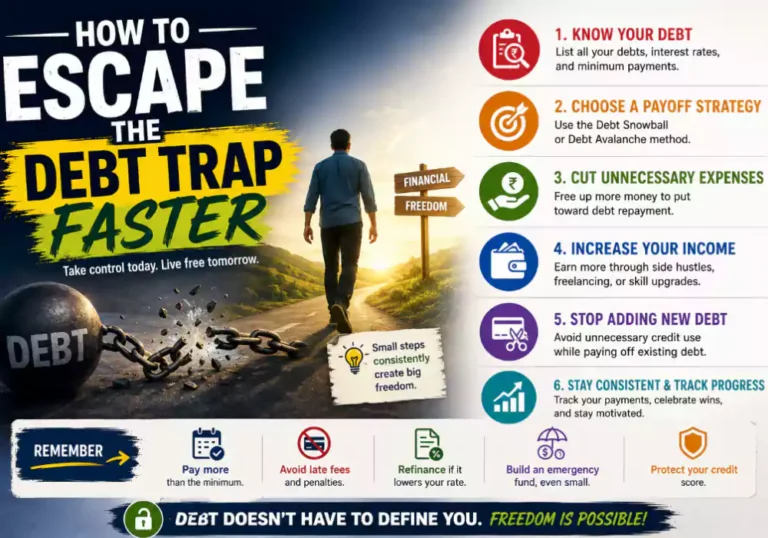
List every debt with its balance and interest rate. Then pick one of two methods:
- Avalanche method: pay minimums on everything, throw extra money at the highest interest rate debt first. Mathematically optimal.
- Snowball method: pay minimums on everything, throw extra money at the smallest balance first. Slower mathematically, but the quick wins keep motivation high.
I personally used the snowball method on our credit cards because watching a balance hit zero gave me the momentum to keep going. The math nerds are right that avalanche saves more money technically, but the method you’ll actually stick with always beats the “better” method you abandon after two months.
For the auto loan trap specifically: if you’re financing a car for more than 4–5 years, that’s usually a sign the vehicle is outside your actual budget, not that the loan terms are generous.
Step 4: Automate Before You Can Talk Yourself Out of It
This step alone fixed more of our problem than any spreadsheet ever did.
Set up automatic transfers the same day your paycheck lands:
- A fixed amount to your emergency fund or savings goal
- A fixed amount to retirement accounts (401k, IRA)
- Whatever’s left becomes your spending money for the month
This flips the entire equation. Instead of saving whatever’s left over at the end of the month (which is almost always close to zero), you spend whatever’s left over after saving. Same dollars, completely different outcome.
If your employer offers a 401k match, contribute at least enough to get the full match before doing anything else with extra money. That match is free money you’re otherwise leaving on the table every single pay period.
Step 5: Build a “Lifestyle Inflation Rule” for Future Raises
This is the step most people never think to put in place, and it’s the one that prevents this mistake from happening again the next time income goes up.
A simple rule that’s worked well for our household: any raise or bonus gets split — roughly half goes toward savings/investing, half is available to actually enjoy or upgrade lifestyle with.
That way you’re not stuck living like you’re broke forever, but you’re also not letting 100% of every income increase get absorbed into a bigger house, bigger car, and bigger subscriptions list. Future-you gets a cut of every raise before present-you spends it.
Step 6: Get the Boring Protections in Place
This part isn’t exciting, but skipping it is its own version of this same mistake — looking financially fine on the surface while one bad event could wreck everything underneath.
- Term life insurance if you have dependents (it’s surprisingly affordable for healthy people in their 30s and 40s)
- Basic disability coverage, since a lost paycheck is more statistically likely than an early death
- A simple will, even a basic one done through an online service, so assets and guardianship decisions aren’t left up to a court
Avoid Along the Way
A few traps I personally walked into, so you don’t have to:
- Don’t try to fix everything in one weekend. I tried an aggressive all-at-once overhaul once and burned out within three weeks. Pick one step, get it solid, then move to the next.
- Don’t cut every small joy to “save more.” Cancelling every subscription and never eating out tends to backfire into a binge-spending rebound later. Budget for some enjoyment on purpose.
- Don’t confuse a higher credit score with healthy finances. A good score just means you handle borrowed money responsibly — it says nothing about whether you actually have savings or net worth.
- Don’t wait for a “big income jump” to start saving. The habits matter more than the income level. Plenty of high earners are broke because they never built the saving habit at a lower income first.
- Don’t ignore small recurring charges. Forgotten subscriptions and “small” financed purchases (buy-now-pay-later apps especially) add up faster than people expect because each one feels too small to matter on its own.
1. What is the biggest financial mistake middle-class families make?
The biggest financial mistake is lifestyle inflation, where expenses increase every time income rises, leaving little or no savings for long-term wealth creation.
2. Why do middle-class families struggle financially even with good income?
Most families struggle due to poor budgeting habits, rising expenses, EMI commitments, and lack of structured financial planning.
3. How can lifestyle inflation be controlled?
Lifestyle inflation can be controlled by increasing savings with every salary hike, avoiding unnecessary EMIs, and following a strict budgeting strategy.
4. How much emergency fund should a family have?
Ideally, a family should have 3 to 6 months of essential expenses saved as an emergency fund for financial safety.
5. What are the best ways to build wealth in middle-class families?
The best ways include SIP investing, compound interest growth, disciplined savings, and avoiding high-interest debt.